ACID, Transactions & Locks
Make multi-step changes correct with atomic transactions, isolation choices, constraints and short-lived locks.
The bank-transfer test
A transfer moves 100 from A to B. If the service crashes after debiting A but before crediting B, money must not disappear. Put both changes in one local transaction: either both commit or both roll back.
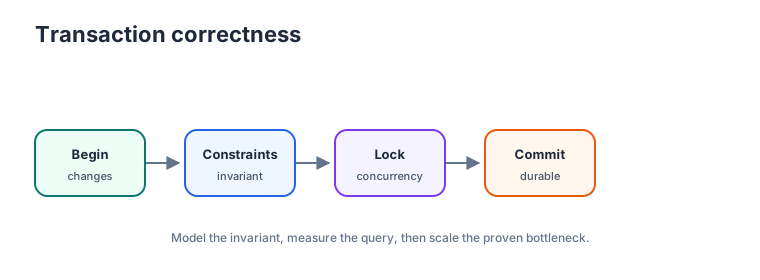 A transaction either commits all related changes or rolls back; locks and isolation protect concurrent writers
ACID without vague definitions
| Property | What it protects | Concrete example |
|---|---|---|
| Atomicity | Partial change | Order and its items save together or neither does. |
| Consistency | Broken invariant | Stock never falls below zero because constraints/conditional update reject it. |
| Isolation | Concurrent interference | Two buyers cannot both reserve the last item. |
| Durability | Crash after success | A committed payment record is recovered from WAL/replication. |
Consistency is not a promise that every replica is instantly current; it means the transaction moves valid state to valid state.
Isolation anomalies you should recognize
| Anomaly | Example | Typical protection |
|---|---|---|
| Dirty read | Read data another transaction may roll back | Read committed or stronger |
| Non-repeatable read | Same row changes during transaction | Repeatable read or explicit lock |
| Phantom | New matching row appears in a range | Serializable isolation/predicate protection |
| Lost update | Two writers overwrite each other | Conditional update, version column or lock |
The exact behavior is engine-specific. In an interview, name the isolation level and the anomaly you are preventing instead of saying “use transactions” alone.
Correct inventory update
Do not read available stock, subtract in application memory, then write it back. Let the database make the decision atomically:
UPDATE inventory
SET available = available - 1
WHERE sku = :sku AND available > 0;
If zero rows change, inventory was unavailable. This avoids a race without a distributed lock.
Locks, deadlocks and good habits
Locks protect conflicting work, but long transactions hold them too long. A deadlock happens when transactions wait in a cycle; databases normally abort one. Retry only the aborted transaction with bounded backoff and idempotency.
Keep transactions short, access tables in a consistent order, avoid network calls inside them, and monitor lock-wait time, deadlock count and transaction age.