Database Relations & Foreign Keys
Model one-to-one, one-to-many and many-to-many data with keys, constraints and deletion rules that protect real business facts.
Start from the real-world ownership rule
A relation is not an ORM decoration. It is a database promise: an order belongs to one customer; an order contains many items; a student may take many courses. Good schemas make invalid states hard or impossible to save.
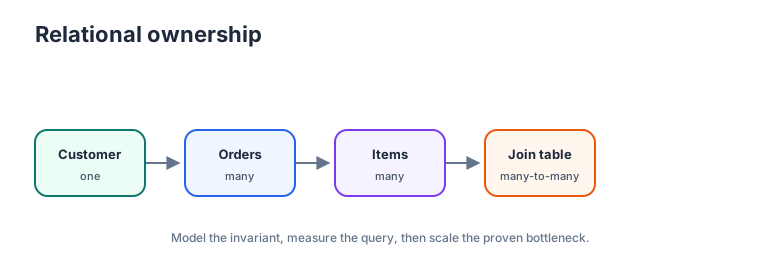 Relations: foreign keys connect one-to-one, one-to-many and many-to-many records
The three relationship shapes
| Shape | Real-life picture | Table design | Constraint that matters |
|---|---|---|---|
| One-to-one | User has one profile | profiles.user_id | UNIQUE plus foreign key |
| One-to-many | Customer places orders | orders.customer_id | Foreign key and index |
| Many-to-many | Students take courses | enrollments table | Two foreign keys and a composite unique key |
One-to-one: use it only when it earns its place
A profile table can separate sensitive or rarely-used data from users. Its user_id is both a foreign key and unique. Do not split tables merely because two columns look related; a profile with the same lifecycle can live in the users table.
One-to-many: the child owns the foreign key
An order has customer_id because many orders point to one customer. Add an index on orders(customer_id) when the product frequently loads a customer orders. A foreign key prevents an order from pointing to a customer that does not exist.
Many-to-many: use a join table, never a comma-separated list
An enrollment is a relationship with its own facts: enrolled_at, role, grade or status. The table belongs in the model.
enrollments(student_id, course_id, enrolled_at, status)
PRIMARY KEY (student_id, course_id)
The composite primary key stops a student being enrolled in the same course twice. Add a reverse index on course_id if you list students in a course.
Constraints are part of the application
| Rule | Database protection |
|---|---|
| Every order has a customer | NOT NULL customer_id + foreign key |
| One profile per user | UNIQUE(user_id) |
| Quantity cannot be negative | CHECK (quantity > 0) |
| One enrollment per pair | PRIMARY KEY(student_id, course_id) |
Application validation gives a friendly message; constraints protect the rule when another service, script or race condition bypasses that validation.
Delete behavior is a product decision
RESTRICT blocks deleting a customer with history. CASCADE removes true dependents, such as temporary draft items. SET NULL preserves a record whose relationship became optional. Never choose CASCADE by default: deleting a parent can destroy far more data than the screen suggests.
Practical checklist
- Name the business relationship in a sentence.
- Choose the table that owns the foreign key.
- Add NOT NULL, UNIQUE and CHECK constraints for invariants.
- Index the foreign key for common joins and filters.
- Decide delete/update behavior before production data exists.