Consumers & Consumer Groups
How consumers read in parallel with consumer groups, how partitions are assigned and rebalanced, how offsets are committed, and how to handle lag, errors and retries.
The big idea
A pile of mail must be sorted. One person can do it alone, slowly. A team can split the pile so each person takes a few mail bags, and nobody sorts the same bag twice. If someone goes home, their bags are handed to the others. A different team (say, the auditors) can read the same mail independently, without affecting the sorters.
- The team = a consumer group.
- The mail bags = partitions.
- Each team member = a consumer.
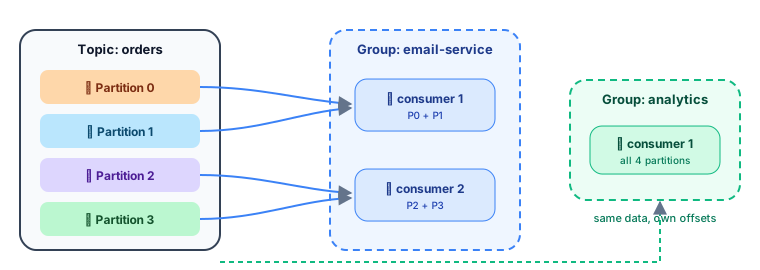 A consumer group splits partitions among its members; another group reads independently
Consumer groups: the rules
- Each partition is read by exactly one consumer in a group at a time.
- One consumer can read several partitions.
- Different groups each get all the messages, independently, with their own offsets.
Scaling a group
| Consumers in the group | 4 partitions → |
|---|---|
| 1 | That consumer reads all 4 |
| 2 | 2 partitions each |
| 4 | 1 partition each ✅ maximum parallelism |
| 6 | 4 busy, 2 idle ❌ (no partition left for them) |
💡 The number of partitions is the maximum parallelism of a consumer group. Plan partitions for the number of consumers you'll need at peak.
Offsets and commits
Each group stores, per partition, the offset of the next record to read. This is the committed offset, saved in Kafka's internal __consumer_offsets topic. If a consumer crashes, its replacement continues from the last committed offset.
When to commit decides your guarantee
The standard choice is at-least-once: process, then commit, and make processing idempotent so a repeat does no harm.
const consumer = kafka.consumer({ groupId: "email-service" });
await consumer.connect();
await consumer.subscribe({ topic: "shop.orders.placed" });

await consumer.run({
  autoCommit: false,
  eachMessage: async ({ topic, partition, message }) => {
    const eventId = message.headers.eventId.toString();
    if (!(await processedEvents.has(eventId))) {         // idempotency check
      await sendOrderConfirmation(JSON.parse(message.value.toString()));
      await processedEvents.add(eventId);
    }
    await consumer.commitOffsets([
      { topic, partition, offset: (BigInt(message.offset) + 1n).toString() }, // commit the NEXT offset
    ]);
  },
});
⚠️ Auto-commit (the default in many clients) commits on a timer, regardless of whether processing finished. Understand it before relying on it.
Rebalancing
When a consumer joins, leaves or crashes, the group rebalances: partitions are reassigned among the remaining members.
- A consumer is considered dead if it misses heartbeats for
session.timeout.ms, or doesn't callpollwithinmax.poll.interval.ms(processing too slowly!). - Older eager rebalancing stopped the whole group; modern cooperative rebalancing moves only the affected partitions.
- Static membership (
group.instance.id) avoids rebalances when a pod simply restarts.
Consumer lag: the key health metric
Lag = latest offset in the partition − committed offset of the group. It tells you how far behind a consumer is.
Growing lag means consumers can't keep up: add consumers (up to the partition count), speed up processing, or process in batches. Alert on lag that keeps growing. Tools: Burrow, Kafka UI, Prometheus exporters.
Handling failures: retries and dead-letter topics
What if a message can't be processed (bad data, a downstream API is down)? Don't block the partition forever.
- Retry transient errors a few times with backoff (in-process, or through retry topics).
- Send poison messages to a dead-letter topic with error details in headers, then move on.
- Monitor the DLT and replay messages after fixing the bug.
Consumer checklist
- One group per logical application (
email-service,analytics) - Commit after processing; make processing idempotent
- Keep processing time under
max.poll.interval.ms, or process asynchronously in batches - Monitor consumer lag and alert on growth
- Retry transient errors; dead-letter poison messages
- Graceful shutdown: finish the current batch, commit, leave the group
Key takeaways
- A consumer group shares a topic's partitions: each partition goes to one consumer in the group.
- Different groups read the same data independently, each with its own committed offsets.
- Partitions cap parallelism; extra consumers sit idle.
- Commit after processing for at-least-once, and make handlers idempotent.
- Rebalances reassign partitions when members change; watch lag; use dead-letter topics for poison messages.