What Is Apache Kafka?
Kafka is a distributed, durable log of events that many systems can write to and read from at huge scale. The big picture, the vocabulary, and why so many companies use it.
The big idea
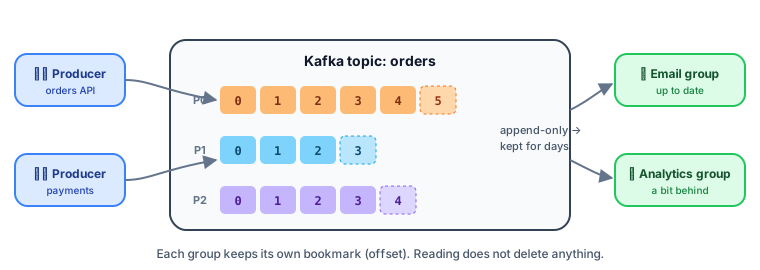
Imagine a newspaper printing press that never throws old editions away. Reporters (producers) keep adding new stories to the end. Readers (consumers) each keep a bookmark of how far they've read. A new reader can start from today's edition, or go back and read everything from the first day. Nobody's reading affects anyone else's.
That's Kafka: an append-only log of events, stored durably, split across many servers, that any number of readers can consume at their own pace, and replay.
 Kafka: producers append events to a log, consumers read at their own pace
Why was Kafka created?
LinkedIn built Kafka around 2010. They had dozens of systems that all needed the same data (page views, profile updates, messages), and point-to-point connections had become spaghetti:
Producers publish once; any number of consumers read independently. Adding a new consumer requires zero changes to the producers.
Core vocabulary
| Term | Meaning | Analogy |
|---|---|---|
| Event / record / message | A fact that happened: key, value, timestamp, headers | One newspaper story |
| Topic | A named stream of related events, e.g. orders | A newspaper section (Sports, Business) |
| Partition | A topic is split into ordered logs spread across brokers | Several printing presses for one section |
| Offset | The position of a record within a partition (0, 1, 2…) | The page number |
| Producer | An app that writes events | A reporter |
| Consumer | An app that reads events | A reader |
| Consumer group | Consumers sharing the work of reading a topic | A team splitting the sections between them |
| Broker | A Kafka server that stores partitions | A printing plant |
| Cluster | A group of brokers working together | The whole newspaper company |
Kafka is a log, not a traditional queue
This is the most important idea:
| Traditional queue (e.g. RabbitMQ) | Kafka | |
|---|---|---|
| After a message is consumed | Deleted | Kept (for days, weeks, or forever) |
| Multiple independent readers | Needs one queue per reader | ✅ Built in: each group has its own offsets |
| Replay old messages | ❌ | ✅ Rewind the offset |
| Ordering | Per queue | Per partition |
| Throughput | Tens of thousands of messages/s per node | Millions of messages/s per cluster |
The analytics consumer is behind; the email consumer is up to date. They don't affect each other.
A first taste (Node.js with KafkaJS)
import { Kafka } from "kafkajs";

const kafka = new Kafka({ clientId: "shop", brokers: ["localhost:9092"] });

// Producer: append an event
const producer = kafka.producer();
await producer.connect();
await producer.send({
  topic: "orders",
  messages: [{ key: "customer-7", value: JSON.stringify({ orderId: "ord_42", totalCents: 8997 }) }],
});

// Consumer: read events as part of a group
const consumer = kafka.consumer({ groupId: "email-service" });
await consumer.connect();
await consumer.subscribe({ topic: "orders", fromBeginning: true });
await consumer.run({
  eachMessage: async ({ partition, message }) => {
    const order = JSON.parse(message.value.toString());
    console.log(`partition ${partition} offset ${message.offset}:`, order);
  },
});
What is Kafka used for?
Who uses it: LinkedIn (trillions of messages per day), Netflix, Uber, Airbnb, banks, retailers. Over 80% of Fortune 100 companies.
Why is it so fast?
- Sequential disk writes: appending to the end of a file is very fast, even on spinning disks.
- Zero-copy: data goes from disk to network without being copied through the application.
- Batching and compression: many records are sent and stored together.
- Partitioning: work is spread over many brokers and consumed in parallel.
Key takeaways
- Kafka is a distributed, durable, append-only log of events.
- Producers write to topics; topics are split into partitions; each record has an offset.
- Records stay after being read; each consumer group tracks its own offset and can replay.
- It decouples producers from any number of consumers at very high throughput.
- Used for event-driven microservices, activity tracking, pipelines, CDC and stream processing.