Kafka Producers
How producers send records: batching, compression, partitioning, the acks setting that trades speed for safety, retries, and the idempotent producer.
The big idea
A postal worker doesn't drive to the sorting office for every single letter. They collect letters in a bag, and drive when the bag is full or when enough time has passed. They can also ask for delivery confirmation: none, "the post office received it", or "the post office and its backup received it".
A Kafka producer works the same way: it batches records, compresses them, sends them to the right partition leader, and waits for the level of acknowledgement you choose.
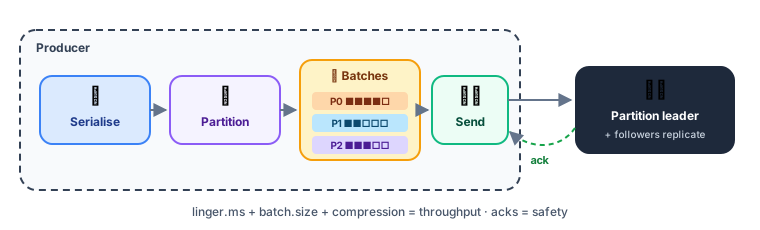 Inside a Kafka producer: serialise, partition, batch, send, acknowledge
The journey of a record
Batching and compression: the speed knobs
| Setting | Meaning | Trade-off |
|---|---|---|
linger.ms | Wait up to N ms to fill a batch | Higher = bigger batches, better throughput, slightly more latency |
batch.size | Max bytes per batch per partition | Bigger = fewer requests |
compression.type | none, gzip, snappy, lz4, zstd | Smaller network and disk usage for some CPU. lz4/zstd are popular |
💡 A few milliseconds of
linger.ms(5–20 ms) pluslz4orzstdcompression can multiply throughput several times, because whole batches are compressed together.
acks: how safe is "sent"? ⭐
The most important producer setting. It controls how many brokers must confirm a write before the producer considers it successful.
acks | Producer waits for | Speed | Can lose data? |
|---|---|---|---|
0 | Nothing ("fire and forget") | ⚡⚡⚡ | ❌ Yes, easily |
1 | The leader wrote it | ⚡⚡ | ⚠️ Yes, if the leader dies before followers copy it |
all (-1) | All in-sync replicas have it | ⚡ | ✅ No (with min.insync.replicas ≥ 2) |
For important data (orders, payments): acks=all, replication.factor=3, min.insync.replicas=2. With these, a write is confirmed only when at least two brokers have it, so losing any single broker loses nothing. (acks=all has been the default since Kafka 3.0.)
Retries and the idempotent producer
Networks fail, and producers retry automatically. But a retry can create a duplicate:
The idempotent producer fixes this. Each producer gets an ID, and every batch gets a sequence number per partition. The broker drops any batch it has already written.
enable.idempotence=true   # default since Kafka 3.0
acks=all                  # required for idempotence
retries=2147483647
max.in.flight.requests.per.connection=5   # ordering still preserved with idempotence
It also preserves ordering during retries. Without it, a retried batch could land after a later batch.
Producing from Node.js (KafkaJS)
import { Kafka, CompressionTypes } from "kafkajs";

const kafka = new Kafka({ clientId: "orders-service", brokers: ["kafka-1:9092", "kafka-2:9092"] });
const producer = kafka.producer({ idempotent: true, maxInFlightRequests: 5 });

await producer.connect();

export async function publishOrderPlaced(order) {
  await producer.send({
    topic: "shop.orders.placed",
    acks: -1,                                  // all in-sync replicas
    compression: CompressionTypes.GZIP,
    messages: [
      {
        key: order.id,                         // keeps all events for this order in order
        value: JSON.stringify({ orderId: order.id, customerId: order.customerId, totalCents: order.totalCents }),
        headers: { eventType: "OrderPlaced", eventId: crypto.randomUUID(), schemaVersion: "1" },
      },
    ],
  });
}

process.on("SIGTERM", async () => {
  await producer.disconnect(); // flush pending batches before exiting
});
Serialisation and schemas
Kafka stores bytes; it doesn't care about the format. But producers and consumers must agree on it.
| Format | Pros | Cons |
|---|---|---|
| JSON | Human-readable, easy | Larger, no enforced schema |
| Avro | Compact, schema evolution rules | Needs a schema registry |
| Protobuf | Compact, typed, great tooling | Needs generated code |
A Schema Registry (Confluent, Apicurio) stores versioned schemas and rejects producers that would send incompatible data, so a producer can't silently break every consumer.
Producer checklist
-
acks=all+ idempotence for important data - A meaningful key for ordering (entity ID)
- Batching (
linger.ms) and compression (lz4/zstd) tuned for throughput - Event metadata in headers: event ID, type, schema version
- A schema (Avro/Protobuf/JSON Schema) with compatibility rules
- Flush and close the producer on shutdown
- Use the outbox pattern when writing to a database and Kafka together (see Microservices → Sagas & Outbox)
Key takeaways
- Producers serialise, partition (by key), batch, compress and send records to partition leaders.
linger.ms,batch.sizeand compression are your throughput knobs.acks=all+min.insync.replicas=2+ replication factor 3 = no data loss if one broker dies.- The idempotent producer (default in modern Kafka) prevents duplicates and reordering from retries.
- Agree on a schema; a schema registry stops producers from breaking consumers.