Delivery Guarantees: At-Most, At-Least & Exactly Once
Can a message be lost? Delivered twice? Learn Kafka's three delivery semantics, idempotent producers, transactions for read-process-write, and why idempotent consumers still matter.
The big idea
Sending an important parcel:
- At most once 📮: you drop it in a postbox. It arrives once, or it's lost. Never twice.
- At least once 📦📦: you keep resending until you get a signature. It always arrives, but sometimes the recipient gets two.
- Exactly once ✅: it always arrives, and exactly one copy counts. The hardest to achieve.
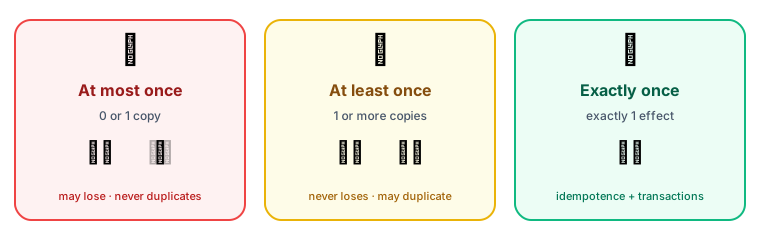 The three delivery guarantees
Where things can go wrong
A message can be lost or duplicated at two points: when the producer writes it, and when the consumer processes it.
At-most-once
Consumer commits the offset before processing. If it crashes during processing, the message is skipped forever.
Use for: metrics or logs where losing a little is acceptable and duplicates would be worse.
At-least-once ⭐ (the usual default)
Producer: acks=all with retries. Consumer: process first, commit after. Nothing is lost, but a crash between processing and committing causes reprocessing.
Fix the duplicates on the consumer side with idempotency:
// Option 1: remember processed event IDs (same transaction as the business change)
await db.transaction(async (tx) => {
  const inserted = await tx.query(
    "INSERT INTO processed_events (event_id) VALUES ($1) ON CONFLICT DO NOTHING RETURNING 1",
    [eventId],
  );
  if (inserted.rowCount === 0) return;             // already processed → skip
  await tx.query("UPDATE accounts SET balance = balance + $1 WHERE id = $2", [amount, accountId]);
});

// Option 2: make the operation naturally idempotent (an upsert with the final value)
await db.query(
  "INSERT INTO order_status (order_id, status) VALUES ($1, $2) ON CONFLICT (order_id) DO UPDATE SET status = $2",
  [orderId, status],
);
💡 At-least-once delivery + idempotent processing = effectively exactly-once results. This works with any broker and any database, and it's what most production systems do.
Exactly-once semantics (EOS) in Kafka
Kafka offers real exactly-once guarantees within Kafka, using two features.
1. Idempotent producer (no duplicates on write)
Covered in Producers: producer ID + sequence numbers let the broker drop retried duplicates. It's on by default in modern Kafka.
2. Transactions (atomic read-process-write)
A stream processor reads from topic A, transforms the record, and writes to topic B. Kafka transactions make "write the output + commit the input offset" one atomic step: either both happen or neither does.
const producer = kafka.producer({ transactionalId: "ledger-writer-1", idempotent: true, maxInFlightRequests: 1 });
await producer.connect();

await consumer.run({
  autoCommit: false,
  eachMessage: async ({ topic, partition, message }) => {
    const tx = await producer.transaction();
    try {
      await tx.send({ topic: "ledger", messages: [{ key: message.key, value: toLedgerEntry(message.value) }] });
      await tx.sendOffsets({
        consumerGroupId: "ledger-writer",
        topics: [{ topic, partitions: [{ partition, offset: (BigInt(message.offset) + 1n).toString() }] }],
      });
      await tx.commit();
    } catch (error) {
      await tx.abort(); // nothing written, offset not committed → the message will be retried
      throw error;
    }
  },
});
Consumers of ledger must use isolation.level=read_committed so they skip records from aborted transactions.
Kafka Streams enables all of this with a single setting: processing.guarantee=exactly_once_v2.
The limit of exactly-once
Kafka's transactions cover Kafka → Kafka. The moment you write to an external system (a database, an email API, a payment provider), Kafka can't include it in its transaction.
For external side effects, you're back to at-least-once + idempotency (idempotency keys, upserts, processed-event tables, or storing the offset in the same database transaction as the data).
Choosing a guarantee
| Guarantee | Producer config | Consumer pattern | Use for |
|---|---|---|---|
| At-most-once | acks=0 or 1 | Commit, then process | Metrics, logs, telemetry |
| At-least-once | acks=all, idempotence | Process, then commit + idempotent handler | Most business events ✅ |
| Exactly-once (in Kafka) | Transactions | read_committed, sendOffsets in the transaction | Stream processing, financial pipelines |
Key takeaways
- Loss or duplication can happen when producing and when consuming.
- At-most-once: commit before processing; may lose messages.
- At-least-once: process before committing; may duplicate, so handlers must be idempotent. This is the standard.
- Exactly-once: idempotent producer + transactions make read-process-write atomic inside Kafka.
- For external systems, exactly-once results come from at-least-once delivery + idempotent processing.