Brokers, Replication & Durability
How Kafka survives server failures. Brokers, leaders and followers, in-sync replicas, min.insync.replicas, leader election and KRaft, drawn step by step.
The big idea
Important documents are kept in several safes in different buildings. One copy is the master that everyone writes to; the others are copies kept up to date. If the building with the master burns down, one of the up-to-date copies becomes the new master, and work continues.
In Kafka, every partition has one leader replica and several follower replicas on different brokers.
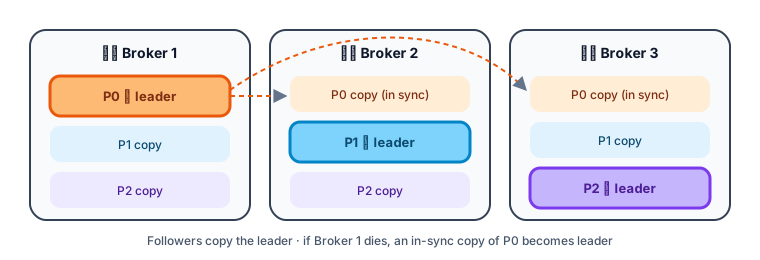 Each partition has a leader and followers on different brokers
Brokers and clusters
- A broker is a Kafka server. It stores partition replicas and serves producers and consumers.
- A cluster is a group of brokers (3 at minimum for production; large clusters run hundreds).
- Partitions and their replicas are spread across brokers so load and risk are shared.
Replication factor
replication.factor=3 means every partition has 3 copies on 3 different brokers: one leader + two followers.
- Producers write to the leader.
- Followers fetch from the leader to stay in sync.
- Consumers read from the leader by default (or from a nearby follower, with rack-aware settings).
- Leadership is spread so each broker leads some partitions.
In-sync replicas (ISR)
A follower is in sync if it has caught up with the leader recently (within replica.lag.time.max.ms, 30 s by default). The leader plus all caught-up followers form the ISR (in-sync replica set).
The durability trio ⭐
These three settings together decide whether an acknowledged write can ever be lost:
| Setting | Where | Recommended |
|---|---|---|
replication.factor | Topic | 3 |
min.insync.replicas | Topic / broker | 2 |
acks | Producer | all |
With these, a write is acknowledged only when at least 2 replicas have it. So:
| Brokers down | Can still write? | Data lost? |
|---|---|---|
| 0 | ✅ | No |
| 1 | ✅ (2 replicas left in sync) | No |
| 2 | ❌ Producers get NotEnoughReplicas (writes pause) | No |
💡 Kafka chooses consistency over availability here: with too few in-sync copies, it refuses writes rather than risk losing confirmed data.
When a broker fails: leader election
Only replicas in the ISR can become leader, so the new leader has every acknowledged record. (Setting unclean.leader.election.enable=true allows an out-of-sync replica to become leader: more available, but it can lose data. Keep it false for important topics.)
The controller and KRaft
One broker acts as the controller: it tracks which brokers are alive and elects partition leaders.
Kafka used to depend on a separate ZooKeeper cluster for metadata. KRaft mode moves metadata into Kafka itself using the Raft consensus algorithm: one fewer system to run, faster failover, and support for millions of partitions. Kafka 4.0 removed ZooKeeper entirely.
Racks and regions
- Rack awareness (
broker.rack): Kafka places replicas in different racks or availability zones, so losing a whole zone doesn't lose a partition. - Multi-region: tools like MirrorMaker 2 or Cluster Linking copy topics between clusters for disaster recovery and geo-locality.
Key takeaways
- A cluster is a group of brokers; each partition has one leader and several followers on different brokers.
- The ISR is the set of replicas that are caught up with the leader.
replication.factor=3+min.insync.replicas=2+acks=all= no acknowledged data loss when one broker fails.- When a leader dies, the controller elects a new leader from the ISR.
- KRaft replaced ZooKeeper; rack awareness spreads replicas across failure zones.