API Gateway, BFF & Service Discovery
How clients find the right service among dozens, and how services find each other. API gateways, Backends for Frontends, service registries, and service meshes.
The big idea
A big hotel has one front desk. Guests don't wander the corridors looking for housekeeping, the restaurant or the spa; they ask at the desk, which checks their room key and sends the request to the right place.
An API gateway is that front desk: one entry point for all clients, routing each request to the right microservice and handling shared concerns on the way.
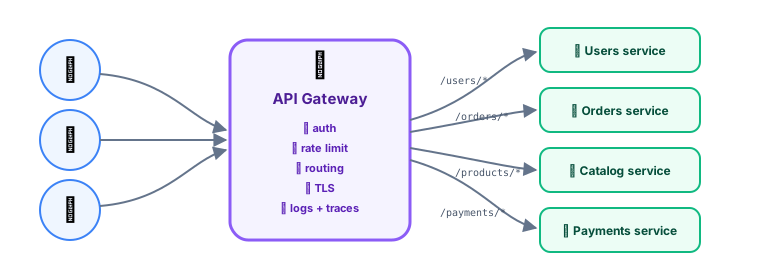 An API gateway: one front door for many services
Without vs with a gateway
Without a gateway, every client must know every service address, and every service must implement auth, rate limiting and CORS itself.
What a gateway does
| Responsibility | Example |
|---|---|
| Routing | /api/orders/* → orders service, /api/users/* → users service |
| Authentication | Verify the JWT once; pass the user ID downstream |
| Rate limiting | 100 requests/minute per API key |
| TLS termination | Handle HTTPS at the edge |
| Request aggregation | One client call → fetch from 3 services → one combined response |
| Protocol translation | Public REST/JSON outside, gRPC inside |
| Caching | Cache public GET responses |
| Observability | Access logs, metrics, start a trace ID |
| Canary routing | Send 5% of traffic to the new version |
# Simplified gateway routing config (Kong / NGINX / Envoy style)
routes:
  - path: /api/users
    service: http://users-svc:8080
    plugins: [jwt-auth, rate-limit: { minute: 100 }]
  - path: /api/orders
    service: http://orders-svc:8080
    plugins: [jwt-auth]
  - path: /api/products
    service: http://catalog-svc:8080
    plugins: [cache: { ttl: 60 }]
⚠️ Keep business logic out of the gateway. It should route and protect, not decide discounts. A gateway full of business rules becomes a new monolith, and a single point of failure (so run several instances).
Popular gateways: Kong, NGINX, Envoy, Traefik, AWS API Gateway, Azure API Management, Apigee.
Backend for Frontend (BFF)
Different clients need different data: a mobile screen wants a small payload; a web dashboard wants everything. One generic API serves nobody well. A BFF is a small backend tailored to one frontend, owned by that frontend team.
// Mobile BFF: one endpoint shaped exactly for the home screen
app.get("/mobile/home", async (req, res) => {
  const [user, orders, recs] = await Promise.all([
    usersClient.get(req.user.id),
    ordersClient.recent(req.user.id, { limit: 3 }),
    recsClient.forUser(req.user.id, { limit: 5 }).catch(() => []), // degrade gracefully
  ]);
  res.json({
    greeting: `Hi ${user.firstName}`,
    recentOrders: orders.map(({ id, status }) => ({ id, status })),
    recommendations: recs.map(({ id, title, thumbUrl }) => ({ id, title, thumbUrl })),
  });
});
A Next.js server (Server Components and Route Handlers) often acts as the BFF for a web app.
Service discovery: how services find each other
In a dynamic environment, service instances come and go (autoscaling, deploys, crashes), and their IP addresses change constantly. Hard-coding 10.0.3.17:8080 doesn't work.
| Style | How | Examples |
|---|---|---|
| Client-side discovery | The client asks the registry and load-balances itself | Netflix Eureka, Consul + client library |
| Server-side discovery | The client calls a stable address; a load balancer/router finds an instance | Kubernetes Services, AWS ALB |
| DNS-based | A stable DNS name resolves to healthy instances | Kubernetes DNS: orders.default.svc.cluster.local |
In Kubernetes this is built in: you call http://orders-svc, and the platform routes to a healthy pod. (See Kubernetes → Services & Ingress.)
Service mesh: networking as infrastructure
As services multiply, every one needs retries, timeouts, mutual TLS, metrics and tracing. Instead of coding this into every service (in every language), a service mesh puts a small proxy (sidecar) next to each service that handles it all.
| Mesh gives you | Without writing code |
|---|---|
| 🔐 Mutual TLS | Encrypted, authenticated service-to-service traffic |
| 🔁 Retries, timeouts, circuit breaking | Configured in YAML |
| 🚦 Traffic splitting | Canary releases, A/B tests |
| 📊 Telemetry | Golden-signal metrics and traces for every call |
Trade-off: more moving parts, extra latency per hop and extra resources. Worth it with many services and strict security needs; overkill for five services.
Gateway vs mesh: the gateway handles north-south traffic (clients → system); the mesh handles east-west traffic (service ↔ service).
Key takeaways
- An API gateway is the single front door: routing, auth, rate limiting, TLS, aggregation. Keep business logic out.
- A BFF tailors an API to one client type (web, mobile), owned by that frontend team.
- Service discovery lets services find each other as instances change; Kubernetes provides it through Services and DNS.
- A service mesh moves retries, mTLS and telemetry into sidecar proxies, for east-west traffic.