Data in Microservices: Sagas & the Outbox Pattern
Each service owns its database, so how do you keep data consistent across services without a shared transaction? Database per service, sagas, compensations and the transactional outbox.
The big idea
Booking a holiday means booking a flight, a hotel and a car from three different companies. No single "transaction" covers all three. If the car rental fails, you don't magically undo everything; you cancel the hotel and cancel the flight yourself.
That's a saga: a sequence of local steps, each with a compensating action that undoes it if a later step fails.
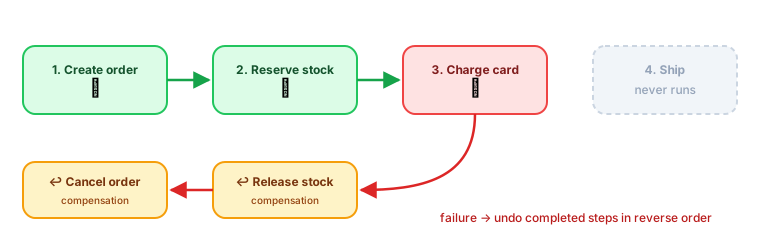 A saga: each step has a compensating action to undo it
Rule #1: database per service
Each service owns its data. Nobody else touches its tables, only its API and events.
Why? With a shared database, one team's schema change breaks another team's service, services can't be deployed independently, and you've built a distributed monolith.
The consequence: there is no single BEGIN … COMMIT across services. We need other tools.
Why not a distributed transaction (2PC)?
Two-phase commit asks every participant "can you commit?" and then "commit!". It exists, but in microservices it's usually avoided:
- Every participant is locked while waiting for the slowest one.
- If the coordinator crashes mid-way, participants can stay stuck.
- Many modern systems (Kafka, most NoSQL stores, SaaS APIs like Stripe) don't support it.
So microservices accept eventual consistency and use sagas.
The saga pattern
A saga is a series of local transactions. Each one updates a single service's database and triggers the next step. If a step fails, the saga runs compensating transactions for the steps that already succeeded.
| Step | Action | Compensation |
|---|---|---|
| 1 | Create order (PENDING) | Mark order CANCELLED |
| 2 | Reserve stock | Release stock |
| 3 | Charge card | Refund card |
| 4 | Schedule shipment | (last step: nothing after it can fail) |
⚠️ Compensation isn't always a perfect "undo". You can't un-send an email; you send an apology email instead. Design compensations as business actions.
Choreography saga (events)
Each service listens for events and reacts. No central coordinator.
✅ Simple for short flows, loosely coupled. ❌ Hard to see the whole flow; risk of cyclic event chains.
Orchestration saga (a coordinator)
A saga orchestrator tells each service what to do and tracks the state.
// A simple orchestrator (tools like Temporal make this durable and crash-safe)
async function placeOrderSaga(order) {
  const done = [];
  try {
    await inventory.reserve(order.items);          done.push(() => inventory.release(order.items));
    const payment = await payments.charge(order);  done.push(() => payments.refund(payment.id));
    await shipping.schedule(order);
    await orders.markConfirmed(order.id);
  } catch (error) {
    for (const compensate of done.reverse()) await compensate(); // undo in reverse order
    await orders.markCancelled(order.id, error.message);
    throw error;
  }
}
✅ The whole flow is visible and testable in one place. ❌ The orchestrator is extra infrastructure, and it must survive crashes: Temporal, AWS Step Functions and Camunda persist saga state for you.
The dual-write problem
A very common bug: a service saves to its database and publishes an event, as two separate steps.
// ❌ Dual write
await db.orders.insert(order);             // 1. succeeds
await kafka.publish("OrderCreated", order); // 2. crashes here → event never sent 😱
Swapping the order doesn't help: publishing first and then failing the DB write sends an event about an order that doesn't exist.
The transactional outbox pattern ⭐
Write the event into an outbox table in the same database, in the same transaction as the business data. A separate relay process reads the outbox and publishes to the broker.
BEGIN;
INSERT INTO orders (id, customer_id, total_cents, status) VALUES ('ord_42', 'cus_7', 8997, 'PENDING');
INSERT INTO outbox (id, aggregate_id, type, payload, created_at)
VALUES (gen_random_uuid(), 'ord_42', 'OrderCreated', '{"orderId":"ord_42","totalCents":8997}', now());
COMMIT; -- both rows or neither
// Relay: publish unsent outbox rows, then mark them as sent
setInterval(async () => {
  const rows = await db.query(
    "SELECT * FROM outbox WHERE sent_at IS NULL ORDER BY created_at LIMIT 100 FOR UPDATE SKIP LOCKED",
  );
  for (const row of rows) {
    await broker.publish(row.type, row.payload, { messageId: row.id });
    await db.query("UPDATE outbox SET sent_at = now() WHERE id = $1", [row.id]);
  }
}, 500);
Guarantee: if the order is saved, the event will eventually be published, at least once. If the relay crashes after publishing but before marking the row, the event is published twice, so consumers must be idempotent.
Change Data Capture (CDC) tools like Debezium read the database's transaction log and stream outbox rows to Kafka, with no polling needed.
The inbox pattern: idempotent consumers
The receiving side records which message IDs it has processed, in the same transaction as its own changes:
BEGIN;
INSERT INTO inbox (message_id) VALUES ('evt_7f3c…');  -- UNIQUE: a duplicate fails here
UPDATE stock SET reserved = reserved + 1 WHERE sku = 'KB-1';
COMMIT;
Outbox on the producer side plus inbox (idempotency) on the consumer side gives effectively exactly-once processing.
Querying across services
"Show orders with customer names and shipping status" needs data from three services. Options:
| Approach | How | Trade-off |
|---|---|---|
| API composition | A BFF/gateway calls each service and joins in memory | Simple; slow for big lists |
| Data replication | Services keep local read-only copies of data they need, updated by events | Fast; eventually consistent |
| CQRS read model | A dedicated query database built from events | Fast, flexible queries; more infrastructure (next lesson) |
Key takeaways
- Database per service: no shared tables, so no cross-service ACID transactions.
- Avoid 2PC; use sagas: local transactions plus compensating actions, run by choreography (events) or orchestration (a coordinator).
- Never dual-write. Use the transactional outbox so data changes and events are committed together.
- Delivery is at-least-once, so make consumers idempotent (the inbox pattern).
- Cross-service queries: API composition, replicated data, or CQRS read models.