Deploying & Operating Microservices
CI/CD per service, blue-green and canary releases, feature flags, API versioning, distributed tracing and the production-readiness checklist every service should pass.
The big idea
A theatre changes the set between scenes without stopping the play: the curtain drops for a moment, the crew swaps pieces, and the show goes on. The audience barely notices.
The whole point of microservices is being able to deploy one service many times a day, safely, without downtime. That takes automation, careful release strategies and good visibility.
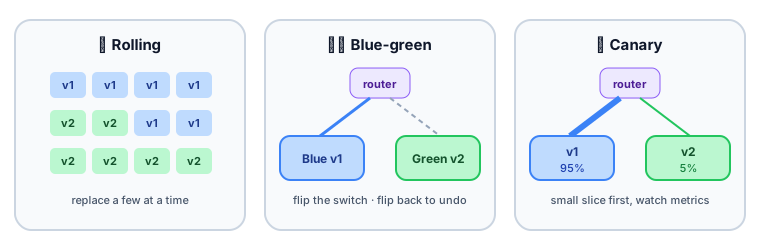 Release strategies: rolling, blue-green and canary
One pipeline per service
Each service has its own repository (or its own folder in a monorepo), its own tests and its own pipeline.
- Build once; promote the same image through every environment.
- Tag images with the git SHA or a version, never just
latest. - Store configuration in the environment, not in the image.
Release strategies
Rolling update (the Kubernetes default)
Replace instances a few at a time. Simple, no extra capacity needed; old and new versions run side by side for a while.
Blue-green
Run two identical environments. Blue serves traffic; deploy to green, test it, then switch the router in one step. Rollback = switch back.
✅ Instant switch and instant rollback. ❌ Double the infrastructure while both run; database changes must work with both versions.
Canary ⭐
Send a small slice of real traffic (1% → 5% → 25% → 100%) to the new version, watching error rates and latency at each step. If metrics get worse, roll back automatically.
✅ Limits the blast radius of a bad release to a few users. Tools: Argo Rollouts, Flagger, service mesh traffic splitting.
| Strategy | Rollback speed | Extra cost | Risk exposure |
|---|---|---|---|
| Rolling | Medium | None | Grows gradually |
| Blue-green | ⚡ Instant | 2× capacity during release | All users at the switch |
| Canary | Fast | Small | ✅ Smallest |
Feature flags: deploy ≠ release
Ship code turned off, then turn it on for specific users (staff, 10% of users, one country) without redeploying.
if (await flags.isEnabled("new-checkout", { userId: user.id, country: user.country })) {
  return renderNewCheckout();
}
return renderOldCheckout();
Flags also act as kill switches: turn a broken feature off in seconds. Remember to delete old flags, or they become technical debt.
Never break your consumers
Other services depend on your API and your events. Changes must be backward compatible.
| ✅ Safe (additive) | ❌ Breaking |
|---|---|
| Add a new optional field | Remove or rename a field |
| Add a new endpoint | Change a field's type |
| Add a new event type | Make an optional field required |
| Accept new optional input | Change what an error code means |
Expand and contract for breaking changes, including database changes:
Consumer-driven contract tests (such as Pact) let each consumer publish what it expects from your API; your pipeline fails if a change would break any of them, before it reaches production.
Observability across services
With dozens of services, you must be able to follow a request across all of them.
- Distributed tracing with OpenTelemetry: one trace ID across every hop.
- Structured logs including the trace ID and service name.
- Golden signals per service: latency, traffic, errors, saturation.
- Correlate everything in one place (Grafana, Datadog, Honeycomb).
(See Backend → Observability for the details.)
Production-readiness checklist
Before a service goes live, it should have:
- Health endpoints (
/health/live,/health/ready) - Timeouts, retries with backoff, and circuit breakers on outgoing calls
- Graceful shutdown (finish in-flight requests on SIGTERM)
- Structured logging with trace IDs
- Metrics and a dashboard for the golden signals
- Alerts linked to a runbook
- Resource limits (CPU/memory) and autoscaling rules
- Config through environment variables; secrets in a secret manager
- API docs (OpenAPI) and versioning policy
- Automated tests and a one-click (or automatic) rollback
- A clear owning team and an on-call rotation
// Graceful shutdown in Node.js
process.on("SIGTERM", () => {
  server.close(async () => {          // stop accepting new requests, finish current ones
    await db.end();
    await broker.disconnect();
    process.exit(0);
  });
  setTimeout(() => process.exit(1), 25_000).unref(); // force-quit if it takes too long
});
Key takeaways
- Each service has its own pipeline; build one image and promote it through environments.
- Rolling updates are the default; blue-green gives instant rollback; canary limits the blast radius.
- Feature flags separate deploying code from releasing features.
- Keep APIs and events backward compatible (expand → migrate → contract) and use contract tests.
- Tracing, logs and golden-signal metrics across services are non-negotiable; use a production-readiness checklist.