Service Communication: Sync vs Async
Should services call each other directly or talk through events? Compare request/response with messaging, orchestration with choreography, and learn when to use each.
The big idea
Two ways to get something from a colleague:
- Phone call (synchronous): you call, wait on the line, and get the answer right now. If they don't pick up, you're stuck.
- Email (asynchronous): you send a message and carry on with your day. They reply when they can. Nobody is blocked.
Services talk to each other the same two ways.
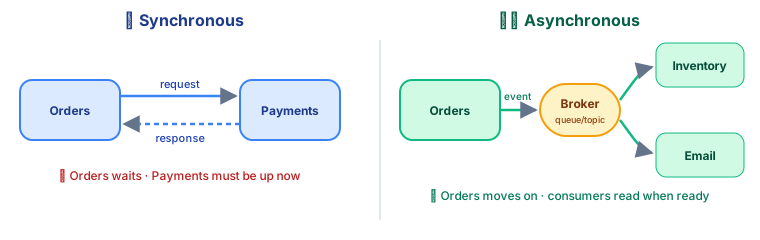 Synchronous calls wait for an answer; asynchronous messages don't
Synchronous: request/response
One service calls another (HTTP/REST or gRPC) and waits for the answer.
✅ Simple to understand and debug; you get an immediate answer. ❌ Temporal coupling: every service in the chain must be up right now. Latencies add up, and failures cascade.
Availability multiplies
If each service is available 99.9% of the time, a request that must pass through 5 services synchronously succeeds only:
0.999⁵ ≈ 99.5%. That's roughly 5× more downtime than any single service.
Asynchronous: messaging and events
A service publishes a message to a broker (Kafka, RabbitMQ, SQS) and moves on. Interested services consume it when they're ready.
✅ Loose coupling: the publisher doesn't know who listens; consumers can be offline for a while; traffic spikes are buffered; new consumers can be added without touching the publisher. ❌ Eventual consistency (data is not updated everywhere instantly), harder debugging, and you need idempotency and ordering strategies.
Commands vs events
| Command | Event | |
|---|---|---|
| Meaning | "Please do this" | "This happened" |
| Naming | Imperative: ReserveStock, SendEmail | Past tense: OrderPlaced, PaymentFailed |
| Receivers | Exactly one handler | Zero, one or many subscribers |
| Coupling | The sender knows who does the work | The publisher doesn't know who listens |
{
  "eventId": "7f3c9a1e-…",
  "type": "OrderPlaced",
  "version": 1,
  "occurredAt": "2026-09-28T10:15:00Z",
  "data": { "orderId": "ord_42", "customerId": "cus_7", "totalCents": 8997, "items": [{ "sku": "KB-1", "qty": 1 }] }
}
💡 Give every event an ID (for idempotency), a type, a version (for schema evolution) and a timestamp.
Orchestration vs choreography
When a business process spans several services, who's in charge?
| Orchestration | Choreography | |
|---|---|---|
| Control | A central coordinator tells each service what to do | Each service reacts to events on its own |
| Visibility | ✅ The whole flow is in one place | ❌ The flow is spread across services |
| Coupling | The orchestrator knows every step | ✅ Services only know events |
| Best for | Complex flows with many steps and compensations | Simple flows, many independent reactions |
| Tools | Temporal, AWS Step Functions, Camunda | Kafka, RabbitMQ, SNS/SQS |
Choosing a style
A common, healthy mix:
- Queries (reads the user is waiting for) → synchronous, with timeouts and fallbacks.
- State changes other services react to → events.
- Background jobs → command queues.
Keeping sync calls safe
- ⏱️ Always set timeouts. No timeout = one slow service can exhaust every thread.
- 🔁 Retry with backoff, but only idempotent operations.
- ⚡ Circuit breakers to fail fast when a dependency is down.
- 🧊 Fallbacks: a cached value, a default, or a degraded feature.
All covered in Resilience Patterns.
Avoid chatty services
Or keep a local copy of the data you need (for example, the customer's name inside the order), kept up to date through events.
Key takeaways
- Sync (REST/gRPC) is simple and immediate, but couples services in time; latency and failures add up.
- Async (events/queues) decouples services and absorbs spikes, at the cost of eventual consistency.
- Commands say "do this" (one handler); events say "this happened" (many subscribers).
- Orchestration centralises a flow; choreography lets services react to events.
- Mix them: sync for queries the user waits on, events for state changes, queues for background jobs.