CQRS & Event Sourcing
Separate the model you write with from the model you read with, and store every change as an event instead of overwriting state. Powerful patterns, explained simply, with honest trade-offs.
Part 1: CQRS
The big idea
A restaurant kitchen and its menu board are optimised for different jobs. The kitchen is organised for cooking (making changes); the menu board is organised for customers reading quickly. Nobody tries to read the menu off the kitchen shelves.
CQRS (Command Query Responsibility Segregation) separates:
- Commands (writes): "place an order", "change an address". They validate business rules and change state.
- Queries (reads): "show my order history". They return data and change nothing.
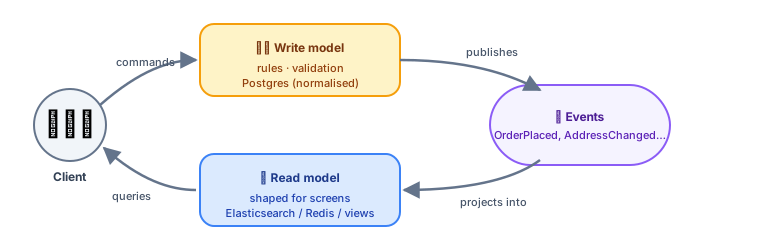 CQRS: a write model for commands, a read model for queries, synced by events
Why split them?
Reads and writes usually have very different needs:
| Writes (commands) | Reads (queries) | |
|---|---|---|
| Volume | Few | Often 10–1000× more |
| Shape | Normalised, enforces rules | Denormalised, joined, pre-computed |
| Storage | Postgres (transactions) | Elasticsearch (search), Redis (fast lookups), a reporting DB |
| Scaling | Consistency matters | Scale out freely |
Example: the "My orders" screen shows the order, product names, images, shipping status and total. With CQRS, a projector keeps an order_summaries view with exactly those fields, so one fast query, no joins across services.
// Command side: rules and state changes
async function changeShippingAddress({ orderId, address }) {
  const order = await orderRepository.load(orderId);
  order.changeAddress(address);           // throws if already shipped
  await orderRepository.save(order);      // + outbox event "ShippingAddressChanged"
}

// Projector: keeps the read model in sync
on("ShippingAddressChanged", async (event) => {
  await readDb.orderSummaries.update(event.orderId, { shippingCity: event.address.city });
});

// Query side: dumb and fast
app.get("/orders/mine", async (req, res) => {
  res.json(await readDb.orderSummaries.find({ customerId: req.user.id }).sort({ placedAt: -1 }));
});
The catch: eventual consistency
The read model updates a moment after the write. A user might save a change and not see it on the next screen for a few milliseconds. Common fixes: show the updated value optimistically in the UI, or read from the write side right after the user's own change.
💡 CQRS doesn't require separate databases. Even separate classes for reads and writes inside one app is CQRS. Start there.
Part 2: Event Sourcing
The big idea
Your bank account doesn't store just "balance: $120". It stores every transaction: deposit $100, withdraw $30, deposit $50. The balance is simply the sum. You can always see how you got there, and what the balance was on any past date.
Event sourcing stores every change as an immutable event, instead of overwriting the current state.
const events = [
  { type: "AccountOpened", accountId: 42 },
  { type: "MoneyDeposited", amount: 100 },
  { type: "MoneyWithdrawn", amount: 30 },
  { type: "MoneyDeposited", amount: 50 },
];

// Current state = a left fold (reduce) over the events
function applyEvent(state, event) {
  switch (event.type) {
    case "AccountOpened": return { id: event.accountId, balance: 0 };
    case "MoneyDeposited": return { ...state, balance: state.balance + event.amount };
    case "MoneyWithdrawn": return { ...state, balance: state.balance - event.amount };
    default: return state;
  }
}

const account = events.reduce(applyEvent, null); // { id: 42, balance: 120 }
Handling a command
async function withdraw(accountId, amount) {
  const history = await eventStore.load(`account-${accountId}`);
  const account = history.reduce(applyEvent, null);
  if (account.balance < amount) throw new Error("Insufficient funds"); // business rule on current state

  await eventStore.append(`account-${accountId}`, [{ type: "MoneyWithdrawn", amount }], {
    expectedVersion: history.length, // optimistic concurrency: fails if someone appended meanwhile
  });
}
What you get
| Benefit | Example |
|---|---|
| 🧾 Complete audit log | Every change, who made it and when: banking, healthcare, legal |
| ⏪ Time travel | "What did this cart look like last Tuesday?" Replay events up to that date |
| 🔄 New read models anytime | Need a new report? Replay all events into a new projection |
| 🐛 Debugging | Replay the exact sequence of events that caused a bug |
| 📣 Natural fit for events | Events are already the source of truth, ready to publish |
What it costs
| Challenge | Mitigation |
|---|---|
| Replaying thousands of events is slow | Snapshots: save state every N events, then replay only newer events |
| Event schemas change over time | Versioned events, upcasters (convert old events to the new format on read) |
| Querying is hard ("all accounts over $1,000") | CQRS read models built from the events |
| "Deleting" data (GDPR) with immutable events | Crypto-shredding: encrypt personal data per user and delete the key |
| Steeper learning curve | Use it only where the benefits are real |
Tools: EventStoreDB, Axon, Marten (Postgres), or Kafka as the event log.
CQRS + event sourcing together
They're often used together, but they're independent: you can use CQRS without event sourcing (very common), and event sourcing almost always needs CQRS for queries.
When to use them
✅ Good fit: complex domains with rich business rules, strong audit requirements (finance, healthcare, insurance), very different read/write loads, and a need to answer "what happened and when?".
❌ Poor fit: simple CRUD apps (a to-do list, a basic admin panel), small teams without the need, domains where eventual consistency confuses users.
⚠️ Apply these patterns to one bounded context that needs them, not to your whole system.
Key takeaways
- CQRS: separate models (or even separate stores) for writes and reads, synced by events.
- Read models are shaped for screens: fast, denormalised, eventually consistent.
- Event sourcing: store every change as an immutable event; current state = replaying events.
- You get audit history, time travel and new projections at any time; you pay with complexity, schema evolution and snapshots.
- Use them where the domain truly benefits, not everywhere.