Finding Service Boundaries with DDD
The hardest part of microservices is deciding where to cut. Learn bounded contexts, ubiquitous language, aggregates and context maps from Domain-Driven Design.
The big idea
The word "Product" means different things in different departments of a shop:
- Catalogue team: name, photos, description, categories.
- Warehouse: weight, shelf location, stock count.
- Billing: price, tax class, discounts.
If one giant Product class tries to serve everyone, every team edits it, it grows to 80 fields, and any change risks breaking someone else.
Domain-Driven Design (DDD) says: let each department have its own model of a product, inside its own boundary. That boundary is a bounded context, and it's the best guide for where to draw service boundaries.
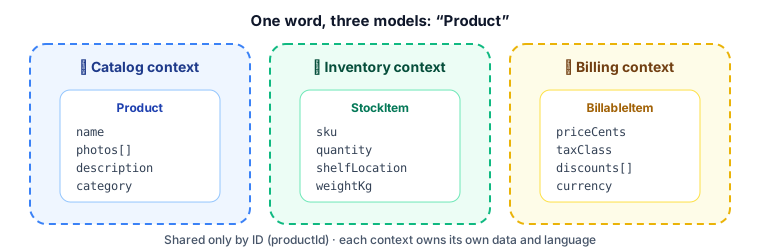 The same "Product" means different things in different bounded contexts
🏛️ This lesson applies DDD to service boundaries. For the full picture, see DDD strategic design and DDD tactical patterns in the Software Architecture topic.
Key DDD vocabulary
| Term | Meaning | Example |
|---|---|---|
| Domain | The business area you're building for | Online retail |
| Subdomain | A distinct part of the business | Catalogue, ordering, shipping, billing |
| Bounded context | A boundary inside which one model and one language apply | The Shipping context |
| Ubiquitous language | Words that developers and business experts share inside a context | "Shipment", "parcel", "carrier" |
| Aggregate | A cluster of objects changed together as one unit, with one root | Order + its OrderLines |
| Domain event | Something that happened that others care about | OrderPlaced, PaymentFailed |
| Context map | How bounded contexts relate to each other | Ordering → Shipping (events) |
Subdomains: where to invest
Put your best engineers and cleanest design into the core; buy generic pieces (Auth0, Stripe, SendGrid) instead of building them.
From contexts to services
A bounded context usually becomes one service (or a small group of services owned by one team). Each context:
- Has its own database: nobody else reads its tables.
- Shares data only through APIs and events.
- Keeps only the data it needs: Ordering stores the product ID, name and price at the time of ordering, not the full catalogue entry.
Aggregates: consistency boundaries
An aggregate is a group of objects that must stay consistent together, changed in one transaction through one entry point, the aggregate root.
// Order is the aggregate root: outside code never edits OrderLines directly
class Order {
  #lines = [];
  #status = "draft";

  addLine(productId, quantity, unitPriceCents) {
    if (this.#status !== "draft") throw new Error("Cannot change a submitted order");
    if (quantity <= 0) throw new Error("Quantity must be positive");
    this.#lines.push({ productId, quantity, unitPriceCents });
  }

  submit() {
    if (this.#lines.length === 0) throw new Error("Order is empty");
    this.#status = "submitted";
    return { type: "OrderSubmitted", orderId: this.id, totalCents: this.totalCents }; // domain event
  }

  get totalCents() {
    return this.#lines.reduce((sum, l) => sum + l.quantity * l.unitPriceCents, 0);
  }
}
Aggregate rules of thumb:
- Keep aggregates small.
- Reference other aggregates by ID, not by object.
- One transaction = one aggregate. Changes across aggregates (or services) happen through events: eventual consistency.
Context mapping: how contexts relate
| Relationship | Meaning |
|---|---|
| Customer / Supplier | Downstream team's needs influence the upstream team's API |
| Conformist | Downstream just accepts the upstream model as it is |
| Anti-Corruption Layer (ACL) | Downstream translates the upstream model into its own, protecting itself from a messy or legacy model |
| Published language | A shared, documented format (for example, event schemas) |
| Shared kernel | A small, jointly owned shared model (use sparingly) |
Practical heuristics for cutting services
- Follow business capabilities, not technical layers. ✅ "Payments service". ❌ "Database service", "Validation service".
- High cohesion inside, loose coupling outside: things that change together stay together.
- Look at the language: where the meaning of a word changes, there's probably a boundary.
- Check the chattiness: if two services call each other for every request, they're probably one context.
- Align with teams: one team should own a context end to end.
- Event storming: put business experts and developers in a room with sticky notes for every domain event (
OrderPlaced,ItemShipped), then group them. The clusters reveal the contexts.
Colour groups from event storming: Ordering (blue), Payments (yellow), Fulfilment (green).
Key takeaways
- One word can mean different things in different parts of a business; give each part its own model.
- A bounded context is the natural boundary for a microservice, with its own data and language.
- Aggregates are consistency boundaries: small, changed in one transaction, referenced by ID.
- Contexts communicate through APIs and domain events; protect clean models with an anti-corruption layer.
- Cut by business capability, not technical layer. Event storming helps find the seams.