Timeouts, Retries & Backpressure
A slow dependency should consume a bounded budget, not create an infinite retry storm.
The big idea
A queue is a restaurant waiting area. When it is full, taking more names creates a longer, less predictable wait; it does not create more tables.
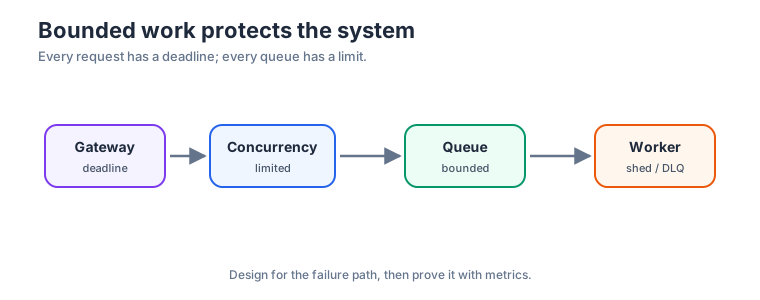 A bounded request path: deadline budgets, limited concurrency, a queue and explicit overload shedding
One deadline, split into budgets
If the user can wait 1,000 ms, every dependency spends part of one budget. Do not give every hop its own 1,000 ms timeout.
| Step | Budget | When it expires |
|---|---|---|
| Gateway/app work | 150 ms | Stop before downstream work. |
| Inventory | 250 ms | Controlled temporary failure. |
| Payment | 450 ms | Reconcile with idempotency key. |
| Safety margin | 150 ms | Return before caller gives up. |
Retry only transient, idempotent work while time and retry budget remain. Use exponential backoff with full jitter so clients do not retry together.
Backpressure choices
- Bound concurrency for expensive work.
- Bound queues; reject or defer instead of retaining unlimited memory.
- Shed optional work before checkout.
- Route poison jobs to a visible DLQ.
Watch: queue age, saturation, rejected work, dependency latency, retries, and error-budget burn.