Proxies, APIs and Real-Time Protocols
Pick REST, RPC, queues, long polling, WebSockets, TCP or UDP based on the interaction shape.
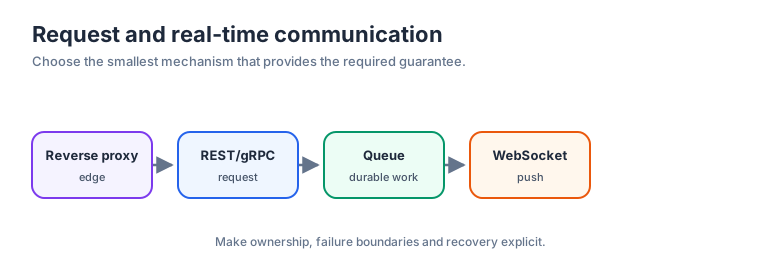 Communication choices: reverse proxy at the edge, request APIs, queues and persistent real-time connections
| Need | Good starting point | Trade-off |
|---|---|---|
| Public resource API | REST over HTTPS | Familiar and cache-friendly |
| Internal typed call | gRPC/RPC | Tighter coupling |
| Slow work | Queue | Eventual result and lag |
| Occasional updates | Long polling | Repeated connections |
| Live two-way chat | WebSocket | Connection lifecycle/fan-out |
| Ordered reliable bytes | TCP | More overhead |
| Loss-tolerant media | UDP/QUIC | App tolerates loss/reordering |
A forward proxy represents clients. A reverse proxy represents servers: it can terminate TLS, route, cache and rate-limit. A queue is not a WebSocket, and a WebSocket is not a durable message log.