Domain-Driven Design: Tactical Patterns
The building blocks for modelling rules in code. Entities, value objects, aggregates and their four rules, repositories, domain services, application services, domain events and factories, all in TypeScript.
The big idea
Strategic DDD draws the boundaries. Tactical DDD gives you a toolbox for writing the model inside one bounded context, so the code expresses business rules clearly and can't be put into an invalid state.
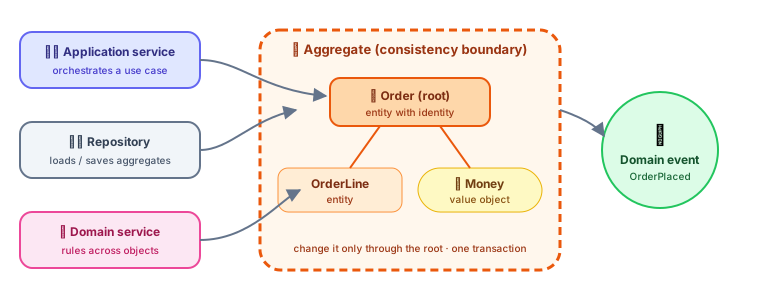 The tactical DDD building blocks and how they relate
| Building block | One-line meaning | Example |
|---|---|---|
| Entity | Has an identity that stays the same while its data changes | Order #42, Customer cus_7 |
| Value object | Defined only by its values, immutable, no identity | Money(€10), Email, Address |
| Aggregate | A cluster of objects changed together as one consistency unit, with a root | Order + its OrderLines |
| Repository | Collection-like access to aggregates | OrderRepository.get(id) / save(order) |
| Domain service | Business logic that doesn't fit one entity | ShippingCostCalculator |
| Application service | Orchestrates a use case: load → call domain → save → publish | PlaceOrderHandler |
| Domain event | Something that happened in the domain | OrderPlaced, OrderShipped |
| Factory | Encapsulates complex creation | Order.create(...), QuoteFactory |
Entities vs value objects
Ask: "If all its attributes are equal, is it the same thing?" Two €10 notes: yes, it's a value. Two customers both named "Ana Silva": no, they're different people, so it's an entity.
Value objects: small, immutable, self-validating ⭐
Value objects are the easiest tactical pattern to adopt, and remove a huge class of bugs (see primitive obsession in the Code Smells lesson).
export class Money {
  private constructor(readonly cents: number, readonly currency: "EUR" | "USD") {
    if (!Number.isInteger(cents)) throw new DomainError("Money must be whole cents");
  }
  static of(cents: number, currency: "EUR" | "USD") { return new Money(cents, currency); }

  add(other: Money): Money {
    if (other.currency !== this.currency) throw new DomainError("Cannot add different currencies");
    return new Money(this.cents + other.cents, this.currency);   // returns a NEW object
  }
  multiply(factor: number): Money { return new Money(Math.round(this.cents * factor), this.currency); }
  equals(other: Money) { return this.cents === other.cents && this.currency === other.currency; }
}

export class Email {
  private constructor(readonly value: string) {}
  static parse(raw: string): Email {
    const value = raw.trim().toLowerCase();
    if (!/^[^@\s]+@[^@\s]+\.[^@\s]+$/.test(value)) throw new DomainError(`Invalid email: ${raw}`);
    return new Email(value);
  }
}
Once you hold an Email, it's guaranteed valid. No more re-validating strings all over the code.
Aggregates: the consistency boundary ⭐
An aggregate is a group of entities and value objects that must stay consistent together. Outside code may only hold a reference to the aggregate root and must change the aggregate through it.
export class Order {                                      // aggregate root
  private lines: OrderLine[] = [];
  private status: "DRAFT" | "PLACED" | "CANCELLED" = "DRAFT";
  private events: DomainEvent[] = [];

  private constructor(readonly id: OrderId, readonly customerId: CustomerId) {}

  static start(id: OrderId, customerId: CustomerId) { return new Order(id, customerId); }

  addLine(productId: ProductId, quantity: number, unitPrice: Money) {
    this.assertDraft();
    if (quantity <= 0) throw new DomainError("Quantity must be positive");
    const existing = this.lines.find((l) => l.productId === productId);
    existing ? existing.increase(quantity) : this.lines.push(new OrderLine(productId, quantity, unitPrice));
  }

  place() {
    this.assertDraft();
    if (this.lines.length === 0) throw new DomainError("Cannot place an empty order");
    if (this.total().cents > 1_000_000) throw new DomainError("Orders over €10,000 need manual approval");
    this.status = "PLACED";
    this.events.push({ type: "OrderPlaced", orderId: this.id, total: this.total(), occurredAt: new Date() });
  }

  total(): Money {
    return this.lines.reduce((sum, l) => sum.add(l.subtotal()), Money.of(0, "EUR"));
  }

  pullEvents(): DomainEvent[] { const e = this.events; this.events = []; return e; }

  private assertDraft() {
    if (this.status !== "DRAFT") throw new DomainError(`Order is already ${this.status}`);
  }
}
The four rules of aggregate design (Vaughn Vernon)
| Rule | Why |
|---|---|
| 1. Protect invariants inside the boundary | Rules like "total ≤ €10,000" are always enforced in one place |
| 2. Design small aggregates | Big aggregates cause lock contention and slow loading |
| 3. Reference other aggregates by ID only | customerId, not a Customer object: keeps boundaries clear |
| 4. Use eventual consistency between aggregates | One transaction changes one aggregate; others react to domain events |
Repositories: a collection of aggregates
A repository makes persistence look like an in-memory collection of aggregates. There is one repository per aggregate root, not per table.
// Defined in the domain (a port), implemented in infrastructure (an adapter)
export interface OrderRepository {
  get(id: OrderId): Promise<Order>;          // loads the WHOLE aggregate
  save(order: Order): Promise<void>;         // saves the WHOLE aggregate atomically
  nextId(): OrderId;
}
⚠️ No repository for
OrderLine. Lines are only reachable through theirOrderroot; otherwise someone will change a line and bypass the order's rules.
Domain services vs application services
// Domain service: a business rule that doesn't naturally belong to one entity
export class ShippingCostCalculator {
  calculate(order: Order, destination: Address): Money {
    const base = destination.country === "PT" ? Money.of(399, "EUR") : Money.of(999, "EUR");
    return order.total().cents >= 5000 ? Money.of(0, "EUR") : base;
  }
}

// Application service (a use case): load, act, save, publish; thin, no if-statements about business
export class PlaceOrderHandler {
  constructor(private orders: OrderRepository, private events: EventPublisher) {}

  async handle(cmd: { orderId: string }) {
    const order = await this.orders.get(cmd.orderId);
    order.place();                                   // the rules live in the aggregate
    await this.orders.save(order);
    await this.events.publish(order.pullEvents());   // better still: via an outbox
  }
}
| Domain service | Application service | |
|---|---|---|
| Contains business rules? | ✅ Yes | ❌ No, only orchestration |
| Knows about transactions, repositories, events? | ❌ | ✅ |
| Named in… | Domain language (ShippingCostCalculator) | Use-case language (PlaceOrderHandler) |
| Lives in | Domain layer | Application layer |
Domain events
A domain event records something meaningful that happened, named in the past tense in the ubiquitous language.
type OrderPlaced = {
  type: "OrderPlaced";
  orderId: string;
  total: Money;
  occurredAt: Date;
};
They let aggregates stay small and decoupled (rule 4), feed other bounded contexts (through an outbox and a broker), and can even become the source of truth (event sourcing, see the Microservices lessons).
Factories
When creating an aggregate is complex (many rules, several sources of data), put the creation logic in a factory: a static method like Order.start(), or a separate class.
export class QuoteFactory {
  constructor(private pricing: PricingPolicy) {}
  fromCart(cart: Cart, customer: CustomerProfile): Quote {
    const lines = cart.items.map((item) => QuoteLine.from(item, this.pricing.priceFor(item, customer)));
    return Quote.create(QuoteId.new(), customer.id, lines, this.pricing.validityFor(customer));
  }
}
Anaemic vs rich domain model
// ❌ Anaemic: a bag of data; the rules live somewhere else (and get duplicated)
class Order { status!: string; lines!: OrderLine[]; }
if (order.status === "DRAFT" && order.lines.length > 0) order.status = "PLACED"; // in 3 services…

// ✅ Rich: data and the rules that protect it live together
order.place(); // throws if not allowed
Martin Fowler calls the anaemic domain model an anti-pattern for complex domains. For simple CRUD, though, it's perfectly fine, and so is skipping tactical DDD entirely.
Where it all lives (with Hexagonal / Clean)
src/ordering/                      # one bounded context
├── domain/
│   ├── Order.ts  OrderLine.ts     # aggregate + entities
│   ├── Money.ts  Email.ts         # value objects
│   ├── events.ts                  # domain events
│   ├── ShippingCostCalculator.ts  # domain service
│   └── OrderRepository.ts         # repository interface (port)
├── application/
│   └── PlaceOrderHandler.ts       # application services / use cases
└── infrastructure/
    └── PostgresOrderRepository.ts # repository implementation (adapter)
Key takeaways
- Entities have identity; value objects are immutable values that validate themselves. Use value objects generously.
- Aggregates are consistency boundaries: small, changed through the root, referenced by ID, one per transaction.
- Repositories load and save whole aggregates, one per aggregate root.
- Domain services hold rules that span objects; application services only orchestrate.
- Domain events decouple aggregates and contexts.
- Use tactical DDD where the domain is complex; plain CRUD doesn't need it.