Arrays & Strings
The most-used data structure. See how arrays live in memory, why some operations are instant and others slow, and the essential string tricks for interviews.
The big idea
An array is like a row of numbered lockers in a school hallway. Because the lockers are side by side and numbered, you can walk straight to locker #42 without opening the first 41.
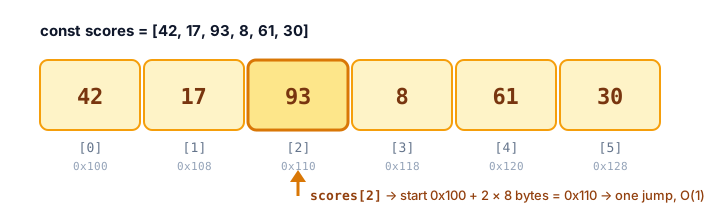 An array in memory: equally sized boxes side by side, reached instantly by index
That's why arr[i] is O(1): the computer calculates start address + i × box size and jumps there directly.
The cost of each operation
| Operation | Code | Big-O | Why |
|---|---|---|---|
| Read by index | arr[i] | O(1) | Direct jump |
| Update by index | arr[i] = x | O(1) | Direct jump |
| Add at end | arr.push(x) | O(1)* | Next locker is free (*amortised) |
| Remove from end | arr.pop() | O(1) | Nothing moves |
| Add at start | arr.unshift(x) | O(n) | Every item shifts right |
| Remove from start | arr.shift() | O(n) | Every item shifts left |
| Insert in middle | arr.splice(i, 0, x) | O(n) | Items after i shift |
| Search (unsorted) | arr.includes(x) | O(n) | Check lockers one by one |
Why is inserting at the front slow?
With 1 million items, that's 1 million moves. If you need fast adds and removes at both ends, use a queue or deque (see Stacks & Queues).
What does "amortised O(1)" mean?
JavaScript arrays are dynamic: when full, the engine allocates a bigger block (often 2×) and copies everything over. That copy is O(n), but it happens so rarely that, on average, each push costs O(1).
Essential array techniques
1. Loop once, track something
// Find max, min, sum in one O(n) pass
function stats(nums) {
  let min = Infinity, max = -Infinity, sum = 0;
  for (const n of nums) {
    min = Math.min(min, n);
    max = Math.max(max, n);
    sum += n;
  }
  return { min, max, avg: sum / nums.length };
}
2. Prefix sums: answer range questions in O(1)
"What's the sum from index 2 to 5?" asked 10,000 times? Precompute once.
const nums = [3, 1, 4, 1, 5, 9, 2];
// prefix[i] = sum of nums[0 .. i-1]
const prefix = [0];
for (const n of nums) prefix.push(prefix.at(-1) + n);
// prefix = [0, 3, 4, 8, 9, 14, 23, 25]

const rangeSum = (i, j) => prefix[j + 1] - prefix[i]; // O(1)
rangeSum(2, 5); // 4 + 1 + 5 + 9 = 19
3. In-place reversal with two pointers
function reverse(arr) {
  let left = 0, right = arr.length - 1;
  while (left < right) {
    [arr[left], arr[right]] = [arr[right], arr[left]];
    left++;
    right--;
  }
  return arr;
}
Strings
In JavaScript, strings are immutable: you can't change a character in place. Every "change" creates a new string.
let s = "cat";
s[0] = "b";   // silently ignored
s = "b" + s.slice(1); // "bat": a brand-new string
⚠️ Building a string with
+=inside a big loop may copy the string again and again. Collect parts in an array andjoin("")at the end.
// ✅ Efficient string building
const parts = [];
for (const word of words) parts.push(word.toUpperCase());
const result = parts.join(" ");
Classic string problems
Is it a palindrome? ("racecar" reads the same backwards)
function isPalindrome(text) {
  const s = text.toLowerCase().replace(/[^a-z0-9]/g, "");
  let left = 0, right = s.length - 1;
  while (left < right) {
    if (s[left++] !== s[right--]) return false;
  }
  return true;
}
isPalindrome("A man, a plan, a canal: Panama"); // true
Are two words anagrams? ("listen" / "silent")
function isAnagram(a, b) {
  if (a.length !== b.length) return false;
  const count = {};
  for (const ch of a) count[ch] = (count[ch] ?? 0) + 1;
  for (const ch of b) {
    if (!count[ch]) return false;
    count[ch]--;
  }
  return true;
}
Counting characters with an object/map is O(n). Sorting both strings and comparing works too, but costs O(n log n).
Common interview gotchas
- Off-by-one errors: the last index is
arr.length - 1. - Mutating while iterating: removing items inside
forEachskips elements. Iterate backwards or usefilter. sort()sorts as strings by default:[10, 9, 1].sort()→[1, 10, 9]. Always pass(a, b) => a - b.- Empty input: always ask "what if the array is empty?"
Key takeaways
- Arrays give O(1) access by index because elements sit side by side in memory.
- Adding/removing at the end is cheap; at the start or middle is O(n).
- Prefix sums turn repeated range sums into O(1).
- Strings are immutable; build big strings with an array and
join. - Two pointers and counting maps solve a huge number of array/string problems.