Hash Maps & Sets
The interview superpower. Learn how hashing gives O(1) lookups, how collisions are handled, and the patterns (counting, seen-set, grouping) that solve dozens of problems.
The big idea
In a library with a million books, you don't search shelf by shelf. You look up the book in the catalogue, which tells you exactly which shelf it's on.
A hash map is that catalogue. A hash function turns a key (like "apple") into a number (a bucket index), so the computer jumps straight to where the value lives.
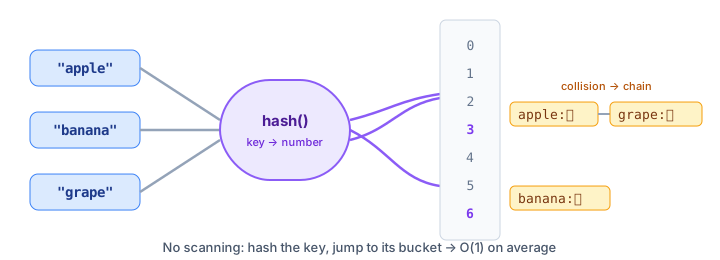 A hash function turns a key into a bucket number, so lookups jump straight to the right place
| Operation | Array (unsorted) | Hash map / Set |
|---|---|---|
| Find by key/value | O(n) | O(1) average |
| Insert | O(1) at end | O(1) average |
| Delete | O(n) | O(1) average |
| Keeps order? | Yes (by index) | JS Map/Set: insertion order |
How hashing works (simplified)
// A toy hash function: sum the character codes, then fit into N buckets
function hash(key, bucketCount) {
  let total = 0;
  for (const ch of key) total = (total * 31 + ch.charCodeAt(0)) >>> 0;
  return total % bucketCount;
}

hash("apple", 8);  // 3  → bucket 3
hash("banana", 8); // 6  → bucket 6
Collisions
Two different keys can land in the same bucket. The usual fix is chaining: each bucket holds a small list.
If the hash function spreads keys well and the table grows when it gets full, those lists stay tiny, so lookups stay O(1) on average. (In the worst case, when everything collides, it's O(n).)
Map vs Object vs Set in JavaScript
// Map: any key type, keeps insertion order, has .size
const ages = new Map();
ages.set("ana", 31).set("bo", 25);
ages.get("ana");   // 31
ages.has("cy");    // false
ages.size;         // 2

// Set: unique values only
const seen = new Set([1, 2, 2, 3]);
seen.has(2);       // true
seen.size;         // 3

// Plain object: string/symbol keys only; fine for simple records
const counts = {};
counts["a"] = (counts["a"] ?? 0) + 1;
💡 Prefer
Mapfor dynamic keys (user IDs, counts). Plain objects have inherited keys like"constructor"that can surprise you.
Pattern 1: "Have I seen it before?" → Set
Contains duplicate?
function hasDuplicate(nums) {
  const seen = new Set();
  for (const n of nums) {
    if (seen.has(n)) return true;
    seen.add(n);
  }
  return false;
}
// O(n) time instead of O(n²) with nested loops
Pattern 2: "What do I need to complete it?" → Map
Two Sum: find two numbers that add up to a target. The most famous interview question.
function twoSum(nums, target) {
  const indexOf = new Map(); // value → index
  for (let i = 0; i < nums.length; i++) {
    const needed = target - nums[i];
    if (indexOf.has(needed)) return [indexOf.get(needed), i];
    indexOf.set(nums[i], i);
  }
  return [];
}

twoSum([2, 7, 11, 15], 9); // [0, 1]
Brute force checks every pair: O(n²). The map remembers what we've seen: O(n).
Pattern 3: Counting → frequency map
Most frequent element:
function mostFrequent(items) {
  const count = new Map();
  for (const item of items) count.set(item, (count.get(item) ?? 0) + 1);

  let best = null, bestCount = 0;
  for (const [item, c] of count) if (c > bestCount) [best, bestCount] = [item, c];
  return best;
}

mostFrequent(["🍎", "🍌", "🍎", "🍇", "🍎"]); // "🍎"
Pattern 4: Grouping → map of lists
Group anagrams: ["eat","tea","tan","ate","nat","bat"] → [["eat","tea","ate"],["tan","nat"],["bat"]]
function groupAnagrams(words) {
  const groups = new Map();
  for (const word of words) {
    const key = [...word].sort().join(""); // "eat" → "aet"
    if (!groups.has(key)) groups.set(key, []);
    groups.get(key).push(word);
  }
  return [...groups.values()];
}
Real-world uses
- Caches (Redis is essentially a giant networked hash map)
- Database indexes (hash indexes)
- Deduplication: "have we processed this event ID before?" (idempotency)
- Counting: word frequency, rate limiting per user
- Routing: URL path → handler
Key takeaways
- Hash maps and sets give O(1) average insert, lookup and delete.
- A hash function maps keys to buckets; collisions are handled by chaining or probing.
- Four patterns solve a huge share of problems: seen-set, complement map, frequency count, grouping.
- When you see a nested loop that searches, ask: can a Map remember this instead?