Heaps & Priority Queues
A heap always gives you the smallest (or largest) item in O(1) and adds or removes items in O(log n). The engine behind "top K" problems, schedulers and Dijkstra.
The big idea
In a hospital emergency room, patients aren't treated first-come-first-served. The most urgent patient goes next, even if they just arrived. That's a priority queue, and a heap is the clever data structure that implements it efficiently.
| Structure | Get min | Insert | Remove min |
|---|---|---|---|
| Unsorted array | O(n) | O(1) | O(n) |
| Sorted array | O(1) | O(n) | O(1)* |
| Binary heap | O(1) | O(log n) | O(log n) |
What is a heap?
A min-heap is a binary tree with two rules:
- Heap rule: every parent is smaller than or equal to its children, so the smallest item is always at the root.
- Shape rule: the tree is complete: filled level by level, left to right, with no gaps.
(A max-heap is the same with "bigger".)
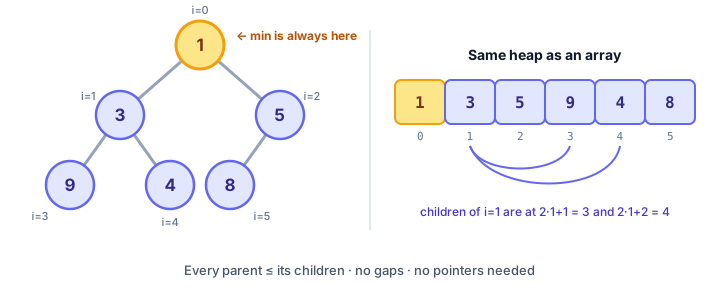 A min-heap as a tree and the same heap stored in an array
The array trick
Because the tree has no gaps, it fits perfectly in a plain array. No node objects needed:
For the node at index i | Formula |
|---|---|
| Parent | Math.floor((i - 1) / 2) |
| Left child | 2 * i + 1 |
| Right child | 2 * i + 2 |
Insert: add at the end, "bubble up"
Remove min: take the root, "sink down"
The tree's height is log n, so each bubble-up or sink-down takes at most O(log n) swaps.
A complete MinHeap in JavaScript
JavaScript has no built-in heap, so this is worth knowing by heart for interviews:
class MinHeap {
  #items = [];
  #compare;

  constructor(compare = (a, b) => a - b) {
    this.#compare = compare;
  }

  get size() { return this.#items.length; }
  peek() { return this.#items[0]; }

  push(value) {
    const items = this.#items;
    items.push(value);
    let i = items.length - 1;
    while (i > 0) {                                   // bubble up
      const parent = (i - 1) >> 1;
      if (this.#compare(items[i], items[parent]) >= 0) break;
      [items[i], items[parent]] = [items[parent], items[i]];
      i = parent;
    }
  }

  pop() {
    const items = this.#items;
    if (items.length === 0) return undefined;
    const top = items[0];
    const last = items.pop();
    if (items.length > 0) {
      items[0] = last;
      let i = 0;
      while (true) {                                  // sink down
        const left = 2 * i + 1, right = left + 1;
        let smallest = i;
        if (left < items.length && this.#compare(items[left], items[smallest]) < 0) smallest = left;
        if (right < items.length && this.#compare(items[right], items[smallest]) < 0) smallest = right;
        if (smallest === i) break;
        [items[i], items[smallest]] = [items[smallest], items[i]];
        i = smallest;
      }
    }
    return top;
  }
}

const heap = new MinHeap();
[5, 3, 8, 1, 9].forEach((n) => heap.push(n));
heap.pop(); // 1
heap.pop(); // 3
For a max-heap, pass (a, b) => b - a. For objects: (a, b) => a.priority - b.priority.
Pattern: Top K ⭐
"Find the k largest numbers in a stream of a million numbers."
Sorting is O(n log n). Better: keep a min-heap of size k. The heap's root is the smallest of the top k: anything smaller than it can't be in the top k.
function topK(nums, k) {
  const heap = new MinHeap();
  for (const n of nums) {
    heap.push(n);
    if (heap.size > k) heap.pop(); // kick out the smallest
  }
  const result = [];
  while (heap.size) result.push(heap.pop());
  return result.reverse();
}

topK([3, 1, 5, 12, 2, 11, 9], 3); // [12, 11, 9]
Time O(n log k), memory O(k). Great when k is small and n is huge (even a stream that doesn't fit in memory).
Pattern: merge K sorted lists
Put the first element of each list in a heap; repeatedly pop the smallest and push the next element from the same list. O(N log k) for N total elements. This is how databases and big-data tools merge sorted files.
Where heaps are used
- Task schedulers: run the job with the nearest deadline first (OS schedulers, BullMQ delayed jobs).
- Dijkstra's shortest path: always expand the closest unvisited node (Google Maps–style routing).
- Median of a stream: a max-heap for the lower half + a min-heap for the upper half.
- Rate limiters and timers: the next timer to fire sits at the root.
- Heap sort: O(n log n) sorting with O(1) extra memory.
Key takeaways
- A heap keeps the min (or max) at the root: peek O(1), push/pop O(log n).
- Stored in an array: children of
iare2i+1and2i+2, parent is(i-1)/2. - Insert = add at the end + bubble up. Remove = move last to root + sink down.
- Top K → min-heap of size k: O(n log k).
- Keywords in problems: k largest, k smallest, closest, most frequent, schedule, merge sorted.