Linked Lists
A chain of nodes where each node points to the next. Learn how they differ from arrays, and master reversal, fast/slow pointers and cycle detection.
The big idea
A treasure hunt: each clue tells you where the next clue is hidden. You can't jump to clue #7; you must follow the chain from clue #1. But adding a new clue in the middle is easy: just change where one clue points.
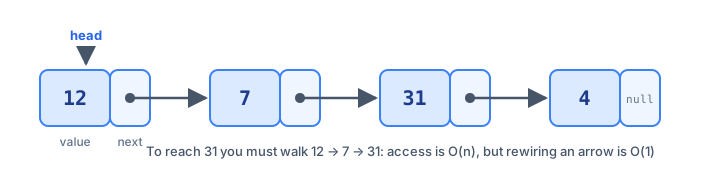 A linked list: each node holds a value and an arrow to the next node
class ListNode {
  constructor(value, next = null) {
    this.value = value;
    this.next = next;
  }
}

// 1 → 2 → 3 → null
const head = new ListNode(1, new ListNode(2, new ListNode(3)));
Array vs Linked List
| Operation | Array | Linked list |
|---|---|---|
| Access i-th element | O(1) | O(n): walk from the head |
| Insert/delete at start | O(n): shift everything | O(1): change one pointer |
| Insert/delete in middle (node known) | O(n) | O(1) |
| Memory layout | One contiguous block | Nodes scattered, linked by pointers |
| Cache friendliness | ✅ great | ❌ worse |
Insert after a node: just rewire two arrows.
function insertAfter(node, value) {
  node.next = new ListNode(value, node.next); // O(1)
}
Types of linked lists
Real uses: browser back/forward history (doubly), music playlist on repeat (circular), LRU caches (doubly linked list + hash map), undo stacks, OS task scheduling.
Technique 1: Traverse
function toArray(head) {
  const values = [];
  for (let node = head; node !== null; node = node.next) values.push(node.value);
  return values;
}
Technique 2: Reverse a linked list ⭐
The #1 linked-list interview question. Use three pointers: prev, current, next.
function reverse(head) {
  let prev = null;
  let current = head;
  while (current !== null) {
    const next = current.next; // 1. remember where to go
    current.next = prev;       // 2. flip the arrow
    prev = current;            // 3. step prev forward
    current = next;            // 4. step current forward
  }
  return prev; // new head
}
Time O(n), space O(1).
Technique 3: Fast & slow pointers (tortoise and hare)
Two pointers move through the list: slow moves 1 step, fast moves 2 steps.
Find the middle
When fast reaches the end, slow is exactly in the middle.
function middle(head) {
  let slow = head, fast = head;
  while (fast && fast.next) {
    slow = slow.next;
    fast = fast.next.next;
  }
  return slow;
}
Detect a cycle (Floyd's algorithm)
On a circular running track, a fast runner eventually laps the slow runner. If the list has a loop, fast and slow will meet; if not, fast hits null.
function hasCycle(head) {
let slow = head, fast = head;
while (fast && fast.next) {
slow = slow.next;
fast = fast.next.next;
if (slow === fast) return true; // 🏃♂️ lapped the 🐢
}
return false;
}
O(n) time and O(1) space, unlike storing visited nodes in a Set (O(n) space).
Technique 4: The dummy head
Many edge cases come from "what if I need to change the head?" A fake dummy node in front removes that special case.
// Merge two sorted lists: 1→3→5 + 2→4 → 1→2→3→4→5
function mergeSorted(a, b) {
  const dummy = new ListNode(0);
  let tail = dummy;
  while (a && b) {
    if (a.value <= b.value) { tail.next = a; a = a.next; }
    else { tail.next = b; b = b.next; }
    tail = tail.next;
  }
  tail.next = a ?? b; // attach the leftovers
  return dummy.next;
}
Common mistakes
- Losing the rest of the list: always save
current.nextbefore changing it. - Null pointer errors: check
node && node.nextbeforenode.next.next. - Forgetting to return the new head after reversing or deleting the first node.
- Drawing helps: sketch boxes and arrows on paper before coding. Seriously.
Key takeaways
- Linked lists trade O(1) index access for O(1) insert/delete at known positions.
- Reverse with
prev / current / next: save, flip, step, step. - Fast & slow pointers find the middle and detect cycles in O(1) space.
- A dummy head node removes edge cases around the first element.