Binary Search
Find anything in a sorted list of a billion items in about 30 steps. Learn the classic algorithm, its off-by-one traps, and the powerful "binary search on the answer" trick.
The big idea
The number-guessing game: "I'm thinking of a number between 1 and 100." The smart strategy is to guess 50. "Higher!" Guess 75. "Lower!" Guess 62… Every guess cuts the remaining options in half, so you always win in 7 guesses or fewer.
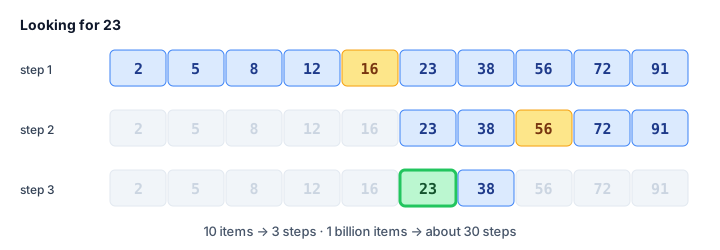 Binary search halves the search space at every step
| Items | Linear search (worst) | Binary search (worst) |
|---|---|---|
| 100 | 100 | 7 |
| 1,000,000 | 1,000,000 | 20 |
| 1,000,000,000 | 1,000,000,000 | 30 |
⚠️ Binary search needs sorted data (or, more generally, a yes/no condition that flips only once).
The classic algorithm
function binarySearch(sorted, target) {
  let lo = 0;
  let hi = sorted.length - 1;

  while (lo <= hi) {                        // search space [lo, hi] is not empty
    const mid = lo + Math.floor((hi - lo) / 2);
    if (sorted[mid] === target) return mid;
    if (sorted[mid] < target) lo = mid + 1; // target is in the right half
    else hi = mid - 1;                      // target is in the left half
  }
  return -1;                                 // not found
}

binarySearch([2, 5, 8, 12, 16, 23, 38, 56, 72, 91], 23); // 5
The three classic bugs
| Bug | Wrong | Right |
|---|---|---|
| Loop condition | while (lo < hi) with hi = length - 1 misses the last element | while (lo <= hi) |
| Infinite loop | lo = mid or hi = mid can stop shrinking | lo = mid + 1, hi = mid - 1 |
| Overflow (other languages) | (lo + hi) / 2 overflows on huge ints | lo + (hi - lo) / 2 |
💡 Test with tiny arrays:
[],[1],[1, 2], and a target smaller than, larger than, and missing from the array. Off-by-one bugs show up immediately.
Variation: find the first / last position
"Find the first index where x appears" in [1, 2, 2, 2, 3]. When you find a match, don't stop: record it and keep searching left.
function firstIndexOf(sorted, target) {
  let lo = 0, hi = sorted.length - 1, answer = -1;
  while (lo <= hi) {
    const mid = lo + ((hi - lo) >> 1);
    if (sorted[mid] >= target) {
      if (sorted[mid] === target) answer = mid;
      hi = mid - 1; // keep looking left
    } else {
      lo = mid + 1;
    }
  }
  return answer;
}

firstIndexOf([1, 2, 2, 2, 3], 2); // 1
The real superpower: search on a condition
Binary search works on anything where a yes/no question flips exactly once:
index:      0     1     2     3     4     5     6
condition:  ❌    ❌    ❌    ✅    ✅    ✅    ✅
                              ↑ find the first ✅
// Generic: smallest x in [lo, hi] where isOk(x) is true
function firstTrue(lo, hi, isOk) {
  while (lo < hi) {
    const mid = lo + ((hi - lo) >> 1);
    if (isOk(mid)) hi = mid;    // mid might be the answer; keep it
    else lo = mid + 1;
  }
  return lo;
}
Example: first bad version
Versions 1..n; from some version on, every build is broken. Find the first broken one with the fewest checks.
const firstBad = firstTrue(1, n, (version) => isBadVersion(version));
This is exactly what git bisect does to find the commit that introduced a bug!
Example: binary search on the answer ⭐
"Ship packages (in order) within D days. What's the minimum truck capacity?" The answer lies between the heaviest package and the total weight. If capacity C works, every bigger capacity works too, so the condition flips once. Binary search the capacity:
function minCapacity(weights, days) {
  const canShip = (capacity) => {
    let neededDays = 1, load = 0;
    for (const w of weights) {
      if (load + w > capacity) { neededDays++; load = 0; }
      load += w;
    }
    return neededDays <= days;
  };
  const lo = Math.max(...weights);
  const hi = weights.reduce((a, b) => a + b, 0);
  return firstTrue(lo, hi, canShip);
}

minCapacity([1, 2, 3, 4, 5, 6, 7, 8, 9, 10], 5); // 15
Recognise it when a problem asks for the minimum or maximum value that satisfies a condition: "minimum speed", "smallest capacity", "maximum distance".
Rotated sorted arrays
[15, 18, 22, 3, 7, 10] was sorted, then rotated. At every step, one half is still sorted; check if the target lies in that half.
function searchRotated(nums, target) {
  let lo = 0, hi = nums.length - 1;
  while (lo <= hi) {
    const mid = (lo + hi) >> 1;
    if (nums[mid] === target) return mid;
    if (nums[lo] <= nums[mid]) {                     // left half is sorted
      if (nums[lo] <= target && target < nums[mid]) hi = mid - 1;
      else lo = mid + 1;
    } else {                                         // right half is sorted
      if (nums[mid] < target && target <= nums[hi]) lo = mid + 1;
      else hi = mid - 1;
    }
  }
  return -1;
}
Key takeaways
- Binary search = halve the search space each step = O(log n).
- Needs sorted data, or any condition that flips from ❌ to ✅ exactly once.
- Watch the classic bugs:
<=vs<, and always move withmid ± 1. - "Binary search on the answer" solves many minimum/maximum that works problems.
git bisectand database B-tree indexes use the same idea.