Dynamic Programming
DP means solving a big problem by remembering the answers to its smaller overlapping sub-problems. A friendly, step-by-step guide with tables you can picture.
The big idea
A teacher writes 1 + 1 + 1 + 1 + 1 + 1 + 1 + 1 on the board. "What's the answer?" You count: 8. She adds + 1 at the end. "And now?" You instantly say 9. You didn't recount; you remembered the previous answer.
📘 Dynamic Programming (DP) = "Don't solve the same sub-problem twice. Remember it."
A problem is a good fit for DP when it has:
- Overlapping sub-problems: the same smaller questions come up again and again.
- Optimal substructure: the best answer can be built from the best answers to smaller questions.
Two ways to do DP
| Top-down (memo) | Bottom-up (table) | |
|---|---|---|
| Style | Recursion + cache | Loop + array |
| Easier to write? | ✅ Usually (follows the recursive idea) | Needs the right fill order |
| Stack overflow risk | Yes, on deep inputs | No |
| Can save memory? | Harder | ✅ Often keep only the last row |
Example 1: climbing stairs ⭐
You can climb 1 or 2 steps at a time. How many different ways are there to climb n steps?
Think: to stand on step n, your last move was either from step n-1 (a 1-step) or from step n-2 (a 2-step). So:
ways(n) = ways(n - 1) + ways(n - 2)
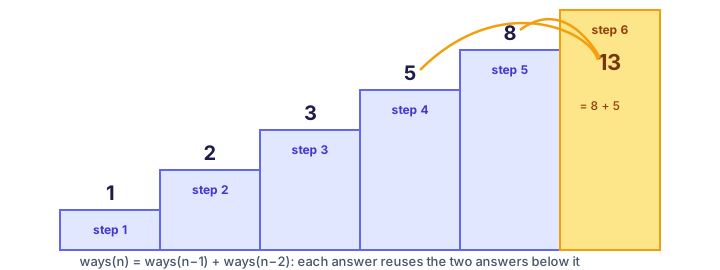 Climbing stairs: the ways to reach each step are the sum of the two steps below it
Top-down:
function climbStairs(n, memo = new Map()) {
  if (n <= 2) return n;                    // 1 way for 1 step, 2 ways for 2 steps
  if (memo.has(n)) return memo.get(n);
  const ways = climbStairs(n - 1, memo) + climbStairs(n - 2, memo);
  memo.set(n, ways);
  return ways;
}
Bottom-up (with O(1) memory):
function climbStairs(n) {
  if (n <= 2) return n;
  let twoBelow = 1, oneBelow = 2;
  for (let step = 3; step <= n; step++) {
    [twoBelow, oneBelow] = [oneBelow, twoBelow + oneBelow];
  }
  return oneBelow;
}
climbStairs(10); // 89
The 5-step DP recipe
Step 1 is the hardest and the most important. Write the meaning of dp[i] as a sentence before coding.
Example 2: coin change
Coins [1, 3, 4]. What is the fewest number of coins that make 6?
Greedy (always take the biggest coin) fails: 4 + 1 + 1 = 3 coins, but 3 + 3 = 2 coins.
- State:
dp[a]= fewest coins that make amounta. - Recurrence:
dp[a] = 1 + min(dp[a - coin])for every coin ≤ a. - Base:
dp[0] = 0. - Order: amounts 1, 2, 3, … up to the target.
- Answer:
dp[target].
function coinChange(coins, amount) {
  const dp = new Array(amount + 1).fill(Infinity);
  dp[0] = 0;
  for (let a = 1; a <= amount; a++) {
    for (const coin of coins) {
      if (coin <= a) dp[a] = Math.min(dp[a], dp[a - coin] + 1);
    }
  }
  return dp[amount] === Infinity ? -1 : dp[amount];
}

coinChange([1, 3, 4], 6); // 2
| amount | 0 | 1 | 2 | 3 | 4 | 5 | 6 |
|---|---|---|---|---|---|---|---|
| dp | 0 | 1 | 2 | 1 | 1 | 2 | 2 |
| how | – | 1 | 1+1 | 3 | 4 | 4+1 | 3+3 |
Example 3: a 2D table, longest common subsequence
Longest sequence of characters appearing in the same order in both strings. "ABCDE" and "ACE" → "ACE", length 3. Used by git diff and DNA comparison.
State: dp[i][j] = LCS length of the first i chars of a and the first j chars of b.
function lcs(a, b) {
  const dp = Array.from({ length: a.length + 1 }, () => new Array(b.length + 1).fill(0));
  for (let i = 1; i <= a.length; i++) {
    for (let j = 1; j <= b.length; j++) {
      dp[i][j] = a[i - 1] === b[j - 1]
        ? dp[i - 1][j - 1] + 1                 // chars match: extend the diagonal
        : Math.max(dp[i - 1][j], dp[i][j - 1]); // skip a char from one string
    }
  }
  return dp[a.length][b.length];
}
| "" | A | C | E | |
|---|---|---|---|---|
| "" | 0 | 0 | 0 | 0 |
| A | 0 | 1 ↘ | 1 | 1 |
| B | 0 | 1 | 1 | 1 |
| C | 0 | 1 | 2 ↘ | 2 |
| D | 0 | 1 | 2 | 2 |
| E | 0 | 1 | 2 | 3 ↘ |
Common DP families
| Family | Example problems | State usually looks like |
|---|---|---|
| 1D sequence | Climbing stairs, house robber, max subarray | dp[i] = best answer using the first i items |
| Knapsack | Coin change, subset sum, 0/1 knapsack | dp[capacity] or dp[i][capacity] |
| Two strings | LCS, edit distance, regex matching | dp[i][j] over prefixes of both strings |
| Grid paths | Unique paths, minimum path sum | dp[row][col] |
| Intervals | Burst balloons, palindrome partitioning | dp[left][right] |
Bonus: house robber
Rob houses in a row for maximum money, but never two neighbours.
State: at each house, keep two numbers: the best total if we skip this house, and the best total if we rob it.
function rob(houses) {
  let bestIfSkipped = 0; // best total so far when the previous house was NOT robbed
  let bestIfRobbed = 0;  // best total so far when the previous house WAS robbed

  for (const money of houses) {
    const skipThis = Math.max(bestIfSkipped, bestIfRobbed); // free to do either before
    const robThis = bestIfSkipped + money;                  // neighbour must be skipped
    bestIfSkipped = skipThis;
    bestIfRobbed = robThis;
  }
  return Math.max(bestIfSkipped, bestIfRobbed);
}
rob([2, 7, 9, 3, 1]); // 12 → 2 + 9 + 1
How to spot a DP problem
Keywords: "number of ways", "minimum/maximum", "longest/shortest", "can you reach / is it possible", and choices at each step that affect the future.
💡 Workflow that always works: write the plain recursive solution → notice repeated calls → add a memo (top-down DP) → optionally convert it to a table (bottom-up).
Key takeaways
- DP = recursion + remembering answers to overlapping sub-problems.
- Top-down (memoisation) is easiest to write; bottom-up (tabulation) avoids deep recursion and can save memory.
- Always start by writing what
dp[i]means in plain words. - Greedy "take the biggest" often fails; DP checks all options efficiently.
- It can turn O(2ⁿ) brute force into O(n) or O(n × m).