Stacks & Queues
Stacks are last-in-first-out, queues are first-in-first-out. Two simple structures behind undo buttons, browser history, task scheduling and many interview problems.
The big idea
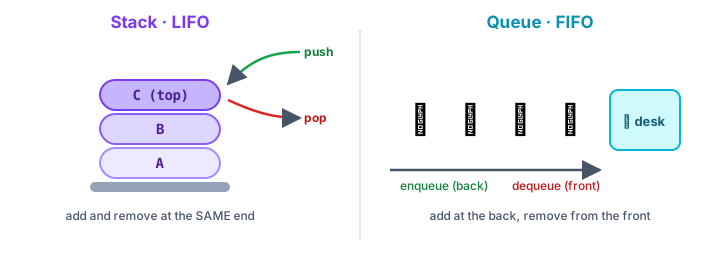 A stack of plates (last in, first out) and a queue at a ticket counter (first in, first out)
- Stack (LIFO — Last In, First Out): a pile of plates. You add to the top and take from the top.
- Queue (FIFO — First In, First Out): a line at a coffee shop. First to arrive, first to be served.
Stack
| Operation | Meaning | JS | Cost |
|---|---|---|---|
push(x) | put on top | arr.push(x) | O(1) |
pop() | take from top | arr.pop() | O(1) |
peek() | look at top | arr.at(-1) | O(1) |
isEmpty() | arr.length === 0 | O(1) |
const stack = [];
stack.push("a"); // ["a"]
stack.push("b"); // ["a", "b"]
stack.pop();     // "b" → ["a"]
Where stacks appear
The call stack
Every time a function calls another, JavaScript pushes a frame onto the call stack. When a function returns, its frame is popped.
function a() { b(); }
function b() { c(); }
function c() { console.trace(); }
a();
Infinite recursion keeps pushing frames until: "RangeError: Maximum call stack size exceeded". That's a stack overflow.
Classic problem: valid parentheses ⭐
"({[]})" ✅ · "([)]" ❌ · "((" ❌
function isValid(s) {
  const pairs = { ")": "(", "]": "[", "}": "{" };
  const stack = [];
  for (const ch of s) {
    if ("([{".includes(ch)) stack.push(ch);            // opener → push
    else if (stack.pop() !== pairs[ch]) return false;  // closer must match the top
  }
  return stack.length === 0; // nothing left open
}
Monotonic stack: "next greater element"
For each number, find the next number to the right that is bigger. Brute force is O(n²); a stack does it in O(n).
function nextGreater(nums) {
  const result = new Array(nums.length).fill(-1);
  const stack = []; // indexes still waiting for a bigger number
  for (let i = 0; i < nums.length; i++) {
    while (stack.length && nums[i] > nums[stack.at(-1)]) {
      result[stack.pop()] = nums[i];
    }
    stack.push(i);
  }
  return result;
}
nextGreater([2, 1, 5, 3, 6]); // [5, 5, 6, 6, -1]
Used for "daily temperatures", "stock span" and "largest rectangle in histogram".
Queue
| Operation | Meaning | Cost (proper queue) |
|---|---|---|
enqueue(x) | join the back | O(1) |
dequeue() | leave the front | O(1) |
peek() | look at the front | O(1) |
⚠️ JavaScript trap:
arr.shift()is O(n) because every element moves. Fine for small arrays; slow for big queues.
An O(1) queue
class Queue {
  #items = new Map();
  #head = 0;
  #tail = 0;

  enqueue(value) { this.#items.set(this.#tail++, value); }
  dequeue() {
    if (this.#head === this.#tail) return undefined;
    const value = this.#items.get(this.#head);
    this.#items.delete(this.#head++);
    return value;
  }
  get size() { return this.#tail - this.#head; }
}
Where queues appear
Queue flavours
| Type | Rule | Example |
|---|---|---|
| Queue | First in, first out | Ticket line |
| Deque (double-ended) | Add/remove at both ends | Sliding window maximum |
| Priority queue | Highest priority out first | ER triage, Dijkstra (see Heaps) |
| Circular buffer | Fixed size, wraps around | Audio buffers, recent logs |
Stack vs Queue in search
The only difference between depth-first and breadth-first search is the container:
You'll see this in the Graphs lesson.
Key takeaways
- Stack = LIFO (plates).
push/popon a JS array are O(1). - Queue = FIFO (a line). Avoid
shift()on large arrays; use a proper queue. - Stacks: undo, call stack, bracket matching, DFS, monotonic-stack problems.
- Queues: task scheduling, message brokers, the event loop, BFS.