Big-O Notation Made Simple
Big-O describes how an algorithm's time or memory grows as the input grows. Learn the 7 common complexities with pictures and how to calculate them.
The big idea
You need to deliver letters to houses on a street.
- O(1): you have one letter for the first house. Doesn't matter if the street has 10 or 10,000 houses.
- O(n): one letter for every house. Double the houses, double the work.
- O(n²): at every house, you walk back to visit every other house. Double the houses, 4× the work.
Big-O answers: "If my input gets 10× bigger, how much slower does my code get?" It ignores exact seconds (which depend on your computer) and focuses on the growth shape.
The growth curves
From bottom to top: O(1), O(log n), O(n), O(n log n), O(n²). The steepest curve explodes fastest.
| Big-O | Name | n = 1,000 → operations | Example |
|---|---|---|---|
| O(1) | Constant | 1 | Array index arr[5], hash map lookup |
| O(log n) | Logarithmic | ~10 | Binary search |
| O(n) | Linear | 1,000 | Loop over an array once |
| O(n log n) | Linearithmic | ~10,000 | Good sorting (merge sort, Array.sort) |
| O(n²) | Quadratic | 1,000,000 | Nested loops over the same array |
| O(2ⁿ) | Exponential | 10³⁰⁰ 💀 | Naive recursive Fibonacci, all subsets |
| O(n!) | Factorial | 💀💀 | All permutations (brute-force travelling salesman) |
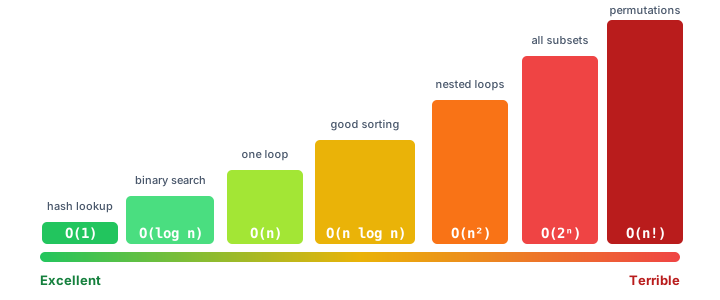 Big-O ladder: from excellent to terrible
Recognising complexity in code
// O(1): same work no matter how big the array is
function first(arr) {
  return arr[0];
}

// O(n): one pass
function sum(arr) {
  let total = 0;
  for (const x of arr) total += x;
  return total;
}

// O(n²): nested loops over the same input
function hasDuplicate(arr) {
  for (let i = 0; i < arr.length; i++) {
    for (let j = i + 1; j < arr.length; j++) {
      if (arr[i] === arr[j]) return true;
    }
  }
  return false;
}

// O(log n): the problem is cut in half every step
function binarySearch(sorted, target) {
  let lo = 0, hi = sorted.length - 1;
  while (lo <= hi) {
    const mid = (lo + hi) >> 1;
    if (sorted[mid] === target) return mid;
    if (sorted[mid] < target) lo = mid + 1;
    else hi = mid - 1;
  }
  return -1;
}
Why is halving "log n"?
You can only halve 1,000,000 about 20 times before reaching 1. log₂(1,000,000) ≈ 20. That's why binary search is so fast.
The 4 rules for calculating Big-O
1. Drop constants. O(2n) → O(n). Two loops one after another are still linear.
arr.forEach(log); // n
arr.forEach(log); // n  → O(2n) = O(n)
2. Drop smaller terms. O(n² + n) → O(n²). For huge n, the n² part dominates everything.
3. Different inputs get different letters.
function printPairs(colors, sizes) {
  for (const c of colors) for (const s of sizes) console.log(c, s); // O(a × b), not O(n²)
}
4. Sequential steps add, nested steps multiply.
Watch out: hidden loops
Some one-liners hide a loop inside:
| Code | Cost |
|---|---|
arr.includes(x), arr.indexOf(x) | O(n) |
arr.slice(), [...arr], arr.concat() | O(n) |
arr.shift(), arr.unshift(x) | O(n): every element moves |
arr.sort() | O(n log n) |
str1 + str2 in a loop | may be O(n) each time |
set.has(x), map.get(k) | O(1) average ✅ |
arr.push(x), arr.pop() | O(1) amortised ✅ |
// Looks like O(n), is actually O(n²): includes() loops inside the loop
const unique = [];
for (const x of arr) if (!unique.includes(x)) unique.push(x);

// ✅ O(n) with a Set
const uniqueFast = [...new Set(arr)];
Space complexity
Big-O also measures extra memory:
// O(1) space: a few variables, no matter the input size
function max(arr) { let m = -Infinity; for (const x of arr) m = Math.max(m, x); return m; }

// O(n) space: builds a new array as big as the input
function doubled(arr) { return arr.map((x) => x * 2); }
💡 Recursion uses space too: each pending call sits on the call stack. A recursion 10,000 levels deep uses O(10,000) stack space and may crash with "Maximum call stack size exceeded".
Best, average and worst case
Big-O usually describes the worst case, because that's the one that wakes you up at 3 a.m.
- Searching an unsorted array: best O(1) (it's the first item), worst O(n) (it's last or missing).
- Quick sort: average O(n log n), worst O(n²) with bad pivots.
Key takeaways
- Big-O = how work grows with input size, not exact time.
- Memorise the ladder: 1 < log n < n < n log n < n² < 2ⁿ < n!
- Drop constants and smaller terms; add sequential steps, multiply nested ones.
- Watch for hidden loops like
includes,shiftandsliceinside loops. - Hash maps and sets turn many O(n) lookups into O(1). That's the next lessons' superpower.