Sorting Algorithms
From simple bubble sort to merge sort and quick sort. See how each one works, compare their speeds, and learn which one JavaScript's sort() actually uses.
The big idea
Sorting a hand of playing cards, organising books by title, ranking search results: sorting is one of the most common things computers do. Different algorithms trade simplicity, speed and memory.
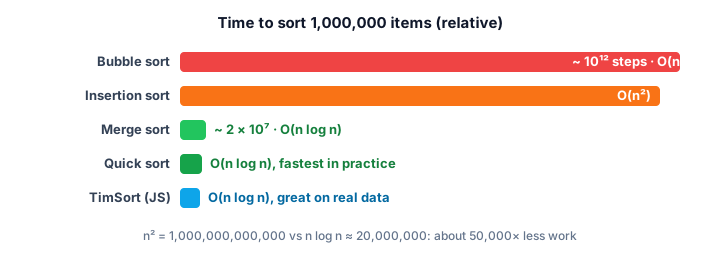 How the main sorting algorithms compare
| Algorithm | Best | Average | Worst | Extra memory | Stable? |
|---|---|---|---|---|---|
| Bubble sort | O(n) | O(n²) | O(n²) | O(1) | ✅ |
| Selection sort | O(n²) | O(n²) | O(n²) | O(1) | ❌ |
| Insertion sort | O(n) | O(n²) | O(n²) | O(1) | ✅ |
| Merge sort | O(n log n) | O(n log n) | O(n log n) | O(n) | ✅ |
| Quick sort | O(n log n) | O(n log n) | O(n²) | O(log n) | ❌ |
| Heap sort | O(n log n) | O(n log n) | O(n log n) | O(1) | ❌ |
| Counting sort | O(n + k) | O(n + k) | O(n + k) | O(k) | ✅ |
💡 Stable means equal items keep their original order. Sort users by city with a stable sort and, within each city, they stay in their previous order (for example, alphabetical). That matters when you sort by several keys.
The simple O(n²) sorts
Bubble sort: big items "bubble" to the end
Compare neighbours and swap if they're in the wrong order. After each pass, the largest remaining item has floated to the end.
function bubbleSort(arr) {
  for (let end = arr.length - 1; end > 0; end--) {
    let swapped = false;
    for (let i = 0; i < end; i++) {
      if (arr[i] > arr[i + 1]) {
        [arr[i], arr[i + 1]] = [arr[i + 1], arr[i]];
        swapped = true;
      }
    }
    if (!swapped) break; // already sorted → O(n) best case
  }
  return arr;
}
Insertion sort: like sorting playing cards in your hand
Take the next card and slide it left until it's in the right place.
function insertionSort(arr) {
  for (let i = 1; i < arr.length; i++) {
    const card = arr[i];
    let j = i - 1;
    while (j >= 0 && arr[j] > card) {
      arr[j + 1] = arr[j]; // shift bigger cards right
      j--;
    }
    arr[j + 1] = card;
  }
  return arr;
}
Insertion sort is very fast for small or nearly sorted arrays. That's why real-world sorts use it for small chunks.
Merge sort: divide and conquer
📚 Analogy: Two friends each sort half a pile of exam papers. Then you merge the two sorted piles by repeatedly taking the smaller top paper.
- Divide: split the array in half until each piece has 1 item (a single item is already sorted).
- Conquer: merge pairs of sorted pieces back together.
function mergeSort(arr) {
  if (arr.length <= 1) return arr;
  const mid = arr.length >> 1;
  return merge(mergeSort(arr.slice(0, mid)), mergeSort(arr.slice(mid)));
}

function merge(left, right) {
  const result = [];
  let i = 0, j = 0;
  while (i < left.length && j < right.length) {
    result.push(left[i] <= right[j] ? left[i++] : right[j++]); // <= keeps it stable
  }
  return result.concat(left.slice(i), right.slice(j));
}
Why n log n? The array is halved log n times (the tree's height), and each level does O(n) merging work.
Quick sort: pick a pivot, partition
🎓 Analogy: A teacher says "everyone shorter than Sam, stand left; taller, stand right." Then each group does the same, recursively.
// Readable version (uses extra arrays)
function quickSort(arr) {
  if (arr.length <= 1) return arr;
  const pivot = arr[arr.length >> 1];
  const less = arr.filter((x) => x < pivot);
  const equal = arr.filter((x) => x === pivot);
  const greater = arr.filter((x) => x > pivot);
  return [...quickSort(less), ...equal, ...quickSort(greater)];
}
Real implementations partition in place (O(log n) memory) and pick a random or "median of three" pivot. Always choosing the first element as pivot on already-sorted data creates the O(n²) worst case.
What does JavaScript's sort() use?
V8 (Chrome, Node.js) uses TimSort: a hybrid of merge sort and insertion sort. It's stable, O(n log n), and very fast on real-world data that is often partly sorted.
// ⚠️ Default sort compares as STRINGS
[10, 9, 1, 100].sort();                 // [1, 10, 100, 9] 😱

// ✅ Always pass a comparator for numbers
[10, 9, 1, 100].sort((a, b) => a - b);  // [1, 9, 10, 100]

// Sort objects by several keys (stable sort makes this work)
users.sort((a, b) => a.city.localeCompare(b.city) || b.age - a.age);

// Don't mutate the original: toSorted() (ES2023)
const sorted = prices.toSorted((a, b) => a - b);
Counting sort: beating n log n
Comparison sorts can't beat O(n log n). But if values are small integers in a known range (ages, exam scores 0–100), you can just count them:
function countingSort(nums, max) {
  const counts = new Array(max + 1).fill(0);
  for (const n of nums) counts[n]++;
  return counts.flatMap((count, value) => Array(count).fill(value));
}
countingSort([3, 1, 2, 3, 0, 1], 3); // [0, 1, 1, 2, 3, 3] in O(n + k)
Key takeaways
- Simple sorts (bubble, insertion, selection) are O(n²). Insertion sort shines on small or nearly sorted data.
- Merge sort: always O(n log n), stable, needs O(n) memory.
- Quick sort: O(n log n) on average, in place, O(n²) with bad pivots.
- JavaScript's
sort()is TimSort (stable). Always pass a comparator for numbers. - Counting sort beats n log n for small integer ranges.