React vs Vue vs Angular
The same counter in three frameworks, a side-by-side comparison of reactivity, templates, state and tooling, and a simple way to choose between them.
The big idea
Three ways to furnish a home:
- React 🧱 = a box of LEGO: a flexible core (UI components) and you pick the other pieces yourself (router, state, forms). Huge community.
- Vue 🪑 = a well-designed starter kit: friendly, gentle learning curve, official router and state library included.
- Angular 🏢 = a fully furnished office: everything built in (router, forms, HTTP, DI, testing), with strong conventions. Great for large enterprise teams.
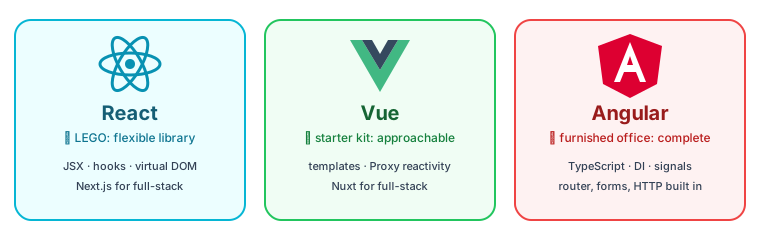 React, Vue and Angular at a glance
The same counter, three ways
React
import { useState } from "react";

export function Counter() {
  const [count, setCount] = useState(0);
  const double = count * 2;
  return (
    <button onClick={() => setCount(count + 1)}>
      Clicked {count} times (double: {double})
    </button>
  );
}
Vue 3 (Composition API, single-file component)
<script setup>
import { ref, computed } from "vue";

const count = ref(0);
const double = computed(() => count.value * 2);
</script>

<template>
  <button @click="count++">Clicked {{ count }} times (double: {{ double }})</button>
</template>

<style scoped>
button { font-weight: bold; }
</style>
Angular (standalone component with signals)
import { Component, signal, computed } from "@angular/core";

@Component({
  selector: "app-counter",
  standalone: true,
  template: `
    <button (click)="increment()">
      Clicked {{ count() }} times (double: {{ double() }})
    </button>
  `,
})
export class CounterComponent {
  count = signal(0);
  double = computed(() => this.count() * 2);
  increment() {
    this.count.update((c) => c + 1);
  }
}
How reactivity works
The biggest difference is how each framework knows what to update.
Drawing diagram…
- React re-renders the component and diffs the result. Simple mental model; sometimes needs memoisation.
- Vue wraps state in Proxies (remember the Proxy pattern?) and tracks exactly which template parts read which values: fine-grained updates with no memoisation.
- Angular historically checked the whole tree after every event (zone.js); modern Angular uses signals for fine-grained updates, much like Vue.
Side-by-side
| React | Vue | Angular | |
|---|---|---|---|
| Type | UI library | Progressive framework | Full framework |
| Maintained by | Meta + community | Evan You + community | |
| Templates | JSX (JavaScript) | HTML templates (v-if, v-for) or JSX | HTML templates (@if, @for) |
| Language | JS or TS | JS or TS | TypeScript (required) |
| Reactivity | Re-render + diff | Proxy-based tracking | Signals |
| State management | Many choices (Zustand, Redux, TanStack Query) | Pinia (official) | Services + signals, NgRx |
| Routing | React Router / Next.js | Vue Router (official) | Built in |
| Forms, HTTP, DI | Pick libraries | Pick libraries | ✅ Built in |
| Meta-framework | Next.js, Remix | Nuxt | Angular SSR / Analog |
| Learning curve | Medium | Gentle | Steeper |
| Job market | Largest | Strong (esp. Asia and Europe) | Strong in enterprise |
Concepts map across frameworks
Once you know one, the others are mostly new syntax:
| Concept | React | Vue | Angular |
|---|---|---|---|
| Local state | useState | ref / reactive | signal |
| Derived value | compute in render / useMemo | computed | computed |
| Side effect | useEffect | watch / watchEffect | effect |
| Props in | props | defineProps | input() |
| Events out | callback props | defineEmits / $emit | output() |
| Conditional | {cond && <X/>} | v-if | @if |
| List | items.map(...) | v-for | @for |
| Shared logic | custom hooks | composables | services |
| Global state | Context / stores | Pinia | injectable services |
How to choose
Drawing diagram…
💡 The skills transfer. Components, props, state, derived values, effects, routing and data fetching exist in all three. Learn the concepts deeply in one; switching later takes days, not months.
Key takeaways
- React: a flexible UI library with the biggest ecosystem; pair it with Next.js.
- Vue: approachable, fine-grained reactivity through Proxies, official router and Pinia; pair it with Nuxt.
- Angular: a complete, opinionated, TypeScript-first framework for large teams; now with signals.
- The core concepts are the same everywhere. Choose based on team, project size and ecosystem.