What Is Software Architecture?
Architecture is the set of big decisions that are expensive to change later. Learn quality attributes, trade-offs, the main architecture styles, and how to record decisions with ADRs.
The big idea
Building a house, you can repaint a room in an afternoon. Moving the staircase, the plumbing or the foundations is a different story: it's slow, expensive and risky.
Software architecture is about the "staircase and foundations" decisions of a system: the ones that are hard to change later.
📘 "Architecture is about the important stuff. Whatever that is." (Ralph Johnson)
📘 "Architecture represents the significant design decisions that shape a system, where significant is measured by cost of change." (Grady Booch)
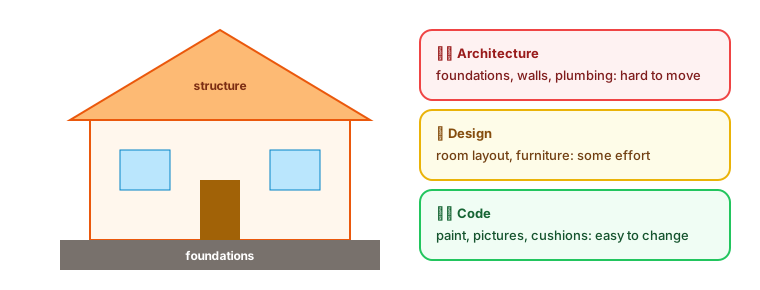 Architecture vs design: foundations and structure vs furniture and paint
Architecture vs design vs code
| Level | Question | Examples | Cost to change |
|---|---|---|---|
| Architecture | How is the whole system shaped? | Monolith or microservices, layers, sync vs async, which database, where the business logic lives | 🔴 High |
| Design | How is one part organised? | Classes, patterns (Strategy, Repository), module APIs | 🟡 Medium |
| Code | How is one thing implemented? | Loops, names, functions | 🟢 Low |
The lines are blurry, and that's fine. What matters is noticing when a decision will be expensive to reverse, and giving it more thought.
Quality attributes: the "-ilities"
Features describe what a system does. Quality attributes describe how well it does it. Architecture is mostly driven by these.
| Attribute | Question | Example requirement |
|---|---|---|
| Performance | How fast? | p95 page load under 300 ms |
| Scalability | Can it grow? | Handle 10× traffic on Black Friday |
| Availability | Is it up? | 99.9% uptime |
| Maintainability | Is it easy to change? | New payment method in under a week |
| Testability | Can we verify it quickly? | Business rules testable without a database |
| Security | Is it protected? | No customer can read another customer's orders |
| Deployability | Can we ship safely and often? | Deploy many times per day with no downtime |
| Cost | Can we afford it? | Infrastructure under $2,000/month |
Everything is a trade-off
🎯 "Everything in software architecture is a trade-off." (Neal Ford & Mark Richards, Fundamentals of Software Architecture)
Improving one attribute usually costs another:
| You gain… | You often pay with… |
|---|---|
| Scalability (microservices) | Simplicity, consistency, operating cost |
| Performance (caching) | Freshness of data, complexity |
| Flexibility (many abstraction layers) | Readability, speed of development |
| Consistency (one big transaction) | Availability and scaling |
| Time to market (quick monolith) | Future flexibility |
A good architect doesn't look for the "best" architecture. They look for the least bad set of trade-offs for this product, this team and this stage.
The main architecture styles (this course)
| Group | Styles | Answers |
|---|---|---|
| Application architecture | Layered, MVC/MVVM, Clean, Hexagonal, Onion, Vertical Slice | How is the code inside one application organised? |
| Domain modelling | Domain-Driven Design | How do we model the business, and where are the boundaries? |
| System architecture | Monolith, modular monolith, microservices, event-driven, microkernel, serverless | How is the whole system split and deployed? How do parts communicate? |
These combine. A common, healthy combination: a modular monolith, split along DDD bounded contexts, where each module uses Hexagonal/Clean architecture inside, and modules talk through events.
Recording decisions: ADRs
Six months from now, someone will ask "Why on earth did we pick MongoDB?" An Architecture Decision Record (ADR) answers that. It's a short document, one per decision, kept in the repo.
# ADR-007: Use PostgreSQL for the orders service

## Status
Accepted (2026-09-28)

## Context
Orders need multi-row transactions (order + lines + stock reservation).
The team knows SQL well. Expected volume: 50k orders/day.

## Decision
Use PostgreSQL 17 (managed, Amazon RDS).

## Consequences
+ ACID transactions, mature tooling, team familiarity
+ JSONB covers the few flexible fields
- Horizontal write scaling needs work later (partitioning / Citus)

## Alternatives considered
- MongoDB: flexible schema, but weaker multi-document transactions for our use case
- DynamoDB: great scale, but complex queries and more vendor lock-in
docs/adr/
├── 0001-record-architecture-decisions.md
├── 0006-modular-monolith-first.md
└── 0007-postgresql-for-orders.md
💡 Never edit an old ADR to change the decision. Write a new one that supersedes it. The history of why is the valuable part.
Architecture diagrams: the C4 model
The C4 model (Simon Brown) draws architecture at four zoom levels, like a map app:
| Level | Shows | Audience |
|---|---|---|
| 1. Context | The system, its users and external systems | Everyone |
| 2. Container | Apps, databases, queues inside the system | Developers, ops |
| 3. Component | Main modules inside one container | Developers |
| 4. Code | Classes (usually generated or skipped) | Rarely needed |
A C4 level-1 context diagram: the system as one box, with its people and neighbours.
Key takeaways
- Architecture = the significant decisions that are expensive to change.
- It's driven by quality attributes (scalability, maintainability, testability…), not just features.
- Every choice is a trade-off; aim for the least bad set for your context.
- Styles work at different levels: inside an app (Layered, Clean, Hexagonal, Onion), the domain (DDD), and the whole system (microservices, event-driven, serverless).
- Record decisions in ADRs and draw them with the C4 model.