Choosing an Architecture
A practical decision guide. Compare every style in this course on one page, match them to your team, domain and scale, see how they combine, and learn how to evolve an architecture over time.
The big idea
There's no "best vehicle". A bicycle, a van, a bus and a plane are each perfect for some journeys and silly for others. Choosing an architecture is the same: match the style to the journey you're actually making, meaning your domain, team, scale and stage.
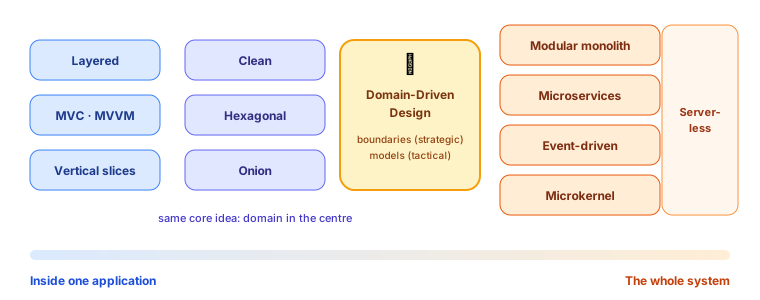 Architecture styles on one map: from inside one app to the whole system
Two decisions, not one
Most confusion comes from mixing two separate questions:
You pick an answer to each question. For example: a modular monolith (1), with Hexagonal modules (2), cut along DDD bounded contexts (3), talking via in-process events.
All the styles on one page
Code organisation (inside one application)
| Style | Core idea | Best for | Watch out for |
|---|---|---|---|
| Layered | Presentation → business → data | Simple/CRUD apps, new teams | Business logic depends on the DB; changes cross all layers |
| MVC / MVVM | Separate view from model and logic | UI code (server pages, SPAs, mobile) | Only covers presentation |
| Clean | Circles; dependencies point inward; use cases | Rich business logic, long-lived apps | Ceremony for simple CRUD |
| Hexagonal | Core + ports; adapters on driving and driven sides | Many entry points, swappable integrations, testability | Ports for things that never change |
| Onion | Rings around the domain model | Domain-centric apps (.NET heritage) | Same as Clean |
| Vertical slices | Organise by feature, top to bottom | Feature-heavy apps, CQRS, fast iteration | Duplication without a shared domain |
System shape
| Style | Core idea | Best for | Watch out for |
|---|---|---|---|
| Monolith | One deployable | Early products, small teams | Turning into a big ball of mud |
| Modular monolith | One deployable, strict modules | ✅ Most teams, most of the time | Needs boundary enforcement |
| Microservices | Independently deployable services | Many teams, very different scaling needs | Distributed-systems complexity |
| Event-driven | Components react to published facts | Many reactions to the same facts, integration, buffering | Eventual consistency, debugging |
| Microkernel | Small core + plug-ins | Extensible products, per-customer rules | Contract design and stability |
| Serverless | Functions triggered by events, managed services | Spiky workloads, event processing, zero-ops | Cold starts, limits, lock-in, cost at scale |
A decision guide
Quality attributes → styles that help
| If you most need… | Consider |
|---|---|
| Speed of delivery now | Monolith / modular monolith, layered or vertical slices, serverless for glue |
| Testability of business rules | Hexagonal / Clean / Onion |
| Independent team autonomy | Modular monolith → microservices |
| Elastic scaling of hotspots | Microservices or serverless for those parts |
| Extensibility by others | Microkernel / plug-ins |
| Loose coupling between reactions | Event-driven |
| Low operating cost and complexity | Modular monolith, serverless for spiky parts |
They combine: a realistic example
Each part uses the style that fits its needs, and that's normal. Consistency within a module matters more than uniformity across the whole company.
Evolutionary architecture
Architecture isn't decided once. Requirements, scale and teams change, so design for change:
| Practice | Why |
|---|---|
| Delay irreversible decisions until you have evidence (last responsible moment) | Avoid expensive guesses |
| Keep boundaries clean even inside a monolith | Future extraction becomes cheap |
| Fitness functions: automated checks for architecture rules (dependency rules, latency budgets) | Guard the architecture continuously in CI |
| ADRs for every significant decision | Future you understands the "why" |
| Strangler fig for big migrations: route traffic piece by piece to the new system | Replace legacy systems without a big-bang rewrite |
The strangler fig pattern: new features and migrated routes go to the new system until the old one can be switched off.
Warning signs you picked the wrong style
| Symptom | Likely problem |
|---|---|
| Every small change needs 5 services deployed together | Distributed monolith; merge services or fix boundaries |
| Business rules scattered across controllers and SQL | Need a real domain core (Clean / Hexagonal) |
| Six layers of pass-through code for simple CRUD | Over-engineering; use slices or simple layers there |
| "Nobody knows what happens when an order is placed" | Event chains without visibility; add orchestration, tracing, an event catalog |
| Teams constantly blocked by each other in one codebase | Missing module boundaries or team alignment |
Key takeaways
- Separate the questions: system shape, code organisation, domain modelling. Answer each.
- The safest default: a modular monolith along DDD bounded contexts, Hexagonal/Clean where logic is rich, simpler slices where it isn't.
- Add events, microservices or serverless for specific, proven needs.
- Mixing styles per module is normal; consistency inside a module matters most.
- Architecture evolves: keep boundaries clean, record decisions in ADRs, automate rules with fitness functions, migrate with the strangler fig.