Hexagonal Architecture (Ports & Adapters)
Put the application in the centre and plug everything else in through ports and adapters. Driving vs driven sides, a complete TypeScript example, testing with fake adapters, and how to structure the folders.
The big idea
A games console has ports: HDMI for a screen, USB for controllers, a network port. The console doesn't care whether you plug in a 4K TV or an old monitor, a wired or wireless controller. Each device just needs an adapter (a cable or dongle) that fits the port.
Hexagonal Architecture, also called Ports & Adapters (Alistair Cockburn, 2005), treats your application the same way. The application core sits in the middle; everything else (web UI, REST API, tests, database, email, message queues) plugs in through ports, using adapters.
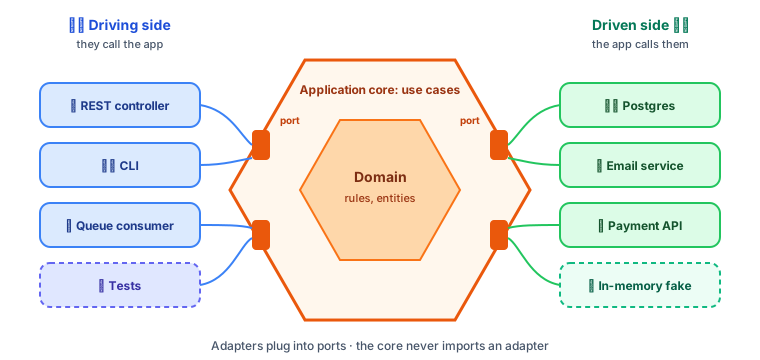 Hexagonal architecture: the application core in the middle, adapters plugged into ports on every side
💡 Why a hexagon? No magic in the number six. Cockburn drew a hexagon to escape the "top-to-bottom layers" picture, and to show there are many sides where things can plug in, all equally "outside".
Core vocabulary
| Term | Meaning | Example |
|---|---|---|
| Application core | Business logic: domain model + use cases. No I/O, no frameworks | Order, PlaceOrder |
| Port | An interface defined by the core, in its own language | ForPlacingOrders, OrderRepository |
| Adapter | Code that connects a real technology to a port | Express controller, Postgres repository |
| Driving (primary) side | Actors that call the application | Web UI, REST API, CLI, tests, a message consumer |
| Driven (secondary) side | Things the application calls | Database, payment provider, email, event bus, clock |
Direction of dependencies: adapters depend on ports; the core depends on nothing outside itself. Exactly the same rule as Clean Architecture, drawn differently.
A complete example: a library loan system
1. The core: domain + ports + use case
// core/domain/Loan.ts
export class Loan {
  constructor(readonly bookId: string, readonly memberId: string, readonly dueDate: Date) {}
  isOverdue(today: Date) { return today > this.dueDate; }
}

// core/ports/driven.ts — what the core NEEDS from the outside world
export interface BookCatalog { isAvailable(bookId: string): Promise<boolean>; markBorrowed(bookId: string): Promise<void>; }
export interface LoanRepository { save(loan: Loan): Promise<void>; countActiveFor(memberId: string): Promise<number>; }
export interface Notifier { loanConfirmed(memberId: string, loan: Loan): Promise<void>; }
export interface Clock { now(): Date; }

// core/ports/driving.ts — what the core OFFERS to the outside world
export interface ForBorrowingBooks {
  borrow(memberId: string, bookId: string): Promise<Loan>;
}

// core/BorrowBook.ts — implements the driving port using the driven ports
const MAX_ACTIVE_LOANS = 3;
const LOAN_DAYS = 14;

export class BorrowBook implements ForBorrowingBooks {
  constructor(
    private readonly catalog: BookCatalog,
    private readonly loans: LoanRepository,
    private readonly notifier: Notifier,
    private readonly clock: Clock,
  ) {}

  async borrow(memberId: string, bookId: string): Promise<Loan> {
    if (!(await this.catalog.isAvailable(bookId))) throw new DomainError("Book is not available");
    if ((await this.loans.countActiveFor(memberId)) >= MAX_ACTIVE_LOANS) {
      throw new DomainError(`Members can borrow at most ${MAX_ACTIVE_LOANS} books`);
    }

    const due = new Date(this.clock.now().getTime() + LOAN_DAYS * 24 * 60 * 60 * 1000);
    const loan = new Loan(bookId, memberId, due);

    await this.catalog.markBorrowed(bookId);
    await this.loans.save(loan);
    await this.notifier.loanConfirmed(memberId, loan);
    return loan;
  }
}
💡 Even time is behind a port (
Clock). "What's today's date?" is input from the outside world, and faking it makes tests deterministic.
2. Driving adapters: the ways in
// adapters/driving/http.ts — REST
export function loanRoutes(app: Express, borrowing: ForBorrowingBooks) {
  app.post("/members/:memberId/loans", async (req, res) => {
    const loan = await borrowing.borrow(req.params.memberId, req.body.bookId);
    res.status(201).json({ bookId: loan.bookId, dueDate: loan.dueDate.toISOString() });
  });
}

// adapters/driving/cli.ts — the same use case from a terminal
export async function borrowFromCli(borrowing: ForBorrowingBooks, [memberId, bookId]: string[]) {
  const loan = await borrowing.borrow(memberId, bookId);
  console.log(`✅ Borrowed ${bookId}, due ${loan.dueDate.toDateString()}`);
}
3. Driven adapters: the ways out
// adapters/driven/PostgresLoanRepository.ts
export class PostgresLoanRepository implements LoanRepository {
  constructor(private readonly db: Pool) {}
  async save(loan: Loan) {
    await this.db.query("INSERT INTO loans (book_id, member_id, due_date) VALUES ($1, $2, $3)", [loan.bookId, loan.memberId, loan.dueDate]);
  }
  async countActiveFor(memberId: string) {
    const { rows } = await this.db.query("SELECT count(*)::int AS n FROM loans WHERE member_id = $1 AND returned_at IS NULL", [memberId]);
    return rows[0].n;
  }
}

// adapters/driven/InMemoryLoanRepository.ts — for tests and local demos
export class InMemoryLoanRepository implements LoanRepository {
  loans: Loan[] = [];
  async save(loan: Loan) { this.loans.push(loan); }
  async countActiveFor(memberId: string) { return this.loans.filter((l) => l.memberId === memberId).length; }
}

// adapters/driven/EmailNotifier.ts
export class EmailNotifier implements Notifier {
  constructor(private readonly mailer: Mailer) {}
  loanConfirmed(memberId: string, loan: Loan) {
    return this.mailer.send(memberId, `Your loan is due on ${loan.dueDate.toDateString()}`);
  }
}
4. Configurator: plug it all together
// main.ts
const borrowing = new BorrowBook(
  new HttpBookCatalog(process.env.CATALOG_URL!),
  new PostgresLoanRepository(pool),
  new EmailNotifier(sendgrid),
  { now: () => new Date() },
);
loanRoutes(app, borrowing);
Testing: swap the adapters
The test is just another driving adapter, and it plugs in fake driven adapters:
test("refuses a 4th loan", async () => {
  const loans = new InMemoryLoanRepository();
  loans.loans = [1, 2, 3].map((n) => new Loan(`book-${n}`, "ana", new Date("2026-10-10")));
  const borrowing = new BorrowBook(
    { isAvailable: async () => true, markBorrowed: async () => {} },
    loans,
    { loanConfirmed: async () => {} },
    { now: () => new Date("2026-09-28") },
  );

  await expect(borrowing.borrow("ana", "book-4")).rejects.toThrow("at most 3 books");
});
The core is tested exactly as it runs in production, in milliseconds, with no database or network.
Folder structure
src/
├── core/
│   ├── domain/            # Loan, Book, rules
│   ├── ports/
│   │   ├── driving.ts     # ForBorrowingBooks, ForReturningBooks
│   │   └── driven.ts      # LoanRepository, BookCatalog, Notifier, Clock
│   └── BorrowBook.ts      # use cases implementing driving ports
├── adapters/
│   ├── driving/           # http.ts, cli.ts, kafka-consumer.ts
│   └── driven/            # postgres/, in-memory/, email/, http-catalog/
└── main.ts                # configurator: wires adapters to ports
Naming ports well
Cockburn suggests naming ports after their purpose, as "For…ing":
| Side | Port name | Adapters |
|---|---|---|
| Driving | ForBorrowingBooks | REST controller, CLI, GraphQL resolver, test |
| Driving | ForManagingCatalog | Admin UI, import job |
| Driven | ForStoringLoans (LoanRepository) | Postgres, DynamoDB, in-memory |
| Driven | ForNotifyingMembers (Notifier) | Email, SMS, push, console log |
Ports speak the language of the domain ("loanConfirmed"), never the language of the technology ("sendSmtpMessage").
Hexagonal vs layered, in one picture
In a layered app, business code depends on the data layer. In hexagonal, the data layer is just another adapter that depends on the business.
When to use it
✅ Business logic that must be tested thoroughly, multiple entry points (API + CLI + queue consumers), external services you might swap (payment providers, email, storage), long-lived systems.
❌ Thin CRUD apps with almost no logic: ports around every table add ceremony without benefit.
Key takeaways
- The application core is in the middle; everything else plugs in through ports using adapters.
- Driving adapters call the core (HTTP, CLI, tests, consumers); driven adapters are called by it (DB, email, payments, clock).
- Ports are interfaces owned by the core, named in domain language.
- Tests are just another driving adapter using fake driven adapters: fast and realistic.
- Same Dependency Rule as Clean Architecture: nothing in the core imports an adapter.