Microkernel (Plugin) Architecture
A small, stable core plus independent plug-ins that add features. How VS Code, browsers, Webpack and ESLint are built, how to design a plug-in contract, and the pitfalls.
The big idea
A smartphone ships with a small, stable operating system. Everything else (maps, games, banking, a flashlight) comes from apps you install. The phone maker doesn't rebuild the OS for each new app; apps plug in through a published contract (the app store rules and APIs).
Microkernel architecture (also called plug-in architecture) works the same way: a minimal core system plus independent plug-in modules that extend it.
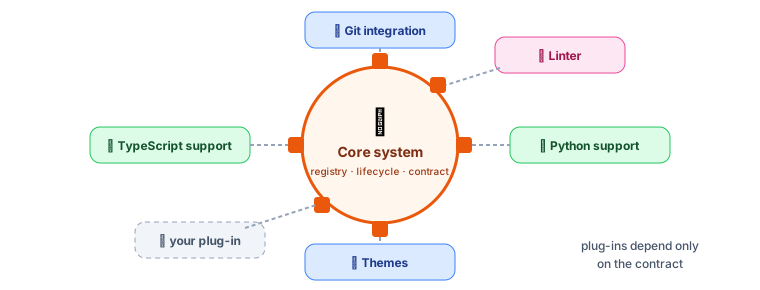 Microkernel: a small core with plug-ins attached through a contract
Where you've already seen it
| Product | Core | Plug-ins |
|---|---|---|
| VS Code | Editor, extension host, APIs | Language support, themes, Git tools, linters |
| Web browsers | Rendering engine, tabs, networking | Extensions (ad blockers, password managers) |
| Webpack / Vite / Rollup | Module graph + build pipeline | Loaders and plugins (TypeScript, CSS, images) |
| ESLint / Babel / PostCSS | Parser + traversal engine | Rules and transforms |
| WordPress | CMS core | 50,000+ plugins |
| Insurance / tax software | Claims or tax engine | One plug-in per country or state's rules |
The parts
| Part | Responsibility |
|---|---|
| Core system | The minimal functionality everyone needs, plus the machinery to find, load and run plug-ins |
| Plug-in contract | The interface and extension points (hooks) plug-ins can use: the only thing plug-ins may depend on |
| Registry | Knows which plug-ins exist, their versions, and how to reach them |
| Plug-ins | Independent modules adding features; ideally unaware of each other |
Building one: a tiny Markdown processor
1. Define the contract
// core/contract.ts: the ONLY thing plug-ins import from the core
export interface MarkdownPlugin {
  name: string;
  version: string;
  /** Transform raw markdown before parsing (optional hook) */
  beforeParse?(markdown: string): string;
  /** Transform the rendered HTML (optional hook) */
  afterRender?(html: string): string;
}
2. The core: registry + lifecycle
// core/processor.ts
export class MarkdownProcessor {
  private plugins: MarkdownPlugin[] = [];

  use(plugin: MarkdownPlugin): this {
    if (this.plugins.some((p) => p.name === plugin.name)) throw new Error(`Plugin ${plugin.name} already registered`);
    this.plugins.push(plugin);
    return this;
  }

  render(markdown: string): string {
    const source = this.plugins.reduce((text, p) => p.beforeParse?.(text) ?? text, markdown);
    const html = basicMarkdownToHtml(source);                     // the core's own small job
    return this.plugins.reduce((out, p) => p.afterRender?.(out) ?? out, html);
  }
}
3. Plug-ins: independent features
// plugins/emoji.ts
export const emojiPlugin: MarkdownPlugin = {
  name: "emoji",
  version: "1.0.0",
  beforeParse: (md) => md.replaceAll(":rocket:", "🚀").replaceAll(":tada:", "🎉"),
};

// plugins/external-links.ts
export const externalLinksPlugin: MarkdownPlugin = {
  name: "external-links",
  version: "1.2.0",
  afterRender: (html) => html.replace(/<a href="http/g, '<a target="_blank" rel="noreferrer" href="http'),
};

// app.ts
const processor = new MarkdownProcessor().use(emojiPlugin).use(externalLinksPlugin);
processor.render("Launch day :rocket: [docs](https://example.com)");
The Open/Closed Principle at architecture scale: the core is closed for modification, open for extension.
Designing the contract well
| Guideline | Why |
|---|---|
| Keep the contract small and stable | Every change can break every plug-in in the ecosystem |
| Version it (semver) and check compatibility on load | Old plug-ins fail loudly instead of mysteriously |
| Plug-ins depend only on the contract, not on core internals or each other | Plug-ins stay independent and replaceable |
Clear, ordered hooks (beforeParse, afterRender) | Predictable behaviour when many plug-ins run |
| Isolate failures: catch plug-in errors, timeouts | One bad plug-in shouldn't crash the host |
| Isolate security where plug-ins are third-party | Sandboxing (VS Code's extension host process, browser permission models) |
// Defensive loading: a broken plug-in is disabled, not fatal
for (const plugin of discovered) {
  try {
    assertCompatible(plugin.version, CONTRACT_VERSION);
    processor.use(plugin);
  } catch (error) {
    logger.warn({ plugin: plugin.name, error }, "Plugin disabled");
  }
}
Plug-in discovery
| Style | How | Example |
|---|---|---|
| Explicit registration | The app lists plug-ins in code or config | vite.config.ts → plugins: [react()] |
| Convention | Load everything matching a naming pattern or folder | eslint-plugin-*, a plugins/ folder |
| Manifest + marketplace | Each plug-in ships metadata; a registry installs it | VS Code extensions (package.json contributes) |
| Remote plug-ins | Plug-ins are services called over HTTP/gRPC | Webhooks, Shopify apps |
Trade-offs
| ✅ Strengths | ❌ Weaknesses |
|---|---|
| Extensible without touching the core | Designing a good contract up front is hard |
| Features can be added, removed or sold separately | Changing the contract is painful for the ecosystem |
| Plug-ins are small, focused and testable in isolation | Plug-in interactions can be hard to debug |
| Customisation per customer/region without forks | Performance overhead of indirection and isolation |
When to use it
✅ Products that need customisation or third-party extensions (IDEs, CMSs, build tools), rules that vary by customer, country or product line, and features that should be switched on and off independently.
❌ Apps without a clear, stable core or without real variation. A plug-in system nobody plugs into is YAGNI.
Key takeaways
- Microkernel = a small, stable core plus independent plug-ins connected through a contract.
- VS Code, browsers, Webpack, ESLint and WordPress are all built this way.
- Keep the contract small, versioned and stable; plug-ins depend only on it.
- Isolate plug-in failures (and, for third parties, security).
- Use it when extensibility and variation are real requirements.