Serverless Architecture
Run code without managing servers. Functions as a Service, event triggers, cold starts, pay-per-use pricing, managed backends, and the patterns and limits you need to know.
The big idea
Owning a car means paying for it 24/7, parking it, servicing it, insuring it, even though it sits idle 95% of the time. Taking a taxi means you pay only for the trips you take, and someone else handles the car.
Serverless is the taxi model for computing: you write functions, the cloud runs them when an event happens, scales them automatically (even to zero), and bills you per request and per millisecond. There are still servers; you just never see or manage them.
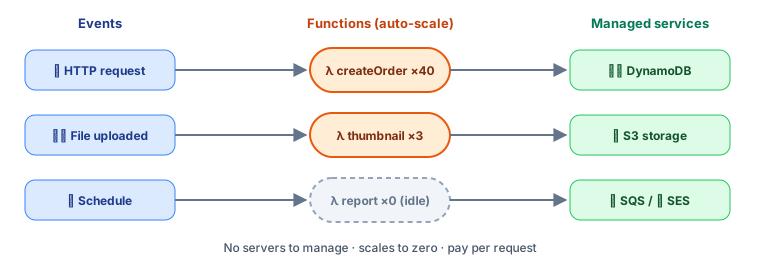 Serverless: events trigger functions that scale automatically and use managed services
Two halves of serverless
| What it is | Examples | |
|---|---|---|
| FaaS (Functions as a Service) | Your code, as small functions triggered by events | AWS Lambda, Google Cloud Functions, Azure Functions, Cloudflare Workers, Vercel Functions |
| BaaS (Backend as a Service) | Managed building blocks you use instead of running your own | DynamoDB, S3, Firebase, Supabase, Auth0/Cognito, SQS, EventBridge |
A "serverless architecture" usually glues managed services together with small functions.
Event triggers
// AWS Lambda handler: create an order from an HTTP request
import { DynamoDBClient } from "@aws-sdk/client-dynamodb";
import { DynamoDBDocumentClient, PutCommand } from "@aws-sdk/lib-dynamodb";

const db = DynamoDBDocumentClient.from(new DynamoDBClient({})); // created ONCE per container, reused

export const handler = async (event: { body: string }) => {
  const input = JSON.parse(event.body);
  const order = { id: crypto.randomUUID(), ...input, status: "PENDING", createdAt: new Date().toISOString() };
  await db.send(new PutCommand({ TableName: process.env.ORDERS_TABLE, Item: order }));
  return { statusCode: 201, body: JSON.stringify({ id: order.id }) };
};
// Triggered by an S3 upload: create a thumbnail
export const handler = async (event: S3Event) => {
  for (const record of event.Records) {
    const image = await s3.getObject(record.s3.bucket.name, record.s3.object.key);
    const thumbnail = await sharp(image).resize(200).webp().toBuffer();
    await s3.putObject("thumbnails-bucket", record.s3.object.key + ".webp", thumbnail);
  }
};
How it scales and bills
| Always-on server | Serverless | |
|---|---|---|
| Idle cost | 💰 Pay 24/7 | ✅ ~$0 when nobody uses it |
| Traffic spikes | Plan capacity ahead | ✅ Scales automatically |
| Ops work | Patching, scaling, monitoring hosts | ✅ The provider handles it |
| Cost at constant high load | ✅ Often cheaper | 💰 Can get expensive |
Cold starts
When no warm instance exists, the platform must start a new one: download code, start the runtime, run your initialisation. That first request is slower: a cold start.
Reduce cold starts: keep bundles small, initialise clients outside the handler (so warm calls reuse them), choose fast-starting runtimes (Node, Go, Rust), use provisioned concurrency for latency-critical paths, or edge runtimes (Cloudflare Workers, Vercel Edge) with near-zero cold starts.
Designing for serverless
| Principle | Why |
|---|---|
| Stateless functions | Any instance can handle any request; instances disappear anytime |
| Small, single-purpose functions | Faster cold starts, independent scaling and permissions |
| Idempotent handlers | Event sources retry; the same event may arrive twice |
| Push work to queues | Smooth spikes, retry failures, add dead-letter queues |
| Watch connection limits | 1,000 concurrent functions × 1 DB connection each can overwhelm Postgres; use RDS Proxy, Data API, or serverless-friendly DBs |
| Least-privilege IAM per function | Each function gets only the permissions it needs |
A typical serverless web backend
Limits and trade-offs
| Limitation | Typical value / impact |
|---|---|
| Max execution time | ~15 minutes on AWS Lambda, so long jobs need Step Functions, containers or batching |
| Cold starts | 100 ms to several seconds, depending on runtime and bundle |
| Vendor lock-in | Triggers, IAM and managed services are provider-specific |
| Local testing and debugging | Harder; use emulators (SAM, LocalStack) and good tracing |
| Observability | Many small pieces: invest in structured logs, tracing (X-Ray / OpenTelemetry) |
| Cost at sustained high load | Containers or VMs can be much cheaper |
💡 Keep your business logic portable. Put it in plain modules (Hexagonal style) and keep the Lambda handler as a thin driving adapter. Moving to containers later then means writing a new adapter, not rewriting the logic.
// handler.ts: thin adapter
export const handler = async (event: APIGatewayProxyEvent) => {
  const result = await placeOrder.execute(JSON.parse(event.body ?? "{}")); // plain use case
  return { statusCode: 201, body: JSON.stringify(result) };
};
When to use it
✅ Spiky or unpredictable traffic, event processing (uploads, queues, webhooks), scheduled jobs, MVPs and small teams that want zero ops, glue between managed services.
❌ Constant high-throughput workloads, long-running or stateful processes (game servers, WebSocket-heavy apps), ultra-low-latency paths where cold starts hurt, and strict portability requirements.
Key takeaways
- Serverless = FaaS (functions triggered by events) + BaaS (managed services); no servers to manage.
- It scales automatically (to zero) and bills per use: great for spiky workloads.
- Design functions to be stateless, small, idempotent and least-privileged; use queues for resilience.
- Watch for cold starts, execution time limits, DB connection limits, lock-in and cost at scale.
- Keep business logic in plain modules and handlers as thin adapters.