Layered (N-Tier) Architecture
The classic way to organise an application into presentation, business and data layers. How it works, its rules, the famous "architecture sinkhole", and when it's the right choice.
The big idea
A restaurant has clear layers: the waiters talk to customers, the kitchen cooks, and the storeroom holds ingredients. A customer never walks into the storeroom, and the storeroom never talks to customers. Each layer only talks to the layer next to it.
Layered architecture organises an application the same way: each layer has one job and only talks to the layer directly below it.
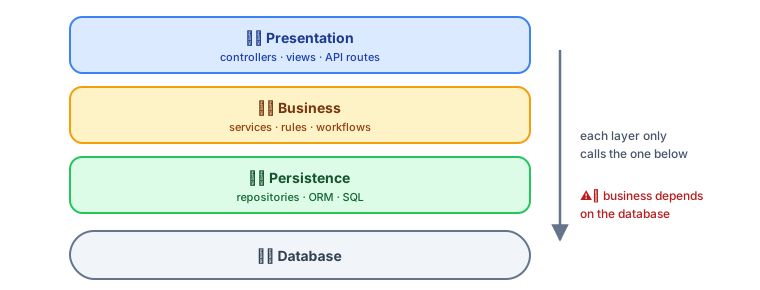 Layered architecture: requests flow down through the layers and back up
The classic layers
| Layer | Job | Examples |
|---|---|---|
| Presentation | Talk to the user or client | React pages, REST controllers, CLI |
| Business (service / application) | Business rules and workflows | OrderService.placeOrder() |
| Persistence (data access) | Read and write data | Repositories, ORM models, SQL |
| Database | Store data | PostgreSQL, MongoDB |
A request through the layers
// presentation/OrderController.ts
export class OrderController {
  constructor(private orders: OrderService) {}

  async create(req: Request, res: Response) {
    const order = await this.orders.placeOrder(req.body.customerId, req.body.items);
    res.status(201).json(order);
  }
}

// business/OrderService.ts
export class OrderService {
  constructor(private repo: OrderRepository) {}

  async placeOrder(customerId: string, items: OrderItem[]) {
    if (items.length === 0) throw new ValidationError("Order is empty");
    const total = items.reduce((sum, i) => sum + i.priceCents * i.qty, 0);
    return this.repo.save({ customerId, items, totalCents: total, status: "PENDING" });
  }
}

// persistence/OrderRepository.ts
export class OrderRepository {
  constructor(private db: Pool) {}

  async save(order: NewOrder) {
    const { rows } = await this.db.query(
      "INSERT INTO orders (customer_id, total_cents, status) VALUES ($1, $2, $3) RETURNING *",
      [order.customerId, order.totalCents, order.status],
    );
    return rows[0];
  }
}
The rules
- Separation of concerns: each layer has one responsibility. No SQL in controllers; no HTTP in services.
- Dependencies point down: a layer may use the layer below it, never the one above.
- Closed vs open layers:
A closed layer must be passed through; an open layer may be skipped. Keep most layers closed, or the separation quickly erodes.
Layers vs tiers
- Layers are a logical split of code.
- Tiers are a physical split onto different machines.
The classic 3-tier web app has three layers of code spread over three tiers.
The weak spots
1. The database sits at the bottom
In a classic layered design, the business layer depends on the persistence layer. So business rules end up shaped by database tables, and testing a service needs a real (or heavily mocked) database.
This is exactly the problem Clean, Hexagonal and Onion architectures fix by inverting that dependency (see the next lessons).
2. The architecture sinkhole
Requests pass through every layer without anything useful happening:
// Controller → Service → Repository, and the service adds nothing
class ProductService {
  getProduct(id: string) {
    return this.repo.findById(id); // just a pass-through
  }
}
A few pass-throughs are normal. If most requests are like this (the rule of thumb is more than ~20%), the layers are ceremony, not value.
3. Changes cut across every layer
"Add a discount code field" touches the controller, the DTO, the service, the repository and the migration: five folders for one feature.
Vertical slice architecture (a later lesson) groups code by feature instead, to fix this.
Folder structure
src/
├── presentation/      # controllers, routes, DTOs, views
├── business/          # services, business rules
├── persistence/       # repositories, ORM entities
└── shared/            # config, logging, errors
When is layered a good choice?
| ✅ Good fit | ❌ Poor fit |
|---|---|
| Small to medium apps, CRUD-heavy | Rich, complex business domains |
| Teams new to architecture: easy to understand | Parts that need to scale or deploy separately |
| Fast start, low ceremony | When business logic must be tested without infrastructure |
💡 Layered is the default mental model most developers start with, and many successful apps use it. Evolve toward Clean/Hexagonal when business logic grows and database coupling starts to hurt.
Key takeaways
- Layered architecture splits an app into presentation, business and persistence layers.
- Each layer only uses the layer below; keep layers closed.
- Layers are logical; tiers are physical.
- Weak spots: business logic depends on the database, pass-through "sinkholes", and features spread across all layers.
- A good simple default that Clean, Hexagonal, Onion and vertical slices improve on.