Event-Driven Architecture
Build systems where components react to events instead of calling each other. Broker vs mediator topologies, the four kinds of event patterns, event design, and the real trade-offs.
The big idea
At a wedding, the photographer doesn't phone the caterer, the band and the florist when the couple arrives. Someone announces "The couple has arrived!", and everyone who cares reacts in their own way: the band starts playing, the caterer serves drinks, the photographer takes pictures.
In an event-driven architecture (EDA), components announce facts ("OrderPlaced") instead of calling each other ("please reserve stock, then charge the card, then email the customer"). Whoever is interested reacts.
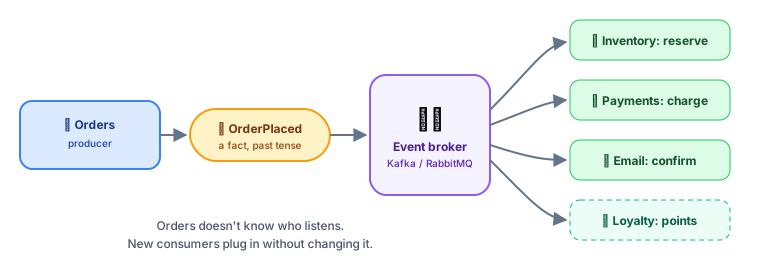 Event-driven: one producer publishes a fact; many consumers react independently
Request-driven vs event-driven
| Request-driven | Event-driven | |
|---|---|---|
| Coupling | Caller knows every callee | Producer knows no consumers |
| Adding a new reaction | Change the caller | Add a subscriber |
| If a consumer is down | The call fails | Events wait in the broker |
| Flow visibility | ✅ Easy to follow in code | ❌ Spread across services |
| Consistency | Immediate | Eventual |
Anatomy
| Part | Role | Examples |
|---|---|---|
| Event producer | Detects something happened and publishes it | Orders service |
| Event | An immutable fact, past tense | OrderPlaced { orderId, total, at } |
| Event channel / broker | Delivers events to consumers | Kafka, RabbitMQ, SNS/SQS, EventBridge, NATS |
| Event consumer | Reacts to events it's interested in | Inventory, Email, Analytics |
Two topologies
Broker topology (choreography)
No central brain. Each service reacts to events and publishes its own.
✅ Highly decoupled and scalable. ❌ Hard to see or change the overall flow; error handling is spread out.
Mediator topology (orchestration)
A mediator (orchestrator) receives the initial event and directs the steps.
✅ The flow and error handling are in one place. ❌ The mediator is extra coupling and a potential bottleneck.
The four event patterns (Martin Fowler)
"Event-driven" means several different things. Knowing which one you mean avoids confusion:
| Pattern | What the event carries | Example | Trade-off |
|---|---|---|---|
| 1. Event notification | Just "something happened" + an ID | { type: "OrderPlaced", orderId: "o42" }; consumers call back for details | Tiny events, but consumers call the producer back (coupling returns) |
| 2. Event-carried state transfer | The data consumers need | { type: "CustomerMoved", customerId, newAddress } | Consumers keep a local copy and never call back; data is duplicated |
| 3. Event sourcing | Events are the source of truth | The account's state is the sum of Deposited / Withdrawn events | Full history and replay; more complex |
| 4. CQRS | Events keep separate read models up to date | Write model publishes; read model projects | Fast, tailored reads; eventual consistency |
Designing good events
{
  "eventId": "0b8c4f0e-6a57-4f7e-9b3d-2f1d1c9a7e11",
  "type": "shop.ordering.OrderPlaced",
  "version": 2,
  "occurredAt": "2026-09-28T10:15:00Z",
  "source": "ordering-service",
  "correlationId": "req-7f3c",
  "data": {
    "orderId": "o42",
    "customerId": "c7",
    "totalCents": 8997,
    "currency": "EUR",
    "lines": [{ "sku": "KB-1", "quantity": 1 }]
  }
}
| Guideline | Why |
|---|---|
Past tense, business language (OrderPlaced, not CreateOrderRow) | Events are facts, in the ubiquitous language |
Unique eventId | Consumers deduplicate (idempotency) |
version + a schema | Evolve safely; old consumers keep working |
correlationId | Trace one business flow across services |
| Include what consumers need, but not your whole database row | Avoid callbacks without leaking internals |
| Standard envelope | e.g. CloudEvents, a CNCF standard format |
The hard parts (be honest)
| Challenge | Mitigation |
|---|---|
| Eventual consistency (the UI may show old data briefly) | Design the UX for it: "Order received, confirming…" |
| Duplicate events (at-least-once delivery) | Idempotent consumers: store processed event IDs |
| Ordering | Partition by entity key (Kafka); include versions/timestamps |
| Lost events when saving + publishing | Transactional outbox pattern |
| Hard to debug "what happened?" | Correlation IDs, distributed tracing, an event catalog |
| Schema changes break consumers | Schema registry, versioning, backward-compatible changes |
| Hidden coupling via event contents | Treat event schemas as public APIs; document them (AsyncAPI) |
(The Kafka and Microservices topics cover delivery guarantees, the outbox, sagas and CQRS in depth.)
EDA inside a single application
Event-driven isn't only for microservices. Inside a modular monolith, modules can communicate with in-process domain events, keeping modules decoupled without any broker:
// A tiny in-process event bus
type Handler<E> = (event: E) => Promise<void>;
class EventBus {
  private handlers = new Map<string, Handler<any>[]>();
  on<E extends { type: string }>(type: E["type"], handler: Handler<E>) {
    this.handlers.set(type, [...(this.handlers.get(type) ?? []), handler]);
  }
  async publish(event: { type: string }) {
    await Promise.all((this.handlers.get(event.type) ?? []).map((h) => h(event)));
  }
}

bus.on("OrderPlaced", (e) => loyalty.awardPoints(e.customerId, e.totalCents)); // loyalty module
bus.on("OrderPlaced", (e) => email.sendConfirmation(e.orderId));               // notifications module
Later, if a module becomes a separate service, swap the in-process bus for Kafka or RabbitMQ; the handlers barely change.
When to use it
✅ Many independent reactions to the same business facts, spiky traffic that needs buffering, integrating many systems, real-time processing, audit trails.
❌ Simple request/response flows where the user needs an immediate answer, small systems where the added complexity isn't earned, and workflows needing strict, immediate consistency.
Key takeaways
- Components publish facts and react to facts instead of calling each other directly.
- Broker topology (choreography) maximises decoupling; mediator topology (orchestration) makes flows explicit.
- Know which pattern you mean: notification, event-carried state transfer, event sourcing, or CQRS.
- Design events as versioned public contracts with IDs and correlation IDs.
- Plan for eventual consistency, duplicates, ordering and debugging from day one.