Comments & Formatting
Good code explains WHAT and HOW by itself; comments should explain WHY. Plus the formatting habits that make code easy to scan.
The big idea
Think of comments as road signs. A sign that says "Sharp bend ahead, icy in winter" is priceless. A sign every 10 metres that says "This is a road" is noise, and people stop reading signs at all.
💡 The golden rule: Before writing a comment, try to make the code say it. Only comment what code cannot express.
Comments that hurt
1. Redundant comments
// ❌ The comment repeats the code
let i = 0; // set i to zero
i++; // increment i

// Get the user
function getUser() {}
2. Comments that replace a good name
// ❌
// check if the user can get a discount
if (user.orders > 10 && user.age > 60 && !user.isBanned) {}

// ✅ The name IS the comment
const isEligibleForDiscount = user.orders > 10 && user.age > 60 && !user.isBanned;
if (isEligibleForDiscount) {}
3. Commented-out code
// ❌ Nobody knows if this is still needed, so nobody deletes it
// const oldTotal = calcOld(cart);
// if (oldTotal > 100) sendCoupon();
Delete it. Git remembers everything you delete.
4. Lying (outdated) comments
// Returns the price in dollars   ← written 2 years ago
function getPrice(item) {
  return item.priceInCents;        // ← the code changed, the comment didn't
}
A wrong comment is worse than no comment. Code is executed and tested; comments are not.
Comments that help
| Type | Example |
|---|---|
| Why (a decision) | // Use insertion sort: lists here are always < 10 items and it's stable |
| Warning | // Not thread-safe. Call only from the main worker. |
| Legal / licence | // Copyright 2026 … |
| TODO with owner | // TODO(ana): remove after v2 migration, see TICKET-481 |
| Public API docs | JSDoc on exported functions |
| Clarify a regex or formula | // Luhn checksum, see https://… |
/**
 * Converts an amount between currencies using the daily rate.
 * @param {number} amount - The amount in the source currency.
 * @param {string} from - ISO code, for example "USD".
 * @param {string} to - ISO code, for example "EUR".
 * @returns {number} The amount rounded to 2 decimals.
 */
export function convertCurrency(amount, from, to) { /* … */ }
// We retry 3 times because the payment provider returns
// random 503s during their nightly maintenance (02:00-02:15 UTC).
const PAYMENT_MAX_RETRIES = 3;
That second comment is gold: no amount of good naming could tell you why it's 3.
Formatting: make code scannable
People scan code the way they scan a newspaper: headline first, details later.
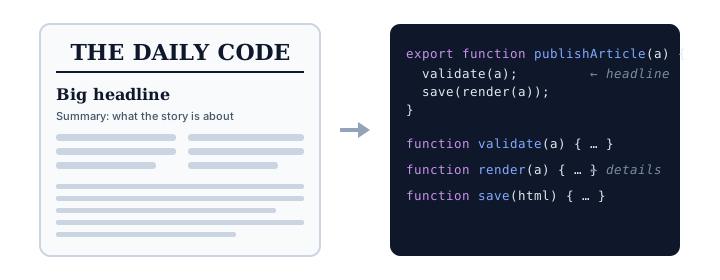 Code formatted like a newspaper: important things at the top, details below
Vertical order: top-down, like a story
Put the high-level function first and its helpers below it, in the order they are called.
export function publishArticle(article) {   // headline
  validate(article);
  const html = render(article);
  return save(html);
}

function validate(article) { /* … */ }        // details, in call order
function render(article) { /* … */ }
function save(html) { /* … */ }
Blank lines separate ideas
// ❌ A wall of text
function checkout(cart){const total=sum(cart);if(total>100){applyDiscount(cart)}const receipt=charge(cart);email(receipt);return receipt}

// ✅ Paragraphs
function checkout(cart) {
  const total = sum(cart);
  if (total > 100) applyDiscount(cart);

  const receipt = charge(cart);
  email(receipt);

  return receipt;
}
Let tools do it
Don't argue about tabs vs spaces in code reviews. Automate it:
// .prettierrc
{ "singleQuote": false, "semi": true, "printWidth": 100 }
Key takeaways
- Code explains what and how; comments explain why.
- Delete redundant, outdated and commented-out code. Git has your back.
- Write comments for decisions, warnings and public APIs.
- Format like a newspaper: headline at the top, details below, blank lines between ideas.
- Automate formatting with Prettier and ESLint.
Try it yourself
Search your project for //. For each comment ask: Could a better name replace this? If yes, rename and delete the comment.