Meaningful Names
Names are the cheapest documentation you have. Learn simple rules for naming variables, functions and classes so code explains itself.
The big idea
A name is a label on a box. If the label says stuff, you must open the box to know what's inside. If it says winter-jackets, you don't.
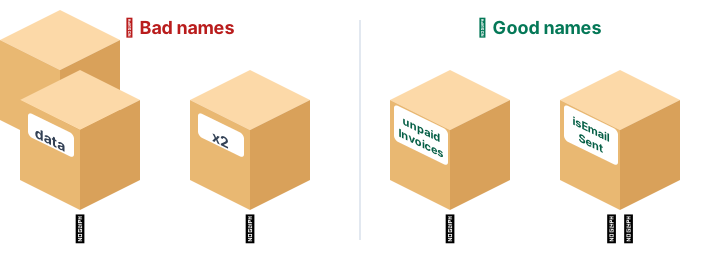 Good names are labels that tell you what is inside without opening the box
💡 Rule of thumb: If you need a comment to explain a name, the name is wrong. Rename it.
Rule 1: Reveal intent
The name should answer three questions: why does it exist, what does it do, how is it used?
// ❌ What is d? Days? Distance? Data?
const d = 7;

// ✅ The name answers the question
const daysUntilTrialEnds = 7;
// ❌ What does this return?
function getThem(list) {
  return list.filter((x) => x[0] === 4);
}

// ✅ Reads like a sentence
const FLAGGED = 4;
function getFlaggedCells(gameBoard) {
  return gameBoard.filter((cell) => cell.status === FLAGGED);
}
Rule 2: Use the right kind of word
Different things need different grammar. Once you follow this, code reads like English.
| Thing | Grammar | Good examples | Bad examples |
|---|---|---|---|
| Variable / object | noun | user, invoice, cartTotal | doUser, data2 |
| Boolean | question: is/has/can/should | isActive, hasPermission, canEdit | active, flag, check |
| Function | verb + noun | sendEmail(), calculateTax() | email(), taxStuff() |
| Class | noun (thing) | PaymentProcessor, Order | ProcessPayment, Manager |
| Collection | plural | users, orderItems | userList2, arr |
| Constant | UPPER_SNAKE | MAX_RETRIES, TAX_RATE | n, x |
Rule 3: Avoid mental mapping
Readers should not have to translate names in their head.
// ❌ The reader must remember that u = user, r = role, p = permissions
for (const u of us) {
  const r = getR(u);
  const p = r.p;
}

// ✅ Nothing to decode
for (const user of users) {
  const role = getRole(user);
  const permissions = role.permissions;
}
Single letters are fine only in tiny scopes where the meaning is universal, like i in a short loop or (a, b) in a sort comparator.
Rule 4: One word per concept
Pick one word for one idea and stick to it across the codebase.
If fetch means "call the network" and get means "read from memory", great. Just be consistent, and write it down for the team.
Rule 5: Make names searchable and pronounceable
// ❌ Try searching for "5" or saying "genymdhms" in a meeting
if (status === 5) {}
const genymdhms = new Date();

// ✅
const ORDER_STATUS_SHIPPED = 5;
if (status === ORDER_STATUS_SHIPPED) {}
const generatedAt = new Date();
Rule 6: Length should match scope
The wider a name travels, the more context it needs to carry.
Before and after: a full example
// ❌ Before
function proc(d) {
  const r = [];
  for (const x of d) {
    if (x.a > 18 && x.v) r.push(x.n);
  }
  return r;
}
// ✅ After
const ADULT_AGE = 18;

function getNamesOfVerifiedAdults(people) {
  return people
    .filter((person) => person.age > ADULT_AGE && person.isVerified)
    .map((person) => person.name);
}
No comments were added, and yet the second version is completely self-explaining.
Common mistakes
- Type prefixes like
strNameorarrUsers. Your editor already knows the type. - Noise words like
data,info,object,manager.UserDataandUserInfomean nothing extra overUser. - Lying names.
getUser()that also creates a user when none exists should begetOrCreateUser(). - Cute names.
nukeEverything()is fun today and confusing tomorrow. UsedeleteAllRecords().
Key takeaways
- A good name removes the need for a comment.
- Nouns for things, verbs for actions,
is/has/canfor booleans. - Be consistent: one word per concept.
- The wider the scope, the longer and clearer the name.
Try it yourself
Rename these: let flag = true (tracks whether an email was sent), function handle(x) (validates a signup form), const list = [] (holds unpaid invoices).
Possible answers
let isEmailSent = true, function validateSignupForm(form), const unpaidInvoices = []