KISS: Keep It Simple, Stupid
The simplest solution that works is usually the best one. Learn to spot over-engineering and choose boring, obvious code.
The big idea
A Rube Goldberg machine uses 40 steps (balls, dominoes, pulleys) to switch on a light. It's fun to watch, and it breaks if one domino is off by a millimetre. A light switch does the same job in one step.
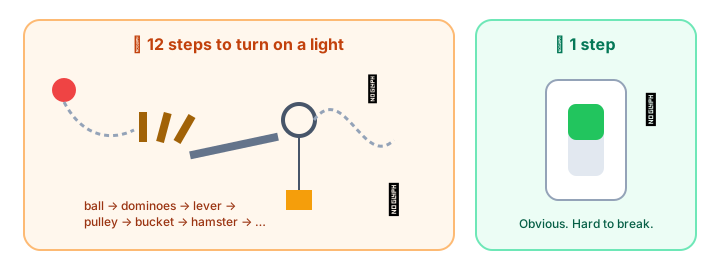 KISS: a light switch beats a Rube Goldberg machine
KISS = Keep It Simple, Stupid. The US Navy coined it in the 1960s: most systems work best when they are kept simple, not made complicated.
💡 Simple ≠ easy. Simple code often takes more thinking to write, because you have to understand the problem well enough to remove everything that isn't needed.
Why complexity hurts
Every extra layer, abstraction or clever trick is something the next developer has to learn before they can change anything.
Example 1: Clever vs clear
// ❌ Clever: a one-liner puzzle
const isEven = (n) => !(n & 1);

// ✅ Clear: anyone understands it instantly
const isEven = (n) => n % 2 === 0;
// ❌ Showing off
const result = arr.reduce((a, c) => ({ ...a, [c.id]: [...(a[c.id] || []), c] }), {});

// ✅ Boring and obvious (and faster: no copying on every step)
const ordersByCustomer = Object.groupBy(orders, (order) => order.customerId);
Example 2: Over-engineering a simple need
The task: "Send a welcome email when a user signs up."
// ❌ Over-engineered for ONE email type
class NotificationStrategyFactory {
  create(type) { return new (this.registry.get(type))(); }
}
class AbstractNotificationStrategy { send() { throw new Error("abstract"); } }
class EmailNotificationStrategy extends AbstractNotificationStrategy { /* … */ }
const strategy = new NotificationStrategyFactory().create("email");
strategy.send(new NotificationContext(user, TemplateRegistry.get("welcome")));
// ✅ KISS
async function sendWelcomeEmail(user) {
  await mailer.send({ to: user.email, subject: "Welcome!", html: welcomeTemplate(user) });
}
When you have five notification channels, a strategy pattern may earn its place. With one, it's just noise. (See the lesson on YAGNI.)
Example 3: Simplify conditions
// ❌
function getShippingCost(country) {
  if (country === "US") { return 5; }
  else if (country === "CA") { return 8; }
  else if (country === "UK") { return 10; }
  else if (country === "DE") { return 10; }
  else { return 20; }
}

// ✅ Data instead of logic
const SHIPPING_COST = { US: 5, CA: 8, UK: 10, DE: 10 };
const DEFAULT_SHIPPING_COST = 20;

const getShippingCost = (country) => SHIPPING_COST[country] ?? DEFAULT_SHIPPING_COST;
KISS in architecture
Start with the simplest architecture that works, like a modular monolith and one database. Add microservices, queues and caches when real problems show up, not before.
How to practise KISS
| Ask yourself | If yes… |
|---|---|
| Could a junior dev understand this in 5 minutes? | ✅ good |
| Am I adding this "just in case"? | ❌ remove it |
| Is there a built-in / standard library function for this? | ✅ use it |
| Would a plain function work instead of a class hierarchy? | ✅ use the function |
| Am I proud of how clever this is? | ⚠️ warning sign |
Common mistakes
- Confusing short with simple. A dense one-liner can be much harder to read than five clear lines.
- Premature optimisation. Making code "fast" before measuring usually just makes it complicated.
- Too simple. KISS doesn't mean skipping validation, error handling or tests.
Key takeaways
- The simplest solution that fully solves the problem wins.
- Clear beats clever, every time.
- Replace branching logic with data (lookup tables) where you can.
- Start with simple architecture and add complexity only for real, measured needs.
Try it yourself
Find an if / else if chain with more than 3 branches in your code. Can a lookup object replace it?