O — Open/Closed Principle
Software should be open for extension but closed for modification. Add new features by plugging in new code instead of editing code that already works.
The big idea
A camera body has a lens mount. When you want to shoot wildlife, you don't open the camera and resolder its insides; you plug in a new lens. The camera is:
- Open for extension: new lenses can be added.
- Closed for modification: the camera body never changes.
📘 OCP (Bertrand Meyer, 1988): "Software entities should be open for extension, but closed for modification."
Why editing working code is risky
Every time you open a working, tested function to add an else if, you risk breaking the cases that already worked, and you must re-test all of them.
Before: the growing if/else
// ❌ Every new payment method = edit this function again
function processPayment(order, method) {
  if (method === "card") {
    return stripe.charge(order.total, order.cardToken);
  } else if (method === "paypal") {
    return paypal.createPayment(order.total, order.email);
  } else if (method === "crypto") {
    return coinbase.charge(order.total, order.wallet);
  }
  // Next month: Apple Pay → edit again. Then Klarna → edit again…
  throw new Error("Unknown payment method");
}
After: plug-in strategies
// ✅ Each payment method is a separate "plug-in" with the same shape
const cardPayment   = { pay: (order) => stripe.charge(order.total, order.cardToken) };
const paypalPayment = { pay: (order) => paypal.createPayment(order.total, order.email) };
const cryptoPayment = { pay: (order) => coinbase.charge(order.total, order.wallet) };

const paymentMethods = new Map([
  ["card", cardPayment],
  ["paypal", paypalPayment],
  ["crypto", cryptoPayment],
]);

// This function is now CLOSED: it never needs to change again
function processPayment(order, methodName) {
  const method = paymentMethods.get(methodName);
  if (!method) throw new ValidationError(`Unsupported payment method: ${methodName}`);
  return method.pay(order);
}

// Adding Apple Pay = ADD code, don't EDIT code
paymentMethods.set("applepay", { pay: (order) => applePay.charge(order.total, order.token) });
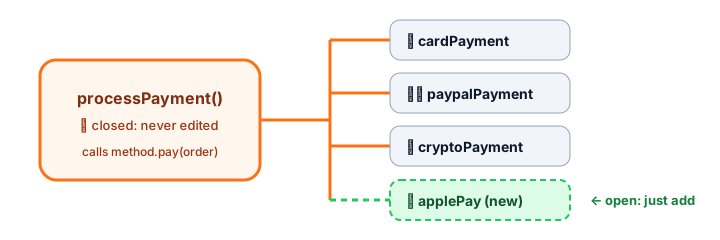 OCP: new behaviour is plugged in, the core stays untouched
With classes and TypeScript
interface DiscountRule {
  appliesTo(cart: Cart): boolean;
  discount(cart: Cart): number;
}

class BlackFridayDiscount implements DiscountRule {
  appliesTo = (cart: Cart) => isBlackFriday(new Date());
  discount = (cart: Cart) => cart.total * 0.3;
}

class LoyaltyDiscount implements DiscountRule {
  appliesTo = (cart: Cart) => cart.customer.yearsActive >= 3;
  discount = (cart: Cart) => cart.total * 0.1;
}

// Closed for modification: new rules never touch this class
class PriceCalculator {
  constructor(private rules: DiscountRule[]) {}

  total(cart: Cart): number {
    const best = Math.max(0, ...this.rules.filter((r) => r.appliesTo(cart)).map((r) => r.discount(cart)));
    return cart.total - best;
  }
}
OCP is everywhere you look
| Tool | Extension point |
|---|---|
| Express / Koa | Middleware: app.use(myMiddleware) |
| VS Code | Extensions |
| Webpack / Vite | Plugins and loaders |
| React | Components via children and render props |
| ESLint | Custom rules |
None of these tools need to change their source code when you add something new.
Don't overdo it
You can't predict every future change, and building extension points everywhere violates YAGNI. A good rule:
💡 Write the simple
iffirst. When the second or third variation appears, refactor to an extension point.
Key takeaways
- Add new behaviour by adding code (new classes, functions, config), not editing tested code.
- Use polymorphism, strategy maps, plugins or middleware to create extension points.
- Growing
if/elseorswitchon a "type" is the classic sign that OCP is needed. - Introduce extension points when real variation appears, not before.