L — Liskov Substitution Principle
If code works with a parent type, it must also work with any child type, with no surprises. Learn the famous square-rectangle trap and how to avoid it.
The big idea
You rent a car. The contract says "a car". Whether you get a Toyota or a Ford, you expect a steering wheel, pedals and gears to work the same way. If one "car" steers backwards, it isn't really a valid substitute, even if it's technically a car.
📘 LSP (Barbara Liskov, 1987): Objects of a subtype must be replaceable for objects of the parent type without breaking the program.
In plain words: a child class must keep every promise the parent class makes.
The classic trap: Square extends Rectangle
In maths, a square is a rectangle. So inheritance seems natural:
class Rectangle {
  setWidth(w) { this.width = w; }
  setHeight(h) { this.height = h; }
  area() { return this.width * this.height; }
}

class Square extends Rectangle {
  // A square must keep both sides equal…
  setWidth(w) { this.width = w; this.height = w; }
  setHeight(h) { this.width = h; this.height = h; }
}
Now some perfectly reasonable code that works with Rectangle:
function stretch(rect) {
  rect.setWidth(5);
  rect.setHeight(4);
  console.assert(rect.area() === 20, "Expected 5 × 4 = 20");
}

stretch(new Rectangle()); // ✅ 20
stretch(new Square());    // ❌ 16 — setHeight(4) also changed the width!
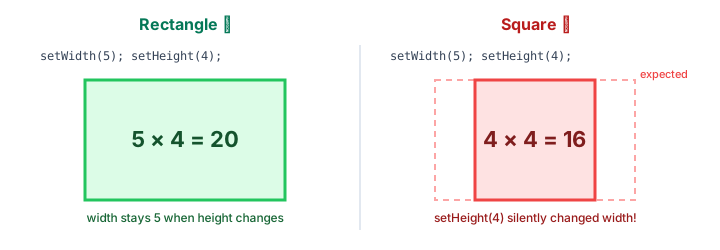 A Square breaks the Rectangle's promise: changing height also changes width
Square broke a promise that Rectangle made: "setting the height doesn't change the width." That is an LSP violation.
The fix: don't force the inheritance
// ✅ Both are shapes; neither pretends to be the other
class Rectangle {
  constructor(width, height) { Object.assign(this, { width, height }); }
  area() { return this.width * this.height; }
}

class Square {
  constructor(side) { this.side = side; }
  area() { return this.side ** 2; }
}

const shapes = [new Rectangle(5, 4), new Square(3)];
shapes.forEach((s) => console.log(s.area())); // any shape works with area()
💡 "Is-a" in the real world doesn't always mean "is-a" in code. In code, inheritance means behaves like.
How to recognise an LSP violation
Red flag 1: "not implemented" methods
class Bird { fly() { /* flap */ } }

class Penguin extends Bird {
  fly() { throw new Error("Penguins can't fly"); } // ❌ breaks every caller of Bird.fly()
}
Fix: model the capability separately.
class Bird { eat() {} }
class FlyingBird extends Bird { fly() {} }
class Sparrow extends FlyingBird {}
class Penguin extends Bird { swim() {} }
Red flag 2: instanceof checks
// ❌ The caller has to know about the special case
function makeBirdsFly(birds) {
  birds.forEach((bird) => {
    if (bird instanceof Penguin) return; // patching around a broken hierarchy
    bird.fly();
  });
}
The contract rules (for the curious)
A child class must:
| Rule | Meaning | Example |
|---|---|---|
| Accept the same or more inputs | Don't tighten preconditions | Parent accepts any number → child can't reject negatives |
| Return the same or narrower outputs | Don't loosen postconditions | Parent returns an array → child can't return null |
| Keep the parent's invariants | Rules that are always true | "balance never negative" stays true |
| Throw no new kinds of errors | Callers aren't ready for them | ReadOnlyList.add() throwing is a violation |
LSP in everyday JavaScript
Even without classes, LSP applies to anything with a shared contract:
// Any "storage" passed in must behave like the others
const memoryStorage = { get: (k) => map.get(k), set: (k, v) => map.set(k, v) };
const redisStorage = { get: (k) => redis.get(k), set: (k, v) => redis.set(k, v) };

function createCache(storage) { /* works with either, same promises */ }
If redisStorage.get returned a string "null" where memoryStorage.get returned undefined, callers would break. That is an LSP violation in duck-typed form.
Key takeaways
- A subtype must be usable anywhere its parent is, without surprises.
- Red flags:
throw new Error("not supported"),instanceofchecks, changed side effects. - Real-world "is-a" ≠ code "behaves-like-a". Prefer composition or separate types.
- LSP is what makes polymorphism (and the Open/Closed Principle) safe.