SOLID at a Glance
Five design principles that keep object-oriented and modular code easy to extend, test and change. One picture and one sentence per letter.
The big idea
SOLID is a set of five principles collected by Robert C. Martin ("Uncle Bob") in the early 2000s. They answer one question:
🎯 How do I structure code so that a change in one place doesn't break ten other places?
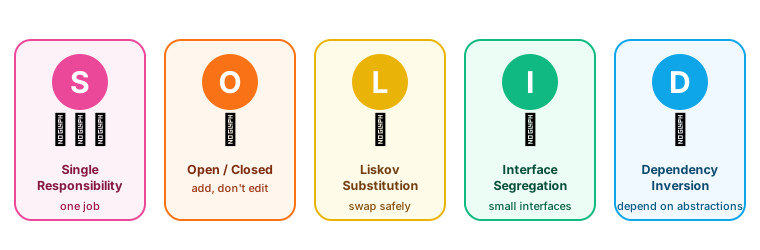 The five SOLID principles, one symbol each
The five letters in one sentence each
| Letter | Principle | In plain words | Real-life analogy |
|---|---|---|---|
| S | Single Responsibility | A class should have only one reason to change. | A chef cooks; a waiter serves. |
| O | Open / Closed | Add new behaviour by adding code, not editing old code. | Plug a new lens onto a camera. |
| L | Liskov Substitution | A subtype must work anywhere its parent works. | Any charger with the right plug should charge your phone. |
| I | Interface Segregation | Many small, specific interfaces beat one huge one. | A TV remote doesn't need a microwave's buttons. |
| D | Dependency Inversion | Depend on abstractions, not concrete details. | Lamps depend on the socket, not the power plant. |
How they connect
Drawing diagram…
- S and I keep things small.
- D and L make small things swappable.
- Swappable pieces give you O: new features by adding code, not rewriting it.
A tiny before/after preview
// ❌ Breaks almost every SOLID rule
class Report {
  generate(data) { /* build numbers */ }
  toPdf() { /* PDF logic */ }
  toExcel() { /* Excel logic */ }
  saveToMySql() { const db = new MySqlConnection(); /* … */ }
  email() { const smtp = new GmailSmtp(); /* … */ }
}
// ✅ SOLID version
class ReportGenerator { generate(data) { /* numbers only */ } }           // S

class PdfExporter { export(report) {} }                                    // O: add new exporters
class ExcelExporter { export(report) {} }                                  //    without editing old ones

class ReportService {
  constructor(repository, notifier) {                                     // D: injected abstractions
    this.repository = repository;
    this.notifier = notifier;
  }
  async publish(report, exporter) {
    const file = exporter.export(report);                                 // L: any exporter works
    await this.repository.save(file);
    await this.notifier.notify("Report ready");
  }
}
Do I need SOLID in JavaScript?
Yes, although it looks a little different from Java or C#:
- JavaScript has no
interfacekeyword, but it has duck typing: "if it has asend()method, it's a sender". TypeScript adds real interfaces. - Functions are first-class, so you can often pass a function where Java would pass an object implementing an interface.
- SOLID applies to modules, functions and React components too, not only classes.
Common misunderstandings
- ❌ "SOLID means more classes." It means better-divided responsibilities, not more files for their own sake.
- ❌ "Apply all five everywhere from day one." Use them when code starts to hurt (see YAGNI).
- ❌ "SOLID is only for OOP." The ideas apply to functions, modules and services.
Key takeaways
- SOLID = five principles for code that is easy to change.
- S, I: keep pieces small. D, L: keep pieces swappable. O: extend by adding.
- The next five lessons cover each letter with pictures and before/after code.