Clean Architecture
Organise an application in layers so business rules don't depend on frameworks, databases or the web. Follow a real request through each layer.
The big idea
Think of a power socket. Your laptop doesn't care whether the electricity comes from solar, wind or coal; it only depends on the socket shape. You can switch the power plant without changing the laptop.
Clean Architecture does the same for code: your business rules (the valuable part) depend only on simple interfaces. The database, web framework and email provider plug in from outside and can be replaced.
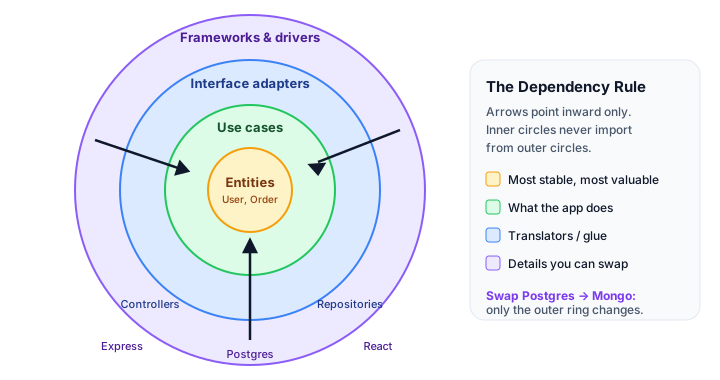 The Clean Architecture onion: dependencies always point inward
💡 The one rule to remember, the Dependency Rule: source code dependencies point inward only. Inner layers never know about outer layers.
🏛️ Want to go deeper? This lesson is the introduction. The Software Architecture topic covers Clean Architecture in depth, Hexagonal, Onion and Domain-Driven Design.
The four layers
| Layer | Contains | Knows about | Example |
|---|---|---|---|
| 🟡 Entities (domain) | Core business objects and rules | Nothing else | User, Order.total() |
| 🟢 Use cases (application) | What the app does: one action each | Entities + interfaces | RegisterUser, PlaceOrder |
| 🔵 Interface adapters | Controllers, presenters, repositories | Use cases | UserController, PostgresUserRepo |
| 🟣 Frameworks & drivers | Express, React, Postgres, Stripe | Adapters | app.listen(), pg.Pool |
Follow a registration request
Notice: RegisterUser calls UserRepository, which is an interface. It has no idea Postgres exists.
The code, layer by layer
1. Entity: pure business rules
// domain/User.js — no imports from frameworks or databases
export class User {
  constructor({ id, email, passwordHash }) {
    if (!email.includes("@")) throw new ValidationError("Invalid email");
    Object.assign(this, { id, email, passwordHash });
  }
}
2. Use case: one application action
// application/RegisterUser.js
export class RegisterUser {
  // Dependencies are injected: only "shapes" (interfaces), never concrete classes
  constructor({ userRepository, passwordHasher, emailSender }) {
    Object.assign(this, { userRepository, passwordHasher, emailSender });
  }

  async execute({ email, password }) {
    if (await this.userRepository.findByEmail(email)) throw new ConflictError("Email taken");
    const user = new User({ email, passwordHash: await this.passwordHasher.hash(password) });
    const saved = await this.userRepository.save(user);
    await this.emailSender.sendWelcome(saved.email);
    return { id: saved.id };
  }
}
3. Adapters: translate between the outside world and the use case
// adapters/PostgresUserRepository.js
export class PostgresUserRepository {
  constructor(pool) { this.pool = pool; }
  async findByEmail(email) {
    const { rows } = await this.pool.query("SELECT * FROM users WHERE email = $1", [email]);
    return rows[0] ? new User(rows[0]) : null;
  }
  async save(user) { /* INSERT … RETURNING id */ }
}

// adapters/UserController.js
export const userController = (registerUser) => async (req, res) => {
  const result = await registerUser.execute(req.body);
  res.status(201).json(result);
};
4. Composition root: wire everything together, once
// main.js — the ONLY place that knows every concrete class
const registerUser = new RegisterUser({
  userRepository: new PostgresUserRepository(pool),
  passwordHasher: new BcryptHasher(),
  emailSender: new SendGridEmailSender(apiKey),
});
app.post("/users", userController(registerUser));
Why bother? Testing becomes trivial
Because the use case only depends on interfaces, you can test it with in-memory fakes. No database, no network, milliseconds per test.
test("rejects duplicate emails", async () => {
  const userRepository = new InMemoryUserRepository([{ id: 1, email: "a@b.com" }]);
  const registerUser = new RegisterUser({ userRepository, passwordHasher: fakeHasher, emailSender: fakeSender });

  await expect(registerUser.execute({ email: "a@b.com", password: "secret123" })).rejects.toThrow(ConflictError);
});
Folder structure
src/
├── domain/          # entities + business rules (no dependencies)
│   └── User.js
├── application/     # use cases + interfaces they need
│   └── RegisterUser.js
├── adapters/        # controllers, repositories, gateways
│   ├── UserController.js
│   └── PostgresUserRepository.js
└── main.js          # composition root: wires it all up
Related names you'll hear
- Hexagonal Architecture / Ports & Adapters (Alistair Cockburn): same idea. Ports are interfaces, adapters plug into them.
- Onion Architecture (Jeffrey Palermo): same idea, drawn as an onion.
- All three share the core rule: business logic in the centre, infrastructure at the edges.
When NOT to use it
For a small script, a prototype or a simple CRUD app, the layers add ceremony without much benefit (remember KISS and YAGNI). Clean Architecture pays off when the business logic is rich and the app will live for years.
Key takeaways
- Dependencies point inward. The domain knows nothing about frameworks or databases.
- Use cases depend on interfaces; concrete implementations are injected.
- One composition root wires everything together.
- Payoff: fast tests, swappable infrastructure, business rules you can read in isolation.