D — Dependency Inversion Principle
High-level business logic should depend on abstractions, not on concrete details like databases or email providers. The key to swappable, testable code.
The big idea
Your lamp doesn't have a wire soldered directly to the power plant. It has a plug, and the wall has a socket. Both depend on a shared standard, the socket shape. That's why you can move the lamp to any room and the utility company can switch from coal to solar.
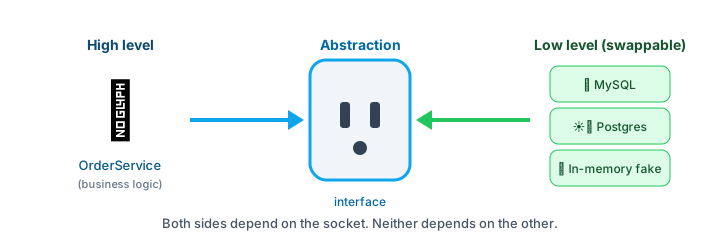 DIP: the lamp and the power plant both depend on the socket standard
📘 DIP:
- High-level modules should not depend on low-level modules. Both should depend on abstractions.
- Abstractions should not depend on details. Details should depend on abstractions.
- High-level module: your business logic (
OrderService). This is what makes money. - Low-level module: details (
MySQLDatabase,SendGridMailer). These are replaceable. - Abstraction: an interface or contract (
OrderRepository,Mailer).
Before: business logic glued to details
import { MySQLDatabase } from "./mysql.js";
import { SendGridMailer } from "./sendgrid.js";

// ❌ OrderService creates its own concrete dependencies
class OrderService {
  constructor() {
    this.db = new MySQLDatabase("mysql://prod-server");   // hard-wired
    this.mailer = new SendGridMailer(process.env.SG_KEY); // hard-wired
  }

  async placeOrder(order) {
    await this.db.insert("orders", order);
    await this.mailer.send(order.email, "Order confirmed");
  }
}
Problems:
- 🧪 Can't unit test without a real MySQL server and real emails.
- 🔄 Can't switch to Postgres or AWS SES without editing business logic.
- 🔗 The valuable code depends on the replaceable code, which is backwards.
After: invert the dependency
// ✅ OrderService depends only on "shapes" it receives
class OrderService {
  constructor({ orderRepository, mailer }) {
    this.orderRepository = orderRepository; // anything with save(order)
    this.mailer = mailer;                   // anything with send(to, text)
  }

  async placeOrder(order) {
    await this.orderRepository.save(order);
    await this.mailer.send(order.email, "Order confirmed");
  }
}
See how the arrows from the details now point up toward the abstractions? That's the "inversion".
Wiring it up: Dependency Injection
DIP is the principle; Dependency Injection (DI) is the most common technique to achieve it: pass dependencies in from outside instead of creating them inside.
// Production: main.js / composition root
const orderService = new OrderService({
  orderRepository: new PostgresOrderRepository(pool),
  mailer: new SesMailer(awsConfig),
});

// Tests: plain fakes, no network
const sent = [];
const testService = new OrderService({
  orderRepository: { save: async () => {} },
  mailer: { send: async (to, text) => sent.push({ to, text }) },
});

await testService.placeOrder({ email: "a@b.com" });
expect(sent).toEqual([{ to: "a@b.com", text: "Order confirmed" }]);
Three ways to inject
| Style | Example | When |
|---|---|---|
| Constructor | new OrderService({ repo, mailer }) | Most common, required dependencies |
| Function parameter | placeOrder(order, { mailer }) | Functional code |
| DI container | NestJS @Injectable(), InversifyJS | Large apps with many dependencies |
// NestJS does the wiring for you
@Injectable()
export class OrderService {
  constructor(
    private readonly orderRepository: OrderRepository,
    private readonly mailer: Mailer,
  ) {}
}
DIP with plain functions
In JavaScript you don't need classes. A higher-order function works just as well:
const makePlaceOrder = ({ saveOrder, sendEmail }) => async (order) => {
  await saveOrder(order);
  await sendEmail(order.email, "Order confirmed");
};

const placeOrder = makePlaceOrder({ saveOrder: pgSaveOrder, sendEmail: sesSend });
DIP vs DI vs IoC
Key takeaways
- Business logic should depend on interfaces, never on concrete databases, APIs or SDKs.
- Details (MySQL, SendGrid) implement the interfaces; the arrows point toward the abstraction.
- Dependency Injection = pass dependencies in, from one composition root.
- Payoff: fast unit tests with fakes, and infrastructure you can swap without touching business rules.
- DIP is the backbone of Clean Architecture.