Small Functions That Do One Thing
Short, focused functions are easy to name, test and reuse. Learn how to spot a function doing too much and how to split it.
The big idea
A Swiss Army knife is handy on a camping trip. In a professional kitchen, chefs use separate tools, and each one is excellent at a single job.
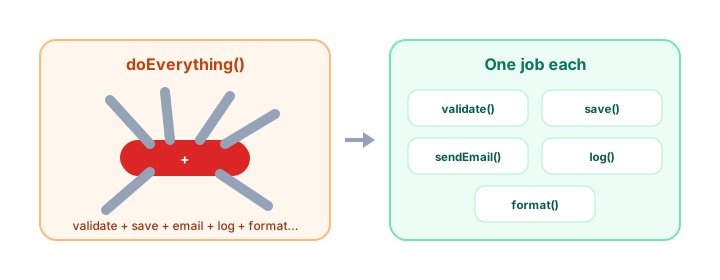 One tool per job: focused functions are like a chef's knife set, not a Swiss Army knife
A function should work the same way: do one thing, do it well, do only that.
How do I know it does "one thing"?
Try to describe the function in one sentence without using "and".
registerUser()"validates input and saves the user and sends a welcome email" → three functions.validateEmail()"checks that an email has a valid format" → one thing. ✅
Before: one function doing everything
async function registerUser(req) {
  // validate
  if (!req.body.email || !req.body.email.includes("@")) throw new Error("Bad email");
  if (!req.body.password || req.body.password.length < 8) throw new Error("Weak password");

  // hash + save
  const hash = await bcrypt.hash(req.body.password, 10);
  const user = await db.users.insert({ email: req.body.email, password: hash });

  // email
  await mailer.send({
    to: user.email,
    subject: "Welcome!",
    html: `<h1>Hi ${user.email}</h1><p>Thanks for joining.</p>`,
  });

  return user;
}
After: small functions with clear names
async function registerUser(input) {
  validateRegistration(input);
  const user = await createUser(input.email, input.password);
  await sendWelcomeEmail(user);
  return user;
}

function validateRegistration({ email, password }) {
  if (!isValidEmail(email)) throw new ValidationError("Invalid email");
  if (!isStrongPassword(password)) throw new ValidationError("Password must be 8+ characters");
}

const isValidEmail = (email) => typeof email === "string" && email.includes("@");
const isStrongPassword = (password) => typeof password === "string" && password.length >= 8;

async function createUser(email, password) {
  const passwordHash = await bcrypt.hash(password, 10);
  return db.users.insert({ email, password: passwordHash });
}

function sendWelcomeEmail(user) {
  return mailer.send({ to: user.email, subject: "Welcome!", html: welcomeTemplate(user) });
}
Now registerUser reads like a table of contents. If you want the details, you jump into the function you care about.
One level of abstraction per function
Don't mix "big picture" steps with tiny details in the same function. It's like a recipe that says "Make the sauce, then turn the knob on the stove 30 degrees clockwise".
// ❌ High level and low level mixed together
function checkout(cart) {
  applyDiscounts(cart);
  let total = 0;
  for (const item of cart.items) total += item.price * item.qty; // low-level detail
  chargeCard(cart.user, total);
}

// ✅ Every line is at the same level
function checkout(cart) {
  applyDiscounts(cart);
  const total = calculateTotal(cart);
  chargeCard(cart.user, total);
}
Keep arguments few
| Arguments | Verdict |
|---|---|
| 0 | 🌟 ideal |
| 1-2 | ✅ great |
| 3 | ⚠️ think twice |
| 4+ | ❌ pass an object instead |
// ❌ What is true? What is 3?
createUser("Ana", "ana@mail.com", true, false, 3);

// ✅ Named options are self-documenting
createUser({ name: "Ana", email: "ana@mail.com", isAdmin: true, sendWelcome: false, retries: 3 });
⚠️ Boolean flag arguments are a smell.
render(true)usually means the function does two things. Split it intorenderForPrint()andrenderForScreen().
Avoid hidden side effects
A function called checkPassword() should only check. If it also logs the user in or resets a counter, it is lying.
// ❌ Surprise: this also starts a session
function checkPassword(user, password) {
  const ok = bcrypt.compareSync(password, user.hash);
  if (ok) session.start(user);
  return ok;
}
Either rename it (loginIfPasswordMatches) or split it.
Common mistakes
- Splitting too much: a 2-line function used once whose name says less than its body.
- Functions with names like
handle(),process(),doStuff(). If you can't name it, it probably does too many things. - Returning different types depending on a flag.
Key takeaways
- One function = one job. No "and" in its description.
- The top-level function should read like a table of contents.
- Keep one level of abstraction per function.
- Prefer 0-2 arguments; use an options object for more.
- No hidden side effects: names must tell the whole truth.
Try it yourself
Take a function over 30 lines in your project. Write down in plain English each step it performs. Each step is a candidate for its own function.