Authentication, Authorization & API Security
Who are you and what are you allowed to do? Sessions vs JWT, OAuth 2.0 and OpenID Connect, password storage, and the OWASP risks every backend developer must know.
The big idea
At an airport:
- Authentication (AuthN) = passport control: "Who are you?" You prove your identity.
- Authorization (AuthZ) = your boarding pass: "What are you allowed to do?" Economy passengers can't enter the business lounge.
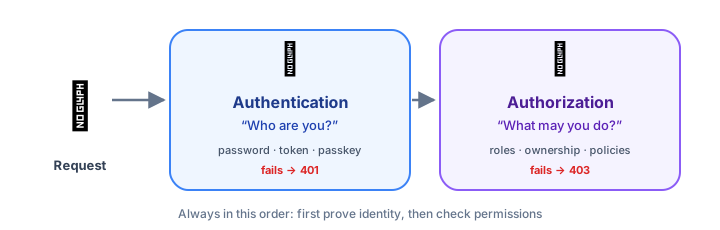 Authentication proves who you are; authorization decides what you can do
AuthN always comes first. A 401 Unauthorized means "I don't know who you are". A 403 Forbidden means "I know who you are, and you're not allowed".
Storing passwords: never in plain text
import bcrypt from "bcrypt";

// Sign up
const passwordHash = await bcrypt.hash(password, 12); // 12 = cost factor (slower = safer)

// Log in
const ok = await bcrypt.compare(passwordAttempt, user.passwordHash);
| ❌ Never | ✅ Always |
|---|---|
| Plain text | argon2id or bcrypt |
| MD5 / SHA-1 / SHA-256 alone (too fast to brute-force) | A unique salt per user (built into bcrypt/argon2) |
| Your own crypto | Well-known libraries |
Sessions vs JWT
Session cookies (stateful)
The server stores the session; the browser holds only a random ID in a cookie.
JWT (stateless tokens)
A JSON Web Token carries the user's claims, signed by the server. Any server with the key can verify it without a database lookup.
eyJhbGciOiJIUzI1NiJ9 . eyJzdWIiOiI0MiIsInJvbGUiOiJhZG1pbiIsImV4cCI6MTc1OTA1MDAwMH0 . Sflk…
└── header ─────────┘   └── payload: { sub: "42", role: "admin", exp: … } ──────────┘   └ signature ┘
⚠️ The payload is only Base64-encoded, not encrypted. Anyone can read it. Never put secrets in a JWT.
import jwt from "jsonwebtoken";

const accessToken = jwt.sign({ sub: user.id, role: user.role }, process.env.JWT_SECRET, { expiresIn: "15m" });

function authenticate(req, res, next) {
  const token = req.headers.authorization?.replace("Bearer ", "");
  try {
    req.user = jwt.verify(token, process.env.JWT_SECRET, { algorithms: ["HS256"] });
    next();
  } catch {
    res.status(401).json({ error: "Invalid or expired token" });
  }
}
| Session cookie | JWT | |
|---|---|---|
| State | Server stores sessions | Stateless |
| Logout / revoke | ✅ Instant (delete the session) | ❌ Hard until it expires |
| Scaling | Needs a shared store (Redis) | Any server can verify |
| Best for | Traditional web apps | APIs, mobile apps, microservices |
Common pattern: a short-lived access token (15 min) plus a long-lived refresh token (days) stored in an HttpOnly cookie and rotated on every use.
OAuth 2.0 and OpenID Connect
"Log in with Google". You let an app access your identity without giving it your Google password.
- OAuth 2.0 = authorization: "this app may read my calendar".
- OpenID Connect (OIDC) = authentication on top of OAuth: "this is who the user is" (an ID token).
Use the Authorization Code flow with PKCE. It is the recommended flow for web, mobile and single-page apps.
Authorization models
| Model | Idea | Example |
|---|---|---|
| RBAC (role-based) | Permissions attached to roles | admin can delete, viewer can read |
| ABAC (attribute-based) | Rules over attributes | "Managers can approve expenses under $5k in their own department" |
| ReBAC (relationship-based) | Permissions from relationships | "You can edit docs shared with you" (Google Docs) |
// Always check ownership, not just "is logged in"
app.get("/orders/:id", authenticate, async (req, res) => {
  const order = await orders.findById(req.params.id);
  if (!order) return res.sendStatus(404);
  if (order.userId !== req.user.sub && req.user.role !== "admin") return res.sendStatus(403);
  res.json(order);
});
OWASP API Top risks (simplified)
| Risk | What happens | Defence |
|---|---|---|
| Broken object-level authorization (BOLA/IDOR) | Change /orders/41 to /orders/42 and see someone else's order | Check ownership on every request |
| Broken authentication | Weak passwords, no rate limit on login, leaked tokens | MFA, rate limiting, short token lifetimes |
| Injection (SQL, NoSQL, command) | ' OR 1=1 -- returns every row | Parameterised queries, never string-concatenate input |
| Excessive data exposure | API returns passwordHash because it serialised the whole row | Explicit response DTOs / allow-lists |
| No rate limiting | Brute force, scraping, denial of service | Rate limits per user/IP (429) |
| Security misconfiguration | Debug mode in prod, open CORS * with credentials, default passwords | Secure defaults, config review |
| SSRF | API fetches a user-provided URL → hits internal services | Allow-list destinations |
// ❌ SQL injection
db.query(`SELECT * FROM users WHERE email = '${req.body.email}'`);

// ✅ Parameterised query: input is always treated as data, never code
db.query("SELECT * FROM users WHERE email = $1", [req.body.email]);
Security checklist
- HTTPS everywhere (HSTS)
- Passwords hashed with argon2id/bcrypt
- Cookies:
HttpOnly,Secure,SameSite - Validate all input (schema validation such as Zod or Joi)
- Parameterised queries / ORM
- Authorization check on every resource access
- Rate limiting on login and expensive endpoints
- Secrets in a vault or env vars, never in git
- Security headers (
helmetin Express) - Dependencies scanned (
npm audit, Dependabot) - Log security events, but never log passwords or tokens
Key takeaways
- AuthN = who you are (401). AuthZ = what you may do (403).
- Hash passwords with argon2id or bcrypt; never store or log them in plain text.
- Sessions are easy to revoke; JWTs are stateless but hard to revoke, so keep them short-lived.
- Use OAuth 2.0 + OIDC (Authorization Code + PKCE) for "Log in with…".
- The #1 API bug is missing ownership checks. Authorize every request.
- Parameterised queries stop injection.