Message Queues & RabbitMQ
Queues let services hand off work without waiting. Learn producers, consumers, acknowledgements, exchanges, retries and dead-letter queues with RabbitMQ.
The big idea
At a busy restaurant, the waiter doesn't stand in the kitchen waiting for each dish. They pin the order ticket on a rail and go back to serving customers. Cooks take tickets from the rail when they're ready.
The ticket rail is a message queue:
- Producer (waiter): puts messages in.
- Queue (rail): holds them safely, in order.
- Consumer (cook): takes messages out and does the work.
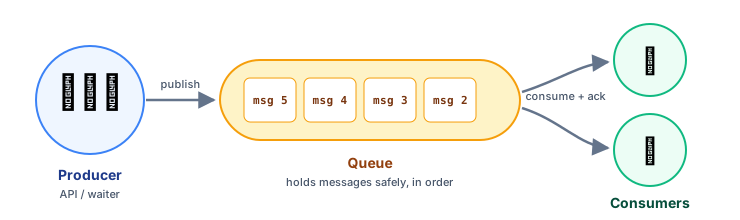 A message queue decouples the producer from the consumer
Why use a queue?
| Benefit | What it means |
|---|---|
| Faster responses | Reply immediately; do slow work in the background |
| Decoupling | The producer doesn't know or care who consumes |
| Load levelling | A traffic spike fills the queue; workers drain it at their own pace |
| Resilience | If the email service is down, messages wait instead of being lost |
| Scaling | Add more consumers to process faster |
Point-to-point vs publish/subscribe
- Work queue: "resize this image". Only one worker should do it.
- Pub/Sub: "a user signed up". Email, analytics and CRM all want to know.
RabbitMQ in one picture
In RabbitMQ, producers never send directly to a queue. They send to an exchange, which routes messages to queues using bindings.
| Exchange type | Routing rule | Example |
|---|---|---|
| Direct | Exact routing key match | "pdf" → pdf-queue |
| Topic | Wildcards: * = one word, # = zero or more | order.*.eu |
| Fanout | Copy to every bound queue, ignore the key | Broadcast "cache clear" |
| Headers | Match on message headers | Rarely used |
Code: producer and consumer (Node.js, amqplib)
// producer.js
import amqp from "amqplib";

const connection = await amqp.connect("amqp://localhost");
const channel = await connection.createChannel();
await channel.assertQueue("emails", { durable: true }); // survives broker restart

channel.sendToQueue(
  "emails",
  Buffer.from(JSON.stringify({ to: "ana@mail.com", template: "welcome" })),
  { persistent: true, messageId: crypto.randomUUID() }, // write to disk
);
// consumer.js
const channel = await connection.createChannel();
await channel.assertQueue("emails", { durable: true });
channel.prefetch(10); // at most 10 unacknowledged messages per worker

channel.consume("emails", async (msg) => {
  const job = JSON.parse(msg.content.toString());
  try {
    await sendEmail(job);
    channel.ack(msg);                 // ✅ done: remove from the queue
  } catch (error) {
    channel.nack(msg, false, false);  // ❌ failed: send to the dead-letter queue
  }
});
Acknowledgements: don't lose messages
Because a message can be delivered more than once (the worker processed it, then crashed before acking), consumers must be idempotent: processing the same message twice must be harmless.
// Idempotent consumer: remember processed message IDs
if (await db.processedMessages.exists(msg.properties.messageId)) return channel.ack(msg);
await db.transaction(async (tx) => {
  await doTheWork(tx, job);
  await tx.processedMessages.insert(msg.properties.messageId);
});
channel.ack(msg);
Retries and dead-letter queues
Some messages fail temporarily (an API is down); some fail forever (bad data). Don't retry forever, and don't lose them.
- Exponential backoff: wait 30 s, then 2 min, then 10 min… so a struggling service can recover.
- Dead-letter queue (DLQ): messages that keep failing are parked for a human to inspect and replay.
- Poison message: a message that crashes every consumer. The DLQ stops it from blocking the queue forever.
Delivery guarantees
| Guarantee | Meaning | How |
|---|---|---|
| At most once | May be lost, never duplicated | Ack before processing |
| At least once ⭐ | Never lost, may be duplicated | Ack after processing + idempotent consumers |
| Exactly once | Never lost, never duplicated | Very hard across systems; in practice, at-least-once + idempotency |
Popular message brokers
| Broker | Model | Best for |
|---|---|---|
| RabbitMQ | Smart broker, queues and routing | Task queues, complex routing, request/reply |
| Apache Kafka | Distributed append-only log | Event streaming, high throughput, replay (see the Kafka lessons) |
| AWS SQS / SNS | Managed queue / pub-sub | Serverless, no ops |
| Redis Streams / BullMQ | In-memory streams | Lightweight background jobs in Node.js |
| NATS | Lightweight pub/sub | Low-latency messaging |
Key takeaways
- Queues decouple producers and consumers, smooth traffic spikes and make systems resilient.
- Work queues send each message to one consumer; pub/sub sends it to every subscriber.
- RabbitMQ routes messages through exchanges (direct, topic, fanout) to queues.
- Ack after processing, make consumers idempotent, and use retries with backoff plus a dead-letter queue.
- "Exactly once" in practice = at-least-once delivery + idempotent processing.