Scaling, Load Balancing & Rate Limiting
How to serve 10 users, then 10 million. Vertical vs horizontal scaling, load balancers, stateless servers, replication, sharding, rate limiting and resilience basics.
The big idea
A small café with one barista is fine for 20 customers a day. At 2,000 customers you can either:
- Give the barista a faster espresso machine → vertical scaling (scale up).
- Hire more baristas and add a host who sends each customer to a free one → horizontal scaling (scale out) with a load balancer.
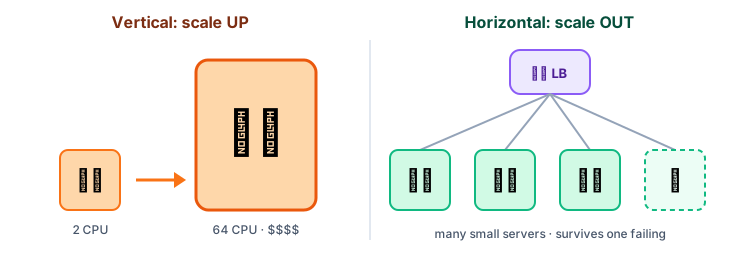 Vertical scaling makes one server bigger; horizontal scaling adds more servers
| Vertical (up) | Horizontal (out) | |
|---|---|---|
| How | Bigger CPU / RAM | More servers |
| Simplicity | ✅ No code changes | Needs stateless design |
| Limit | Hardware ceiling, expensive at the top | Practically unlimited |
| Failure | One server = single point of failure | Survives losing a server |
The scaling journey
Don't jump to step 7 on day one (remember KISS and YAGNI). Each step solves a real, measured bottleneck.
Load balancers
A load balancer spreads requests across healthy servers and stops sending traffic to broken ones.
Algorithms
| Algorithm | How it picks | Good when |
|---|---|---|
| Round robin | A, B, C, A, B, C… | Servers are identical |
| Weighted round robin | Bigger servers get more | Mixed server sizes |
| Least connections | Server with the fewest active requests | Requests vary in duration |
| IP hash / consistent hashing | Same client → same server | Need stickiness or cache locality |
Layer 4 vs Layer 7
- L4 (transport): routes by IP and port. Very fast, doesn't read HTTP.
- L7 (application): reads HTTP, so it can route
/api/*to API servers and/images/*to storage, terminate TLS, add headers. Examples: NGINX, HAProxy, AWS ALB, Envoy.
Stateless servers: the key to scaling out
If a server keeps user sessions in its own memory, the next request might land on a different server that doesn't know the user.
Rule: any server should be able to handle any request. Keep sessions in Redis or in tokens, files in object storage (S3), and state in the database.
Scaling the database
The database is usually the hardest part to scale.
Read replicas
Most apps read far more than they write. Copy the data to replicas and send reads there.
⚠️ Replication lag: a replica may be a few milliseconds behind. After a user updates their profile, read their profile from the primary ("read your own writes").
Sharding (partitioning)
When one primary can't handle the writes or the data size, split the data across several databases by a shard key.
| Challenge | Why |
|---|---|
| Choosing the shard key | A bad key creates "hot" shards (all celebrities on one) |
| Cross-shard queries and JOINs | Must query every shard and combine the results |
| Re-sharding | Adding shards moves data. Consistent hashing minimises that |
| Transactions across shards | Hard; avoid them by design |
Rate limiting
Protect your API from abuse, bugs and traffic spikes by limiting requests per user, IP or API key. Over the limit → 429 Too Many Requests with a Retry-After header.
Token bucket (most popular)
🪣 A bucket holds up to 10 tokens and refills at 1 token per second. Each request takes a token. Empty bucket → request rejected. Allows short bursts but enforces an average rate.
| Algorithm | Idea | Trade-off |
|---|---|---|
| Fixed window | Count per minute (resets at :00) | Simple; allows 2× bursts at window edges |
| Sliding window | Count over the last 60 s | Smoother, slightly more work |
| Token bucket | Tokens refill steadily | Allows bursts, smooth average ✅ |
| Leaky bucket | Queue drains at a fixed rate | Very smooth output, adds latency |
In a multi-server setup, keep counters in Redis so all servers share the same limits (see Caching & Redis for code).
Resilience basics
At scale, something is always failing. Design for it:
| Pattern | Purpose |
|---|---|
| Timeouts | Never wait forever on a dependency |
| Retries with exponential backoff + jitter | Survive brief glitches without hammering the service |
| Circuit breaker | Stop calling a service that keeps failing; fail fast and give it time to recover |
| Bulkhead | Separate resource pools, so one slow dependency can't consume every thread |
| Graceful degradation | Show cached or partial results instead of an error page |
| Health checks | Let load balancers route around sick servers |
These are covered in depth in Microservices → Resilience Patterns.
Back-of-the-envelope numbers
| Metric | Rough figure |
|---|---|
| 1 million requests/day | ≈ 12 requests/second average (peak maybe 5–10×) |
| One Node.js / Go server | Hundreds to thousands of simple requests/second |
| One Postgres primary | Thousands of simple writes/second, many more reads |
| One Redis node | ~100,000 operations/second |
Key takeaways
- Scale vertically first (simple), horizontally when needed (resilient, unlimited).
- Load balancers spread traffic and route around failures; L7 can route by path.
- Stateless app servers are the foundation of horizontal scaling.
- Databases scale with caching, read replicas, then sharding.
- Rate limit with a token bucket in Redis; return 429 with
Retry-After. - Assume failure: timeouts, retries with backoff, circuit breakers.