Database Indexing & Transactions
Why some queries take 2 ms and others 20 seconds. Learn how B-tree indexes work, how to read a query plan, and how isolation levels prevent concurrency bugs.
Part 1: Indexes
The big idea
To find "photosynthesis" in a 900-page textbook, you don't read every page. You check the index at the back: "photosynthesis … page 412". A database index works the same way.
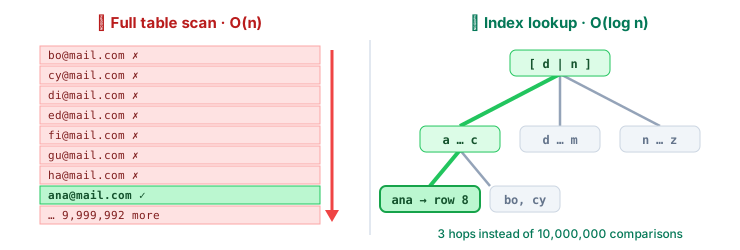 Without an index the database scans every row; with one it jumps straight to the match
| No index (full table scan) | With a B-tree index | |
|---|---|---|
| Rows checked for 10M rows | 10,000,000 | ~4 page reads |
| Big-O | O(n) | O(log n) |
| Typical time | seconds | milliseconds |
How a B-tree index works
A B-tree is a short, wide, sorted tree. Each node holds many keys, so even a billion rows fit in a tree only 3–4 levels deep.
Looking for id = 60: 60 is between 40 and 80 → middle child → found. Because the keys are sorted, B-trees also make ORDER BY, BETWEEN and > / < fast.
Creating and checking indexes (PostgreSQL)
-- Slow: no index on email
SELECT * FROM users WHERE email = 'ana@mail.com';

CREATE INDEX idx_users_email ON users (email);
-- UNIQUE also prevents duplicates
CREATE UNIQUE INDEX idx_users_email_unique ON users (email);
Use EXPLAIN ANALYZE to see what the database actually does:
EXPLAIN ANALYZE SELECT * FROM users WHERE email = 'ana@mail.com';
-- Before: reads every row
Seq Scan on users  (cost=0.00..18334.00 rows=1) (actual time=0.03..142.8 ms)
  Filter: (email = 'ana@mail.com')
  Rows Removed by Filter: 999999

-- After: jumps straight to it
Index Scan using idx_users_email on users  (actual time=0.02..0.03 ms)
  Index Cond: (email = 'ana@mail.com')
Composite indexes and the left-most rule
An index on (country, city, age) is sorted like a phone book: by country, then city, then age.
CREATE INDEX idx_people_location ON people (country, city, age);
| Query filters on | Uses the index? |
|---|---|
country | ✅ |
country, city | ✅ |
country, city, age | ✅ |
city only | ❌ (skips the first column) |
country, age | ⚠️ partly (country only) |
💡 Put the columns you filter by equality first and range filters (
>,BETWEEN) last.
Index types at a glance
| Type | Good for |
|---|---|
| B-tree (default) | =, <, >, BETWEEN, ORDER BY, prefix LIKE 'abc%' |
| Hash | Equality only |
| GIN | Full-text search, JSONB, arrays |
| GiST | Geospatial (PostGIS), ranges |
| Partial | WHERE status = 'active' only: smaller and faster |
Covering (INCLUDE) | Answer the query from the index alone |
The cost of indexes
Indexes aren't free:
- Every
INSERT,UPDATEandDELETEmust update every index on the table: slower writes. - They take disk and memory.
- Unused indexes are pure cost. Check
pg_stat_user_indexesand remove them.
Index these: primary keys (automatic), foreign keys, columns in frequent WHERE, JOIN and ORDER BY clauses.
Queries that can't use an index
WHERE LOWER(email) = 'ana@mail.com'    -- ❌ function on the column (fix: index on LOWER(email))
WHERE name LIKE '%son'                 -- ❌ leading wildcard (fix: trigram / full-text index)
WHERE created_at::date = '2026-09-28'  -- ❌ cast on the column (fix: a range on created_at)
Part 2: Transactions and concurrency
The big idea
Two people try to book the last seat on a flight at the same moment. Both check: "1 seat left ✅". Both book. Now the flight is overbooked. This is a race condition, and transactions with the right isolation prevent it.
Fix 1: let the database do it atomically
UPDATE flights
SET seats_left = seats_left - 1
WHERE id = 42 AND seats_left > 0
RETURNING seats_left;
-- 0 rows updated → sold out. The check and the update happen as ONE step.
Fix 2: lock the row (pessimistic locking)
BEGIN;
SELECT seats_left FROM flights WHERE id = 42 FOR UPDATE; -- others must wait
-- … check and book …
UPDATE flights SET seats_left = seats_left - 1 WHERE id = 42;
COMMIT;
Fix 3: version numbers (optimistic locking)
No locks. Each row has a version; an update only succeeds if nobody changed the row since you read it.
UPDATE products SET stock = 9, version = version + 1
WHERE id = 7 AND version = 3;   -- 0 rows → someone else won, reload and retry
Pessimistic (FOR UPDATE) | Optimistic (version) | |
|---|---|---|
| Idea | "Lock it, then work" | "Work, then check nobody interfered" |
| Best when | Conflicts are frequent | Conflicts are rare |
| Cost | Waiting, possible deadlocks | Retries on conflict |
Isolation levels
Isolation controls what a transaction can see of other, concurrent transactions.
| Level | Dirty read | Non-repeatable read | Phantom read | Notes |
|---|---|---|---|---|
| Read Uncommitted | possible | possible | possible | Almost never used |
| Read Committed | ✅ prevented | possible | possible | Postgres default |
| Repeatable Read | ✅ | ✅ prevented | possible* | MySQL InnoDB default |
| Serializable | ✅ | ✅ | ✅ prevented | Safest, slowest, may need retries |
* Postgres's Repeatable Read also prevents phantoms.
- Dirty read: you see another transaction's changes before it commits (and it might roll back).
- Non-repeatable read: you read a row twice and get different values.
- Phantom read: you run the same query twice and new rows appear.
BEGIN ISOLATION LEVEL SERIALIZABLE;
-- …
COMMIT; -- may fail with "could not serialize access": retry the transaction
Transaction tips
- Keep transactions short. Never wait for an HTTP call or user input inside one.
- Always handle rollback on errors (most ORMs do this for you).
- Lock rows in a consistent order to avoid deadlocks.
- Transactions don't span services or external APIs: for that, see Sagas & the Outbox Pattern in the Microservices lessons.
Key takeaways
- Indexes turn O(n) scans into O(log n) lookups; B-trees handle equality, ranges and sorting.
- Use
EXPLAIN ANALYZEto verify; follow the left-most rule for composite indexes. - Indexes speed up reads but slow down writes, so add them deliberately.
- Race conditions: prefer atomic
UPDATE … WHERE, then optimistic or pessimistic locking. - Know the isolation levels; Postgres defaults to Read Committed.