SQL vs NoSQL Databases
Relational tables or flexible documents? Understand how each stores data, the four NoSQL families, ACID vs BASE, and a simple way to choose.
The big idea
- SQL (relational) is like a set of spreadsheets with strict columns that reference each other: a
customerssheet, anorderssheet, linked by customer ID. Very organised, very consistent. - NoSQL is like a filing cabinet of folders: each folder (document) holds everything about one thing, and folders don't have to look identical.
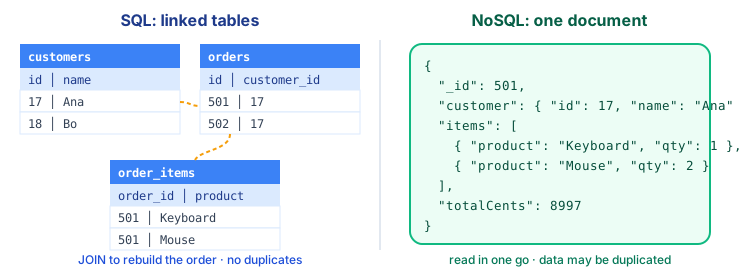 Relational tables vs a document store for the same data
SQL: tables, rows, relationships
CREATE TABLE customers (
  id         BIGSERIAL PRIMARY KEY,
  email      TEXT NOT NULL UNIQUE,
  name       TEXT NOT NULL
);

CREATE TABLE orders (
  id          BIGSERIAL PRIMARY KEY,
  customer_id BIGINT NOT NULL REFERENCES customers(id),
  total_cents INTEGER NOT NULL CHECK (total_cents >= 0),
  created_at  TIMESTAMPTZ NOT NULL DEFAULT now()
);

-- Join them back together
SELECT c.name, o.total_cents, o.created_at
FROM orders o
JOIN customers c ON c.id = o.customer_id
WHERE c.email = 'ana@mail.com'
ORDER BY o.created_at DESC;
Strengths: a strict schema catches bad data, JOINs answer complex questions, ACID transactions keep money and inventory correct, and SQL is a universal language.
Examples: PostgreSQL, MySQL, SQL Server, SQLite (which this very app uses!).
ACID: the four promises
| Letter | Promise | Example |
|---|---|---|
| Atomicity | All or nothing | Transfer $100: debit AND credit both happen, or neither |
| Consistency | Rules always hold | Balance can never go below 0 (constraint) |
| Isolation | Concurrent transactions don't see each other's half-done work | Two people buying the last ticket |
| Durability | Once committed, it survives a crash | Power cut after "Payment successful" |
BEGIN;
UPDATE accounts SET balance = balance - 100 WHERE id = 1;
UPDATE accounts SET balance = balance + 100 WHERE id = 2;
COMMIT; -- both or neither
NoSQL: four families
| Family | Think of it as… | Great for | Example |
|---|---|---|---|
| Document | A folder of JSON files | Catalogs, profiles, CMS content | MongoDB |
| Key-value | A giant hash map | Caching, sessions, counters | Redis, DynamoDB |
| Wide-column | Rows with millions of flexible columns, spread over many servers | Time series, IoT, messaging at massive scale | Cassandra |
| Graph | Nodes and relationships | Social networks, recommendations, fraud detection | Neo4j |
A document example (MongoDB)
// One document holds the order AND its items: no JOIN needed to read it
{
  _id: ObjectId("…"),
  customer: { id: 17, name: "Ana", email: "ana@mail.com" },
  items: [
    { productId: 5, name: "Keyboard", qty: 1, priceCents: 4999 },
    { productId: 9, name: "Mouse", qty: 2, priceCents: 1999 }
  ],
  totalCents: 8997,
  createdAt: ISODate("2026-09-28T10:00:00Z")
}

db.orders.find({ "customer.email": "ana@mail.com" }).sort({ createdAt: -1 });
💡 Model for your queries. In document databases, you design documents around how the app reads data. Data that is read together is stored together.
Scaling: vertical vs horizontal
NoSQL databases like Cassandra and DynamoDB were built to spread data across many machines (sharding) from day one. SQL databases can scale out too (read replicas, Citus, Vitess, CockroachDB), but it's more work.
ACID vs BASE and the CAP theorem
Distributed NoSQL systems often choose BASE: Basically Available, Soft state, Eventually consistent. After a write, some replicas may briefly show old data, but they catch up.
The CAP theorem: when the network between servers breaks (a Partition), a distributed database must choose between:
- Consistency: refuse requests rather than return stale data (banks).
- Availability: keep answering, even with possibly stale data (social feeds).
How to choose
| Choose SQL when… | Choose NoSQL when… |
|---|---|
| Data is relational (customers ↔ orders ↔ products) | Data is naturally a self-contained document or key-value |
| You need transactions (money, inventory, bookings) | You need massive write throughput or global scale |
| Queries are varied and change over time | Access patterns are known and simple |
| Data integrity matters most | Schema changes constantly (early prototyping, user-defined fields) |
💡 Default advice: start with PostgreSQL. It's relational, rock solid, and it also handles JSON (
jsonb), full-text search and geospatial data. Add a specialised NoSQL store when a real need appears: Redis for caching, Elasticsearch for search, Cassandra for huge write volumes. Using several databases for different jobs is called polyglot persistence.
Key takeaways
- SQL: tables, schemas, JOINs and ACID transactions. The safe default for business data.
- NoSQL: document, key-value, wide-column and graph stores, built for flexibility and horizontal scale.
- In document DBs, model data for how you read it.
- CAP: during a network partition, choose consistency or availability.
- Start with Postgres; add specialised stores for specific needs.