REST API Design
Design APIs that are predictable and pleasant to use: resource naming, methods, status codes, pagination, versioning, errors and idempotency.
The big idea
A good API is like a well-organised restaurant menu: items are grouped logically, named clearly, and ordering works the same way for every dish. Once you've ordered one thing, you can guess how to order anything.
REST (Representational State Transfer) organises an API around resources (nouns like users, orders) and uses HTTP methods (verbs) to act on them.
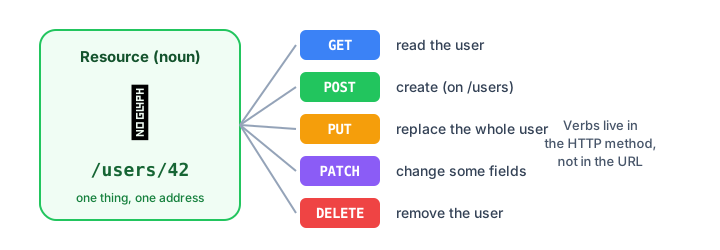 REST: nouns in the URL, verbs in the HTTP method
Rule 1: URLs are nouns, methods are verbs
| ❌ Verb in the URL | ✅ RESTful |
|---|---|
GET /getAllUsers | GET /users |
POST /createUser | POST /users |
GET /getUser?id=42 | GET /users/42 |
POST /updateUser/42 | PATCH /users/42 |
POST /deleteUser/42 | DELETE /users/42 |
GET /getOrdersOfUser/42 | GET /users/42/orders |
The standard CRUD map
| Action | Method + path | Success status |
|---|---|---|
| List | GET /articles | 200 |
| Read one | GET /articles/7 | 200 (or 404) |
| Create | POST /articles | 201 + Location: /articles/7 |
| Replace | PUT /articles/7 | 200 |
| Partial update | PATCH /articles/7 | 200 |
| Delete | DELETE /articles/7 | 204 No Content |
Naming conventions
- Plural nouns:
/users, not/user. - Lowercase, hyphens:
/order-items, not/orderItemsor/Order_Items. - Nest only one level for ownership:
/users/42/orders✅,/users/42/orders/9/items/3/reviews❌ (use/reviews?itemId=3). - Actions that aren't CRUD: use a sub-resource:
POST /orders/9/cancel,POST /users/42/password-reset.
Rule 2: Use status codes honestly
⚠️ Never return
200 OKwith{ "error": "not found" }in the body. Clients, caches and monitoring tools all rely on the status code.
Rule 3: Consistent error format
Pick one error shape and use it everywhere. RFC 9457 "Problem Details" is a good standard:
{
  "type": "https://api.shop.com/errors/validation",
  "title": "Validation failed",
  "status": 422,
  "detail": "The request body has 2 invalid fields.",
  "errors": [
    { "field": "email", "message": "must be a valid email" },
    { "field": "age", "message": "must be at least 18" }
  ],
  "traceId": "a1b2c3d4"
}
Rule 4: Paginate, filter and sort lists
Never return an unbounded list; one day it will be a million rows.
GET /products?category=keyboards&minPrice=20&sort=-price&limit=20&cursor=eyJpZCI6MTAwfQ
| Style | Request | Pros | Cons |
|---|---|---|---|
| Offset | ?page=3&limit=20 | Simple, jump to any page | Slow on big tables; items shift when data changes |
| Cursor | ?cursor=abc&limit=20 | Fast and stable at any scale | Can't jump to page 50 |
{
  "data": [ { "id": 101, "name": "Keyboard" } ],
  "pagination": { "nextCursor": "eyJpZCI6MTIwfQ", "hasMore": true }
}
Rule 5: Idempotency for unsafe retries ⭐
Networks fail. A client sends POST /payments, the connection drops, and the client doesn't know if the payment happened. It retries… and the customer is charged twice.
Fix: the client sends a unique Idempotency-Key. The server remembers the result for that key and returns it again on a retry instead of charging again.
app.post("/payments", async (req, res) => {
  const key = req.get("Idempotency-Key");
  if (!key) return res.status(400).json({ error: "Idempotency-Key header is required" });

  const existing = await idempotency.find(key);
  if (existing?.status === "COMPLETED") return res.status(existing.code).json(existing.body);
  if (existing?.status === "PROCESSING") return res.status(409).json({ error: "Request in progress" });

  await idempotency.start(key, hash(req.body)); // UNIQUE constraint stops concurrent duplicates
  const payment = await payments.charge(req.body, { idempotencyKey: key }); // pass it to the provider too
  await idempotency.complete(key, 201, payment);
  res.status(201).json(payment);
});
Rule 6: Version your API
Once clients depend on your API, breaking changes hurt them. Common strategies:
| Strategy | Example |
|---|---|
| URL path (most common) | /v1/users, /v2/users |
| Header | Accept: application/vnd.shop.v2+json |
| Query | /users?version=2 |
Non-breaking changes (adding a field, adding an endpoint) don't need a new version. Breaking changes (removing or renaming a field, changing a type) do.
Rule 7: Document it with OpenAPI
An OpenAPI (Swagger) spec describes every endpoint in YAML/JSON. From it you get interactive docs, client SDK generation, request validation and contract tests.
paths:
  /users/{id}:
    get:
      summary: Get a user by id
      parameters:
        - { name: id, in: path, required: true, schema: { type: string } }
      responses:
        "200": { description: The user, content: { application/json: { schema: { $ref: "#/components/schemas/User" } } } }
        "404": { description: User not found }
Checklist
- Plural nouns, no verbs in paths
- Correct methods and status codes
- One consistent error format
- Pagination on every list endpoint
- Idempotency keys for payments and other critical POSTs
- Versioning strategy decided
- Authentication on every non-public route (see Authentication & Security)
- Rate limiting (see Scaling)
- OpenAPI documentation
Key takeaways
- Resources are nouns in the URL; actions are HTTP methods.
- Status codes tell the truth: 2xx success, 4xx client error, 5xx server error.
- Paginate lists; prefer cursors at scale.
- Idempotency keys make retries of payments and other critical POSTs safe.
- Version breaking changes and document everything with OpenAPI.