Backend Languages: Node.js, Go, Python & Rust
A friendly tour of the four backend languages in your notes. How each handles concurrency, what it's best at, and the same tiny API written in all four.
The big idea
Choosing a backend language is like choosing a vehicle:
- Node.js 🛵 = a nimble scooter: quick to start, great in city traffic (lots of small I/O trips), same fuel (JavaScript) as the frontend.
- Go 🚚 = a reliable delivery van: simple to drive, very efficient, built for many deliveries at once.
- Python 🚙 = a comfortable SUV: easy for everyone, fits every accessory (data science, AI), not the fastest.
- Rust 🏎️ = a race car: top speed and safety, but you need training to drive it.
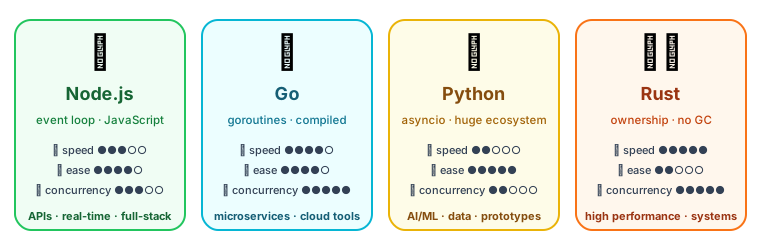 Four backend languages compared
How each handles many requests at once
This is the most important difference for backend work.
| Language | Concurrency model | Great at | Watch out for |
|---|---|---|---|
| Node.js | Single-threaded event loop, async/await | I/O-heavy APIs, real-time apps, full-stack JS | CPU-heavy work blocks the loop (use worker threads) |
| Go | Goroutines + channels, multi-core | High-concurrency services, cloud tools (Docker and Kubernetes are written in Go) | Verbose error handling, a smaller ecosystem than JS/Python |
| Python | async (asyncio) or threads/processes (GIL limits CPU threads) | AI/ML, data, scripting, fast prototyping | Slower raw speed |
| Rust | async (Tokio) + threads, no data races guaranteed by the compiler | Performance-critical systems, low latency, low memory | Steep learning curve, slower compile times |
The same API in all four
Goal: GET /users/:id returns a user as JSON, or 404.
Node.js: Express
import express from "express";
const app = express();

app.get("/users/:id", async (req, res) => {
  const user = await db.users.findById(req.params.id);
  if (!user) return res.status(404).json({ error: "Not found" });
  res.json(user);
});

app.listen(3000);
Node.js: NestJS (structured, TypeScript-first)
NestJS adds modules, dependency injection and decorators on top of Express/Fastify, similar to Angular or Spring. It's great for larger teams.
@Controller("users")
export class UsersController {
  constructor(private readonly users: UsersService) {} // injected (Dependency Inversion!)

  @Get(":id")
  async findOne(@Param("id") id: string) {
    const user = await this.users.findById(id);
    if (!user) throw new NotFoundException();
    return user;
  }
}
Go: Gin
package main

import (
	"net/http"

	"github.com/gin-gonic/gin"
)

func main() {
	r := gin.Default()
	r.GET("/users/:id", func(c *gin.Context) {
		user, err := findUser(c.Request.Context(), c.Param("id"))
		if err != nil {
			c.JSON(http.StatusNotFound, gin.H{"error": "Not found"})
			return
		}
		c.JSON(http.StatusOK, user)
	})
	r.Run(":3000")
}
Go's concurrency in two lines: go doWork() starts a goroutine, and channels pass data between them safely.
results := make(chan string)
for _, url := range urls {
	go func(u string) { results <- fetch(u) }(url) // all fetches run concurrently
}
for range urls {
	fmt.Println(<-results)
}
Python: FastAPI
from fastapi import FastAPI, HTTPException
from pydantic import BaseModel

app = FastAPI()

class User(BaseModel):
    id: int
    name: str
    email: str

@app.get("/users/{user_id}", response_model=User)
async def get_user(user_id: int):
    user = await db.find_user(user_id)
    if user is None:
        raise HTTPException(status_code=404, detail="Not found")
    return user
FastAPI generates OpenAPI docs automatically from type hints (visit /docs). Django is the "batteries included" alternative, with an ORM, admin panel and auth built in.
Rust: Axum
use axum::{extract::Path, http::StatusCode, routing::get, Json, Router};

async fn get_user(Path(id): Path<u64>) -> Result<Json<User>, StatusCode> {
    find_user(id).await.map(Json).ok_or(StatusCode::NOT_FOUND)
}

#[tokio::main]
async fn main() {
    let app = Router::new().route("/users/{id}", get(get_user));
    let listener = tokio::net::TcpListener::bind("0.0.0.0:3000").await.unwrap();
    axum::serve(listener, app).await.unwrap();
}
Rust's ownership system catches memory bugs and data races at compile time: no garbage collector, no null pointer crashes.
Popular frameworks
| Language | Minimal | Batteries included |
|---|---|---|
| Node.js | Express, Fastify, Hono | NestJS |
| Go | net/http, Gin, Echo, Fiber | (Go prefers small libraries) |
| Python | FastAPI, Flask | Django |
| Rust | Axum, Actix Web | Loco |
How to choose
💡 Team skills beat benchmarks. A language your team knows well will beat a "faster" one they're learning, for almost every business app. Performance bottlenecks are usually the database and the network, not the language.
Key takeaways
- Node.js: event loop, perfect for I/O-heavy APIs and full-stack JavaScript. NestJS adds structure.
- Go: goroutines and channels, simple and fast, the language of cloud infrastructure.
- Python: the king of AI/data; FastAPI for modern APIs, Django for full-featured apps.
- Rust: top performance with compile-time safety, at the cost of a learning curve.
- Choose by team skills and problem type; the database is usually the real bottleneck.