Caching & Redis
Keep frequently used data close and fast. Learn caching strategies, invalidation, eviction policies, the classic pitfalls, and what Redis can do beyond caching.
The big idea
You keep the things you use every day (keys, phone, wallet) on your desk, not in the basement storage room. Going to the basement takes 5 minutes; reaching to your desk takes 1 second.
A cache is your desk: a small, fast store of copies of data that is expensive to fetch or compute.
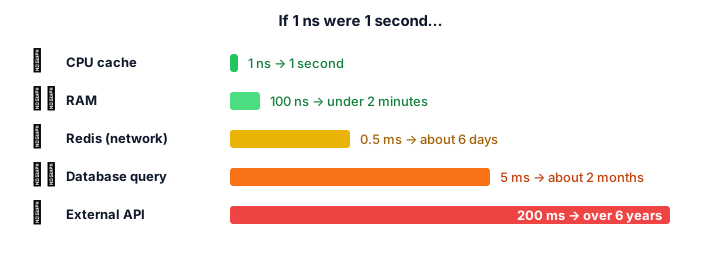 The memory hierarchy: the closer the data, the faster it is
| Where data lives | Typical latency | Analogy |
|---|---|---|
| CPU cache | ~1 ns | In your hand |
| RAM / in-process cache | ~100 ns | On your desk |
| Redis over the network | ~0.5 ms | In the next room |
| Database with an index | ~5 ms | Downstairs |
| Slow DB query / external API | 100 ms – 2 s | Across town |
Where caches live
Every layer can answer the request and save all the layers behind it.
Strategy 1: Cache-aside (lazy loading) ⭐ most common
The app checks the cache first; on a miss it reads the database and stores the result.
async function getProduct(id) {
  const key = `product:${id}`;
  const cached = await redis.get(key);
  if (cached) return JSON.parse(cached);

  const product = await db.products.findById(id);
  if (product) await redis.set(key, JSON.stringify(product), { EX: 300 }); // TTL 5 min
  return product;
}
Other strategies
| Strategy | How it works | Pros | Cons |
|---|---|---|---|
| Cache-aside | App reads cache → DB on miss → fills cache | Simple, only caches what's used | First request is slow; can serve stale data |
| Read-through | The cache itself loads from the DB on a miss | Cleaner app code | Needs a cache library/provider that supports it |
| Write-through | Write to cache and DB together | Cache is always fresh | Slower writes, caches data nobody reads |
| Write-behind | Write to cache, flush to DB later | Very fast writes | Risk of losing data if the cache crashes |
The hardest part: invalidation
📘 "There are only two hard things in computer science: cache invalidation and naming things." (Phil Karlton)
When data changes, the cached copy is stale. Options:
- TTL (time to live): entries expire automatically. Simple; data can be stale for up to the TTL.
- Delete on write: when the product changes, delete its cache key so the next read reloads it.
- Events: publish
product.updated; every service with a cached copy removes it.
async function updateProduct(id, changes) {
  await db.products.update(id, changes);
  await redis.del(`product:${id}`); // delete, don't update: avoids race conditions
}
💡 Prefer deleting the key over writing the new value into it. Two concurrent updates can otherwise leave the older value in the cache.
Eviction: when the cache is full
Memory is limited, so something must go:
| Policy | Evicts | Good for |
|---|---|---|
| LRU (Least Recently Used) | The item not used for the longest time | Most workloads ✅ |
| LFU (Least Frequently Used) | The item used the fewest times | Stable "popular items" |
| FIFO | The oldest item | Simple streams |
| TTL | Expired items | Time-sensitive data |
In Redis: maxmemory 2gb and maxmemory-policy allkeys-lru.
Classic caching problems
1. Cache stampede (thundering herd)
A popular key expires; 10,000 requests miss at the same moment and all hit the database.
Fixes: a lock so only one request rebuilds the value (others wait or get the stale copy), refreshing hot keys before they expire, and adding random jitter to TTLs so keys don't all expire together.
2. Cache penetration
Requests for IDs that don't exist always miss and always hit the DB (sometimes an attack). Fix: cache the "not found" result briefly, or use a Bloom filter to reject IDs that certainly don't exist.
3. Hot key
One key (a celebrity's profile) gets so much traffic it overloads a single Redis node. Fix: a small in-process cache in front of Redis, or replicate the key.
Redis: more than a cache
Redis is an in-memory data-structure server. Its data types solve many real problems:
| Type | Commands | Use case |
|---|---|---|
| String | SET, GET, INCR, EXPIRE | Cache, counters, rate limits |
| Hash | HSET, HGETALL | User sessions, objects |
| List | LPUSH, RPOP, BLPOP | Simple queues, recent activity |
| Set | SADD, SISMEMBER | Unique visitors, tags |
| Sorted set | ZADD, ZRANGE, ZREVRANK | Leaderboards, priority queues, time windows |
| Stream | XADD, XREADGROUP | Event log with consumer groups |
| Pub/Sub | PUBLISH, SUBSCRIBE | Real-time notifications, chat |
// Leaderboard in 3 commands
await redis.zAdd("leaderboard", { score: 4200, value: "ana" });
await redis.zIncrBy("leaderboard", 50, "bo");
const top10 = await redis.zRangeWithScores("leaderboard", 0, 9, { REV: true });

// Rate limit: max 100 requests per minute per user
const key = `rate:${userId}:${Math.floor(Date.now() / 60000)}`;
const count = await redis.incr(key);
if (count === 1) await redis.expire(key, 60);
if (count > 100) throw new TooManyRequestsError();
Persistence and availability
- RDB snapshots: save the whole dataset every N minutes (fast restarts, may lose the last minutes).
- AOF (append-only file): log every write (safer, bigger files). You can use both.
- Replication + Sentinel: automatic failover to a replica.
- Redis Cluster: shards data across nodes using 16,384 hash slots.
⚠️ Redis keeps data in RAM. Treat it as a cache or as fast secondary storage, not as your only copy of critical data (unless you configure persistence carefully).
What to cache (and what not to)
✅ Cache: data read far more often than written (product pages, configs), expensive computations, sessions, rate-limit counters, 3rd-party API responses.
❌ Don't cache: data that must be perfectly fresh (account balance at the moment of payment), data that is rarely re-read, highly personalised data with no reuse.
Key takeaways
- A cache stores copies of expensive data close to where it's needed.
- Cache-aside is the default pattern: check cache → DB on miss → store with a TTL.
- Invalidate by TTL, by deleting on write, or through events. Prefer delete over update.
- Guard against stampedes (locks, jitter), penetration (cache "not found") and hot keys.
- Redis offers strings, hashes, lists, sets, sorted sets and streams: leaderboards, rate limits, queues, sessions.